

By Marc Mercier, owner of Rhino Shield of Michigan, Brighton, MI. Family owned, 25+ years in home improvement.
I am standing under a second floor window on a stucco house, looking at a brown streak that runs down from the lower corner. The homeowner tells me it started as a hairline crack. Before I say a word about coatings, I press my thumb gently on the stucco and check the caulk at the sill.
That is where I always start. The streak is rarely the real problem. It is the clue.
When there is water behind stucco, the answer is to find where it is getting in, stop it, have the wet material checked and repaired, and only then patch the cracks and coat the wall. Painting first hides the problem and often makes it worse.
The Short Answer
If water gets behind stucco, find and stop the source first, such as failed caulk, flashing, or gutter overflow. Then have a professional test for moisture and repair any wet material. Only after the wall is dry and sound should cracks be patched and a breathable coating applied.
A coating does not cure a wet wall. I want you to hear that from me before anything else in this post.
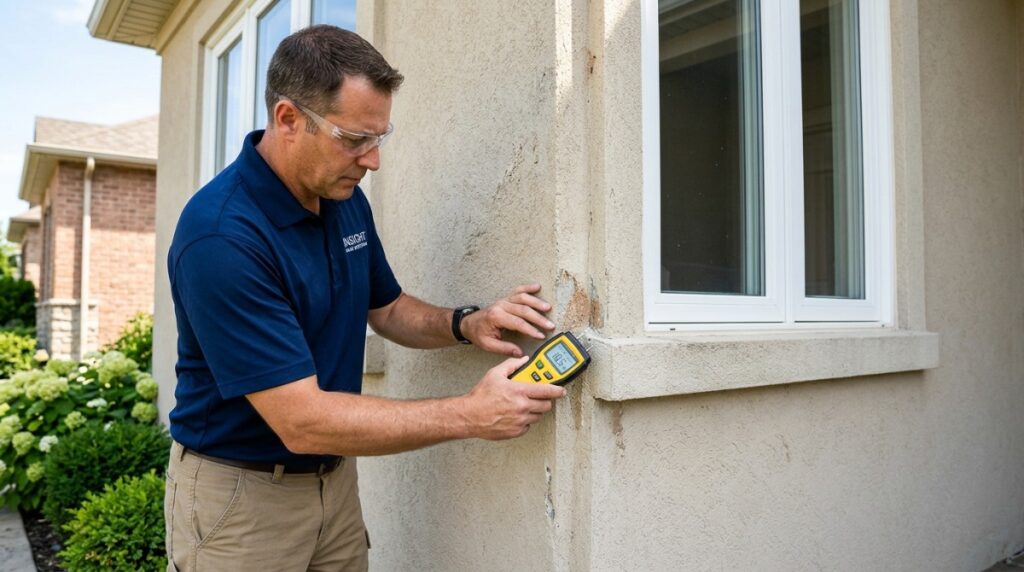
Quick Diagnosis: Is Water Behind Your Stucco?
Stucco hides its problems. Water behind stucco can sit there for a long time before anything shows on the surface. These are the signs we look for.
| What you see | What it can mean | Urgency | Next step |
|---|---|---|---|
| Stain below a window or corner | Water entering at the opening | Moderate | Check caulk and flashing, document it |
| Hairline crack that is stable | Normal movement or shrinkage | Low | Watch it, patch when dry |
| Crack that grows or returns | Movement or a water path | Moderate to high | Investigate before repairing |
| Bubbling or peeling paint | Moisture pushing out from behind | Moderate to high | Find the source, do not repaint |
| Soft or spongy spot | Wet or damaged material behind | High | Get a moisture test |
| Bulge or sag | Separation or wet backing | High | Call a stucco or envelope specialist |
| White powder on the stucco | Salts moving with water | Moderate | Fix the moisture, then clean |
| Musty smell or interior stain on the same wall | Water has reached the inside | High | Inspect inside and outside |
| Stucco touching soil | Water wicking up from the ground | Moderate | Create clearance |
When our crew walks a wall, we look at the windows first. Stains and cracks cluster at window corners, sill edges, and where the roof meets the wall. Water gets in at details, not in the middle of a blank wall. That is the single most useful thing to know when you walk your own house.
Cosmetic crack versus water path
Not every crack is a leak. A thin, stable hairline crack that has not changed in a year is often cosmetic. A flexible coating can bridge it.
A crack that is getting wider, comes back after patching, or runs diagonally from a window corner deserves a closer look. Those can mean movement or a path for water.
When symptoms point inside the house
If you see a damp stain on an interior wall, a musty smell near a garage or basement window, or paint lifting on the inside of an exterior wall, the water may already be past the stucco. Do not wait on those. Have someone look at both sides of the wall.
Bubbling paint has more than one cause. Moisture pushing out from behind is one. Heat is another. Moisture is the one to rule out first on stucco.
How Water Gets Behind Stucco
Water behind stucco almost always comes in at a detail.
- Window and door edges, sills, and heads
- Where the roof meets the wall
- Gutters and downspouts that spill onto the wall
- Penetrations such as hose bibs, vents, and light fixtures
- Places where kick out flashing is missing at a roof edge
- Stucco that runs into soil, a walkway, or a driveway with no gap
- Caulk that has pulled away or gone brittle
The Washtenaw County Conservation District, a Michigan source, puts it plainly. Water is the main culprit. Stucco that is poorly installed or poorly maintained lets water through to the structure. Stucco that sits below grade or lacks clearance can trap moisture. Water also enters around windows and doors, often where flashing was not installed correctly. The page warns that dealing with mold on the surface does not solve the problem. You have to find where the water is coming from.
Behind the stucco there is normally a layered system. Many walls have a water resistant barrier, flashing, and a way for water to drain out at the bottom, often with a weep screed. When any of those details is missing or poorly lapped, water that gets in cannot get out.
Hard coat stucco versus synthetic stucco (EIFS)
Not all stucco is the same. Traditional hard coat stucco is a cement based layer applied over lath. Synthetic stucco, called EIFS, is a thinner finish applied over foam insulation board. Redfin describes these types in its stucco inspection guide, and the type matters because inspectors test and repair them differently. If you are not sure which you have, ask the inspector to tell you before they start.
What Michigan Winters Do to Wet Stucco
Michigan winters are hard on any wall that has a small opening. The cycle goes like this. A little water gets into a crack or a joint. It freezes and expands. The opening gets bigger. The next thaw lets in more water.
In March and April, when our crews first walk a wall after winter, we often see the result. Cracks that were hairline in October are wider. Caulk has split. Stains show up where water traveled in a thaw.
Ice dams and gutters feeding the wall
Ice dams at a roof edge can push meltwater under shingles and down into a wall. Overflowing gutters can pour water against stucco for weeks. Both feed the same wall. If your stains sit just below a roof edge, look up before you look at the stucco.
Freezing water widening cracks and joints
Freeze and thaw does not need much to start. A hairline opening is enough. Over several winters it can turn into a real gap. This is why a small crack is worth a look this year and not five years from now.
A local note
Southeast Michigan, Ann Arbor, Lansing, Grand Rapids, and the Lake Michigan coastline all see different snow and wind. The freeze and thaw is the same everywhere. A house in Royal Oak and a house near Traverse City are fighting the same physics.
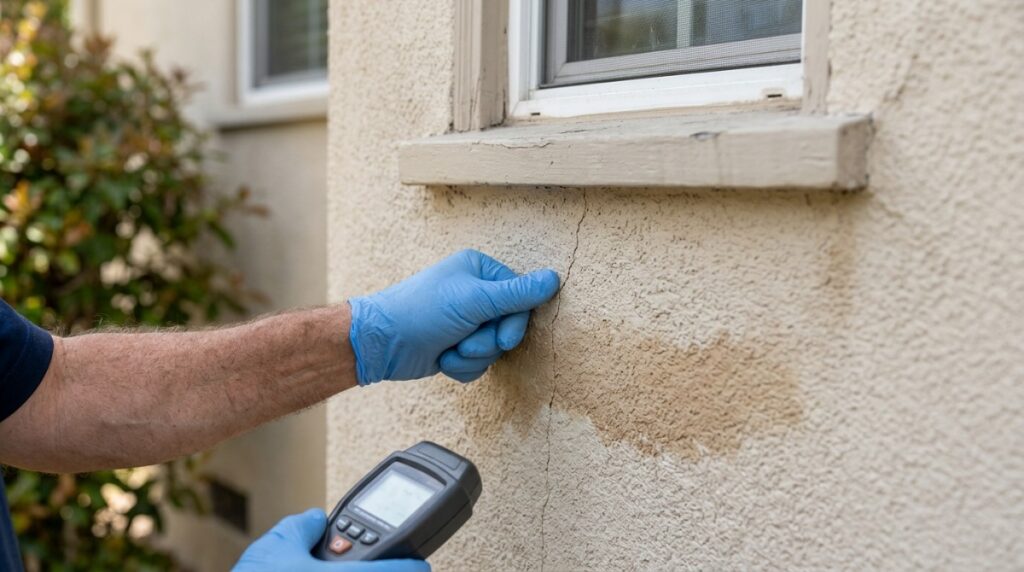
What to Do Right Now
You can do a lot without opening a wall. Here is the order I would follow.
Step 1. Document with dated photos
Photograph the stains, cracks, and any bubbling. Note where each stain begins. A stain that starts at a window corner tells a different story from one that starts mid wall.
Step 2. Control the water you can
Clean gutters. Redirect downspouts away from the wall. Trim shrubs that hold moisture against the stucco. Pull snow away from the base. Check that sprinklers do not spray the wall.
Step 3. Protect obvious openings, as a short term measure
Failed caulk at a window or door can be re-sealed to slow water. Treat this as temporary. It is not a repair, and you should not caulk every joint shut without understanding how the wall drains.
Step 4. Do not drill into the wall yourself
It is tempting to poke a hole to check. Leave that to someone who knows how to seal it again. A bad hole becomes a new leak.
Step 5. Get a moisture test or a stucco inspection
If you see stains, soft spots, or a cracking pattern that repeats, get the wall tested. Do the same before buying or selling a stucco home.
Redfin explains the two kinds of inspection. A non-invasive inspection looks at the surface with tools that do not damage the exterior, including surface moisture scanning. An invasive inspection drills small holes to place moisture probes in the wall cavity, and the holes are patched afterward. Redfin lists national estimates of $400 to $600 for non-invasive and $600 to $1,500 or more for invasive. Those are national numbers, not Michigan quotes.
A cold climate case study from Structure Tech, a Minnesota inspection firm, describes probe testing under windows and then choosing between a full tear off and a retrofit. It also notes that a retest a few years later is a good habit. Their cost comparison was one inspector’s local experience, so I would not treat it as a rule for your house.
Step 6. Tell your insurance agent if there is a sudden leak
If you have a sudden leak, call your agent and ask what your policy covers. This is general information, not insurance or legal advice. Policies differ.
If you want a straight opinion on who should come first, you can book a 5 minute call. We will look at the wall and tell you honestly if a stucco specialist or a roofer should go before a coating company.
What Not To Do
I have seen these go wrong more than once.
- Do not paint over damp stucco. Paint or a thick coating over a wet area traps water and fails.
- Do not caulk everything shut. Some stucco systems need to drain. Sealing every joint without knowing the wall can hold water in.
- Do not pressure wash at close range. You can drive water into the wall and damage the finish. Read more about pressure washing and exterior surfaces.
- Do not fill cracks with rigid patch products and call it done. A rigid patch cracks again where the wall moves.
- Do not ignore soft spots. Soft stucco means something behind it has changed.
One job comes to mind. A wall had been painted with a heavy coat right over a crack and a damp area. A few months later the paint blistered. When we scraped, we found what you would expect. Moisture. Chalky stucco. Soft areas. Failed caulk. The paint had sealed the water in. The paint was never the fix.
A Practical Example: A Stucco Wall With Stains Under the Windows
Here is a job type we see often.
A homeowner has brown stains under several windows and a few cracks at the corners. First, someone looks at the water path. That might be a stucco or building envelope specialist, a window contractor, or a roofer, depending on what the inspection shows. A moisture reading is taken. Where the wall is wet, it is opened and repaired properly, including flashing at the window head.
Only then does our work begin. Our crew cleans the wall, patches the cracks, rebuilds the caulk joints at the windows and doors, and primes the full area. Then the finish coat goes on.
Where our work starts matters. We do not repair a leak at a window head. We do not rebuild flashing. Those belong to another trade, and the order matters more than the paint. When that trade is done and the wall is dry, we step in.
See our coating process for what the prep and finish look like.
Repair, Remediation, or Replace: How to Decide
These terms get mixed up, so here is a plain version. Repair means patching visible damage. Remediation means removing compromised stucco, fixing the cause, and rebuilding. HomeAdvisor draws the same line between the two.
| Condition | Response | Who |
|---|---|---|
| Stable hairline cracks and a dry wall | Patch and flexible coat | Coating contractor |
| Failed caulk with no wet material | Re-seal and monitor | Coating contractor or handyman |
| High readings or soft spots | Remediation | Stucco specialist |
| Wet sheathing or framing damage | Partial or full cladding replacement | Building envelope or stucco pro |
Many problems are local. A wet corner does not always mean the whole house. Early action keeps the scope small.
Where a Ceramic Elastomeric Coating Fits (and Where It Doesn’t)
I will be honest about this. Rhino Shield is a ceramic based acrylic elastomeric coating. It is flexible, so it can bridge hairline cracks. It is breathable, so moisture vapor can escape. It is water resistant.
It is applied after cleaning, crack patching, caulking, and full area priming. See what Rhino Shield is and how we handle prep on our substrate and repairs page.
It is not a fix for a wet wall. It does not replace flashing. It does not repair rotted sheathing. When the wall is dry and sound and the owner wants protection and a fresh look, that is the right time for a coating.
The 25-year No Chip, Crack, or Peel warranty covers chipping, cracking, and peeling under its written terms. It does not cover leaks, moisture damage, or structural issues.
Cost and Timing in Michigan
Moisture testing costs are the national estimates above. Repair costs vary widely with scope, so I will not guess. A localized fix costs far less than opening a large area.
For coating cost, see our pricing page.
Timing is simple. Exterior stucco work and coating are best in warm, dry months. Get testing done in spring so you can plan for summer. Do not coat a damp wall.
Frequently Asked Questions
How do I know if there is water behind my stucco?
Look for stains below windows and corners, cracks that grow or return, bubbling paint, soft spots, and a musty smell. A moisture test confirms it.
Can I paint over stucco that has moisture in it?
No. Paint over damp stucco traps water and tends to blister. Find the source, dry the wall, and repair first.
Are hairline cracks in stucco a problem?
Stable hairline cracks are often cosmetic, and a flexible coating can bridge them. Cracks that grow or keep coming back need investigation.
How is moisture behind stucco tested?
A non-invasive test scans the surface with a moisture meter. An invasive test uses probes through small holes that are sealed afterward. Redfin lists national cost ranges for both.
What is the difference between stucco repair and remediation?
Repair patches visible damage. Remediation removes compromised stucco, fixes the cause, and rebuilds the wall.
Will water behind stucco cause mold or rot?
It can. Water that sits behind stucco can lead to mold and damage to sheathing or framing. That is why the source matters more than the surface.
Does a coating stop water getting in?
A coating helps shed water and bridges hairline cracks, but it does not replace flashing or fix a leak. Think of it as protection for a sound wall.
How often should I inspect my stucco?
A check in spring and fall is a common recommendation, including from HomeAdvisor. Look at window corners, caulk, and the base of the wall.
Worried About Your Stucco? Let Us Take a Look
If you see stains, cracks, or bubbling on your stucco, you do not have to figure it out alone. Schedule a free estimate and we will look at the wall. If the wall needs to be opened up, we will say so, and we will tell you who should come first. A second opinion from an independent stucco or building envelope specialist is a good idea for any wet wall.
Call us at 810-360-6583. We are a family owned, BBB accredited A+ business with MI License #2102200455, and you can see our 4.8 star rating on our Google Business Profile.
We serve Brighton, Livingston County, Southeast Michigan, Ann Arbor, Lansing, Grand Rapids and many other communities. See the full list on our areas we serve page.