
By Marc Mercier, owner of Rhino Shield of Michigan, Brighton, MI. Family owned, 25+ years in home improvement.
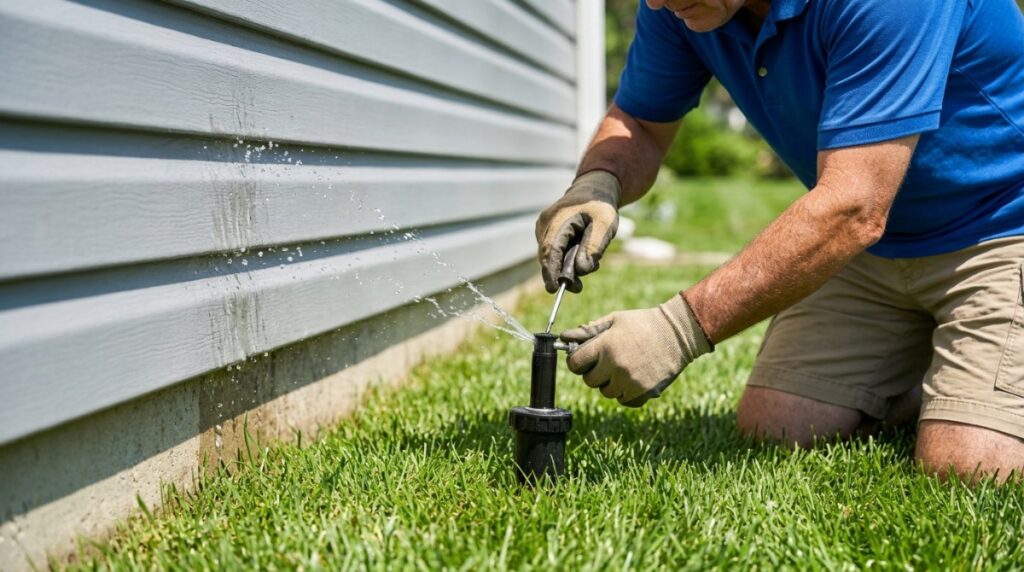
Midsummer. Our crew pulls up for an estimate and I notice a neat row of fan shaped marks along the base of a wall. They are all the same distance apart. Each one lines up with a sprinkler head on the lawn.
The homeowner tells me they thought the siding was going bad. I tell them what I tell everyone in this spot. It is the water, not the siding, and it is fixable.
Sprinkler stains on siding come from minerals or iron in the water. Stop the spray from hitting the wall, work out whether the stain is mineral scale or iron, clean it with the mildest product that works on a test patch, and then re-aim the heads. We are a family business in Brighton, and in most of these calls the honest answer is a cleaning job, not a paint job.
The Short Answer: What Sprinkler Stains Are and How to Fix Them
Sprinkler stains are mineral deposits left when water evaporates. White crust is usually hard water scale and orange streaks are iron. First stop the spray hitting the wall. Then test a mild acid cleaner, such as diluted white vinegar for scale or a siding safe rust remover for iron, on a hidden spot before cleaning.
Sprinkler stains on siding are cosmetic on most homes. Constant wetting is a different story, and I will get to that.
Quick Diagnosis: Is It Hard Water, Iron, Chalk or Mold?
Do not buy a cleaner for sprinkler stains on siding until you know what you are cleaning. Different stains need different treatment.
| What you see | What it feels like | Likely cause | First move |
|---|---|---|---|
| White crusty spots | Rough, like sandpaper when old | Calcium and magnesium scale from hard water | Stop the spray, test mild acid |
| Orange or brown streaks | Smooth stain on the surface | Iron or rust in the water | Stop the spray, use a rust remover made for siding |
| White powder that comes off on your finger | Soft, chalky | Paint chalking or siding oxidation, not sprinkler | Treat as a finish problem |
| Green film | Slimy or fuzzy | Algae | Treat moisture and clean |
| Black specks | Dotted, may smear | Mildew | Treat moisture and clean |
| Fan pattern at head spacing, low on the wall | Varies | Sprinkler spray | Re-aim the heads |
The finger swipe test
Here is the moment I teach this on a job. Our crew leader runs a finger across a mark in front of the homeowner. If a white powder comes off easily and leaves a film on the fingertip, that is chalk from the paint or the siding surface. That is a different problem. If the mark is crusty, hard, and rough, and a light wipe barely moves it, that is mineral scale. Fresh scale wipes off a little. Old scale feels like sandpaper.
Then we point at the spray arc. If the pattern sits low on the wall, repeats, and lines up with the height of the spray from the heads, the sprinkler is the cause.
If your marks look more like flaking paint than crust, that is a paint failure and not a sprinkler stain. If you see green film, that is algae, and it has a different cause and fix.
Read the pattern
A stain pattern that repeats at the spacing of the heads, low on the wall, is almost always the sprinkler. A random pattern high on the wall is something else.
Other field clues help too. Orange tint often looks worse on light siding and fades toward the top of the stain. Caulk lines and window sills catch the most deposit. And we usually notice the heads before the stain, because the grass beside that wall is always greener.
Why Sprinklers Leave Marks on Siding
The basic idea is simple. Water evaporates and leaves behind what was dissolved in it.
The U.S. Geological Survey defines water hardness as the amount of dissolved calcium and magnesium in the water. When that water dries on siding, the calcium and magnesium stay behind as a white crust. Iron in the water leaves orange or brown stains instead.
Some homes on private wells have more iron and minerals in their water. I will not say most, because it varies. A municipal supply can still leave light spotting.
Why Michigan summers make it worse
Hot, dry afternoons dry water fast, and that concentrates the minerals. If the sprinklers run daily, a new layer lands every day. Over a summer it builds up.
There is a winter side to this too. Water that sits in joints and at end grain through the summer has more chance to work its way in before the freeze and thaw cycles begin. Siding that stays wet is siding that has a harder winter.
Does it damage siding?
On vinyl and well sealed siding, staining alone is cosmetic. On wood siding, trim, and caulk joints, constant wetting is the real risk.
Here is what to check on wood. Look for soft spots, bubbling paint, and a musty smell. Press a screwdriver tip into the lowest boards. If it sinks in, the problem is more than a stain. That is rot, and it needs carpentry before anything else.
What To Do Right Now
Do these in order. Order matters here.
Step 1. Stop the spray
Turn off the zone, or adjust the head so water stays on the lawn. Watch one full cycle to be sure. Check heads again after lawn aeration or mowing, since they get bumped.
Step 2. Identify the stain
Use the table above. If the stain returns after cleaning, a home water test for hardness and iron can tell you what is in your water.
Step 3. Test a small hidden patch
Every product, every time. Pick a spot that nobody will see, like behind a downspout or a shrub. Start with the mildest option. If it changes the color or finish, stop.
I want to repeat that. The test patch comes before any cleaner on this page.
Step 4. Clean by stain type
Mineral scale. After the test patch, try diluted white vinegar or a citric acid cleaner. Use a soft brush. Keep the surface wet, keep the contact time short, and rinse well. Vinegar can harm plants, so wet them down first and protect beds. Never let acid dry on the surface.
Iron and rust. After the test patch, use a rust remover made for exterior siding. Products with oxalic acid are what professionals commonly use on vinyl. Follow the label. The University of Georgia Extension notes that oxalic acid is poisonous and should not touch skin, so wear rubber gloves.
Do not use chlorine bleach on rust. The University of Georgia Extension says plainly that chlorine bleach will set rust stains. Never mix bleach with acids or with other cleaners. The fumes can hurt you.
Fresh stains come off more easily than old ones. Do not expect an old, heavy stain to disappear in one pass.
A homeowner once told me she had already scrubbed an orange stain with bleach. It looked worse than before. Our crew leader explained why. Bleach and rust do not get along, and the bleach had helped the stain set. We cleaned the area with the right product, and it improved a lot. It never went completely back to new, which is something you should expect with an old stain.
Step 5. Rinse and recheck after a week
Use light brushing only. Hard scrubbing can spread rust stains across the wall. Come back in a week and look again in good light.
What Not To Do
- Do not put bleach on rust.
- Do not mix cleaners.
- Do not use high pressure on siding seams. Water can be forced behind the laps. Read more about pressure washing and exterior paint.
- Do not use wire brushes or scouring pads on vinyl or painted surfaces.
- Do not paint over stains or over soft wood.
- Do not let acid dry on the surface.
Practical Example: One Wall, One Summer
Here is a typical wall.
Stains run along the lower boards at head spacing. The sprinkler has hit the same boards all summer. Our crew leader probes the lowest boards with a screwdriver. We clean a test patch. Some stains lift. Some do not.
Then we find two boards near a corner that feel soft.
That is the lesson. A cosmetic problem and a structural problem can sit side by side. The stain tells you where the water has been. The probe tells you whether it did more than stain.
We leave alone what is sound. We clean what can be cleaned. We flag what has to be replaced.
Repair vs Recoat vs Replace
| Situation | Best move |
|---|---|
| Light staining on vinyl or sealed siding | Clean and re-aim |
| Heavy, old staining on a few panels | Repeat cleaning, accept some ghosting, or replace those panels |
| Stain on paint that is chalking, peeling or cracking | Prep and recoat after fixing the water source |
| Soft or rotted siding or trim | Replace the wood first, then coat |
| Stain on brick or block | Treat per masonry methods and fix the moisture first |
If the paint under the stain is chalking or peeling, send us a photo or book a free look. If it is just a stain, we will tell you to clean it. You can start with a 5 minute call.
How a Ceramic Elastomeric Coating System Fits
Let me be honest. A coating does not make a wall immune to staining.
Rhino Shield is a flexible, breathable, water resistant ceramic based acrylic elastomeric coating that resists mold, mildew and algae. Our FAQ recommends cleaning walls annually to remove surface dirt and stains. It fits when the paint underneath has failed from constant wetting, or when a homeowner wants a surface that can be washed.
The process has 11 steps. It covers inspection, cleaning, patching and repairs, scraping, caulking, priming, and the finish coat. See our 11 step coating process.
When is it not the answer? When only a few vinyl panels are stained. When the sprinkler problem has not been fixed. In those cases, clean and re-aim.
The 25-year No Chip, Crack, or Peel warranty covers chipping, cracking, and peeling under its written terms. It does not cover stains.
Cost and Timing in Michigan Seasons
Cleaning is usually inexpensive compared with repainting. I will not quote prices for cleaning, because they vary.
For Rhino Shield, our pricing page explains that it costs about 2 to 2.5 times a traditional paint job. A typical three bedroom home with about 2,000 square feet of wall runs about $13,000 to $18,000. Latex runs about $5,000 to $9,000 and needs repeating every 5 to 7 years. The website currently advertises up to 25% off and 0% financing, and your written estimate will confirm what applies.
Timing is straightforward. Clean in warm, dry weather. Fix sprinkler heads in spring at start up. Schedule coating work in the warm season.
Frequently Asked Questions
What are the white spots on my siding from sprinklers?
Usually mineral scale from hard water. Run a finger across it. Crusty and rough means scale. Soft powder that wipes off means chalk.
How do I remove hard water stains from vinyl siding?
Test a small hidden patch first. Then use diluted white vinegar or citric acid with a soft brush, keep it wet, rinse well, and protect plants.
How do I remove rust stains from siding caused by well water?
Use a rust remover made for siding and follow the label. Never use bleach, which sets rust. Brush lightly.
Will vinegar damage my siding?
It is usually fine on vinyl in short contact, but test first, never let it dry, and keep it off plants. I will not promise it is safe on every color.
Can I pressure wash sprinkler stains off?
Only with a low pressure rinse. High pressure can force water behind the siding.
Will the stains come back?
Yes, if the heads still hit the wall or the water carries minerals. Re-aim the heads first. Water time of day and drip lines matter too.
Is a water softener or iron filter worth it?
It depends on a water test. It treats the source, but it has its own cost and upkeep.
Does the Rhino Shield warranty cover sprinkler stains?
No. The warranty covers chipping, cracking, and peeling. We recommend annual cleaning.
Talk to Us Before You Repaint
If sprinkler stains are on your siding, you do not need to repaint to fix them most of the time. Schedule a free estimate if you want us to look at the paint under the stain. No pressure.
Call us at 810-360-6583. We are a family owned, BBB accredited A+ business with MI License #2102200455, and you can see our 4.8 star rating on our Google Business Profile.
We serve Brighton, Livingston County, Southeast Michigan, Ann Arbor, Lansing, Grand Rapids, Traverse City, and the Lake Michigan coastline. See the full list on our areas we serve page.