
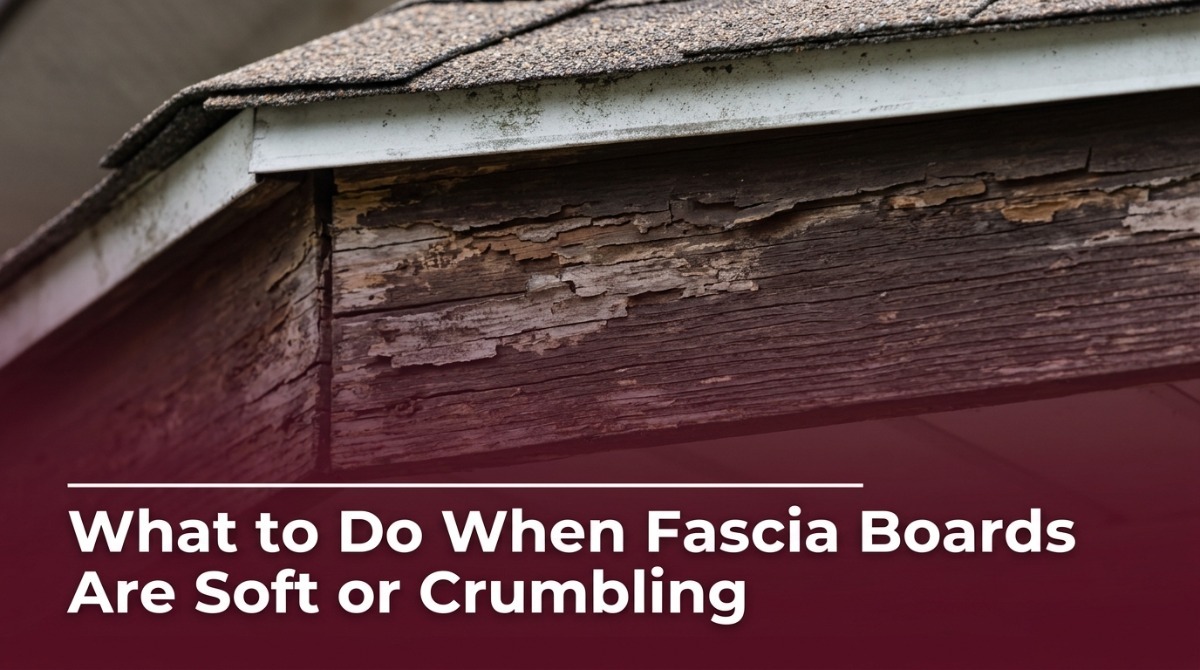
During an estimate, one of our crew leaders climbed up to the eave and pressed his thumb into the fascia, just behind the gutter. The paint skin tore. Underneath, the wood was brown, stringy and crumbled between his fingers.
The homeowner had painted that same fascia more than once. Every time, it peeled again. They wanted to know why it wouldn’t hold.
I told them what I tell most people in that spot. Paint was never the issue. Water was.
Soft or crumbling fascia boards almost always mean water has been sitting at the roof edge. So probe the board to see how far the rot goes. Find the water source, whether that’s gutters, ice dams, a missing drip edge, a roof leak or attic ventilation. Replace what’s rotten. Then protect the new or sound wood.
I’m Marc Mercier, and my wife Sheryl and I run Rhino Shield of Michigan in Brighton. Below is how our crews look at a roof edge, what usually causes the damage and which trade you should call first.
The Short Answer: What to Do About Soft or Crumbling Fascia Boards
What should you do when fascia boards are soft or crumbling?
Soft or crumbling fascia means water has been sitting at the roof edge. Probe the board and the rafter tails to see how far the rot goes, fix the source (gutters, ice dams, drip edge or a roof leak), replace the rotted wood, then prime and coat the new or sound wood.
Think of the fascia as the messenger. It’s telling you something is wrong at the roof edge.
Quick Diagnosis: How Bad Is It and Where Is the Water Coming From?
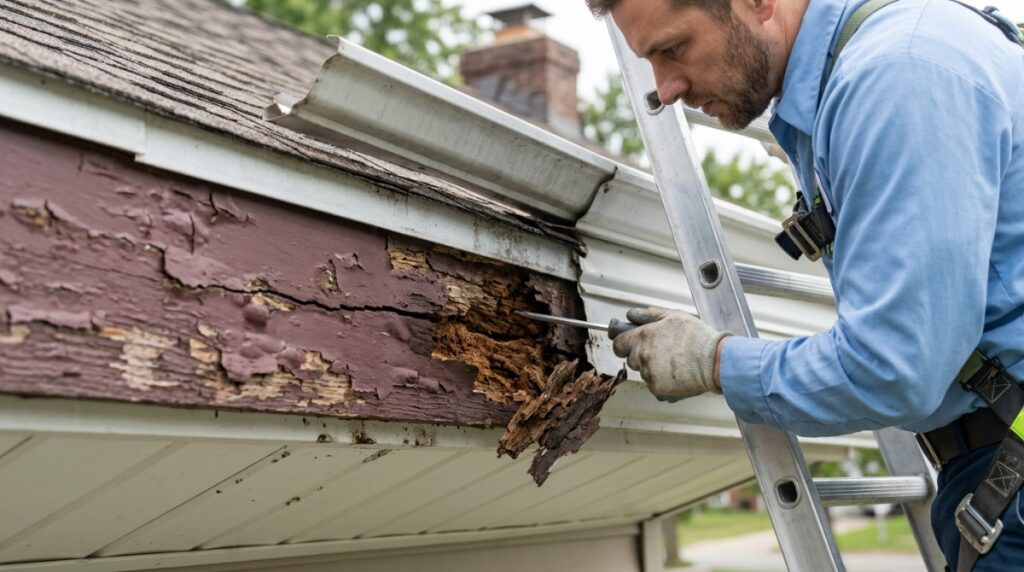
When we find soft or crumbling fascia boards, our crews always check two places first: the bottom edge of the fascia and the area right behind the gutter. That’s where rot starts, and that’s where it hides.
Water runs down the face of the board and sits along the lowest edge. Gutters press against it and hold moisture there for days.
How Bad Is the Damage?
| What you find | What it means |
|---|---|
| Paint peeling, wood firm | Moisture problem, no rot yet |
| Surface soft, screwdriver goes in slightly | Early rot in the outer fibers |
| Wood crumbly or hollow, screwdriver sinks easily | Advanced rot, board has lost strength |
| Soft wood running many feet or across joints | Long term water problem along the eave |
| Soft wood near rafter tails or soffit | Damage may go beyond the fascia |
If you’re only seeing peeling with firm wood under it, our post on paint flaking off wood siding may help you sort out the coating side.
Where Is the Water Coming From?
Where the damage sits usually points to the cause:
| Where the damage is | Likely cause |
|---|---|
| Behind the gutter and along the bottom edge | Gutter overflow, clogged downspouts, hangers holding water |
| Stains below gutter seams | Leaking gutter seams |
| Along a whole eave after winter, often the north side | Ice dams from attic heat loss |
| Near a roof valley or dormer | Roof leak or failed flashing |
| At corners and butt joints | Bare end grain or failed caulk |
| Soft fascia plus damp soffit | Ventilation problem or roof leak |
How to Probe Safely
Work from a stable ladder with someone holding it. Use a screwdriver or awl at the bottom edge, the ends and the joints. If you can reach them, probe the rafter tails too.
If you can’t get up there safely, use binoculars from the ground. Look for peeling paint, dark staining and gaps behind the gutter.
Two story roof edges and steep roofs belong to professionals. That’s not worth the risk.
Signs It’s More Than the Fascia
Call in help if you notice any of these:
- Soft or sagging soffit
- Water stains on a ceiling inside
- Daylight visible at the eave from the attic
- Wasps, birds or squirrels getting in at the corners
Why Fascia Boards Rot in Michigan
After a hard winter, our crews often see the same pattern. Dark streaks below gutter seams. Fascia that stays damp in one stretch where ice built up again and again. Gutters pulling away because the screws have nothing solid left to grip.
Soft or crumbling fascia boards don’t fail on their own. Something is feeding them water.
Gutters and Downspouts
Clogged gutters overflow straight onto the fascia. Blocked downspouts back water up the run. Sagging gutters tilt the wrong way and hold water against the board.
This is the most common cause we see, by a wide margin.
Ice Dams
Michigan winters make ice dams a real factor. Heat leaking from the living space warms the roof deck and melts the snow. That meltwater runs down to the cold eave and freezes again.
Over time, a ridge of ice builds up and traps water behind it. The ice dam entry on Wikipedia explains how that trapped water can leak into roofing, walls and insulation.
The fix isn’t on the fascia. Michigan’s MI Ready guidance points to clean gutters, better attic insulation and ventilation from the soffit to the ridge. That’s work for an insulation contractor or roofer.
Drip Edge and Roof Edge Details
A drip edge is the metal strip that guides water off the roof and into the gutter. When it’s missing or lapped poorly, water runs behind the gutter and soaks the top of the fascia.
Building codes address drip edge, but requirements vary. Ask your roofer or local building department what applies to your home.
Freeze-Thaw, End Grain and Older Wood
Water gets into small cracks, freezes and widens them. Each Michigan winter repeats the cycle.
Bare cut ends and butt joints soak up water fast. That’s why rot so often starts at corners and where two boards meet. We cover more about how winters break down a paint film in paint that peels after one Michigan winter.
What the Moisture Numbers Say
The USDA Forest Products Laboratory puts the decay threshold at roughly 30 percent moisture content. Below about 20 percent, decay fungi don’t do much.
For painting, Dunn-Edwards technical guidance sets 15 percent as the upper limit for exterior wood. So fascia that’s been wet needs time to dry before any coating goes on.
What To Do Right Now
You don’t have to solve everything at once. But a few steps now can keep the damage from growing.
1. Look, Photograph and Probe
Take dated photos from the ground and up close. Mark how far the soft area runs. That record helps when you get quotes.
2. Clear the Gutters and Downspouts
Do it safely, or have someone do it for you. Make sure water flows away from the house at the bottom of each downspout.
3. Check the Attic
From inside, look along the eaves. Damp rafter tails, stained sheathing or wet, compressed insulation all point to a bigger problem.
4. Cover or Brace If Needed
A temporary tarp or sealant can slow water until a repair happens. Never leave a heavy gutter hanging on a soft board. It can fall.
5. Put Safety First
Follow basic ladder rules, work with a helper and stay clear of power lines. Don’t climb a roof edge in icy weather.
If the home was built before 1978, the old paint may contain lead. The EPA’s Renovation, Repair and Painting Program requires certified firms for paid work that disturbs painted surfaces in those homes. If you’re doing the work yourself, follow lead safe practices before scraping.
6. Call the Right Trade
Here’s the usual order:
- Roofer for roof leaks, flashing and drip edge
- Gutter contractor for overflow, pitch and downspouts
- Insulation contractor for ice dam causes in the attic
- Carpenter for the rotted fascia, rafter tails and soffit
- Coating contractor once the wood is sound and dry
What Not To Do
These shortcuts usually cost more in the end:
- Painting or wrapping over soft fascia. It hides the rot while it keeps spreading.
- Filling deep rot with caulk. Caulk cannot rebuild wood.
- Rehanging heavy gutters on rotten boards. The screws won’t hold for long.
- Climbing a roof edge in winter. Ice and snow make it dangerous.
- Ignoring damp rafter tails. That’s structural wood.
- Pulling gutters without a plan. Know who’s putting them back and when.
Practical Example: A Soft Fascia Run Near a Downspout Corner
Here’s a pattern our crews see often.
During an estimate, the crew leader probes the fascia along one side of the house. Most of it is firm. But near the downspout corner, the screwdriver sinks in. The same thing happens at a butt joint a few feet away.
He checks the rafter tails behind that corner and presses on the soffit. He notes that the gutter sags toward the corner instead of draining to the downspout.
So the water source is clear. The gutter is holding water at that corner.
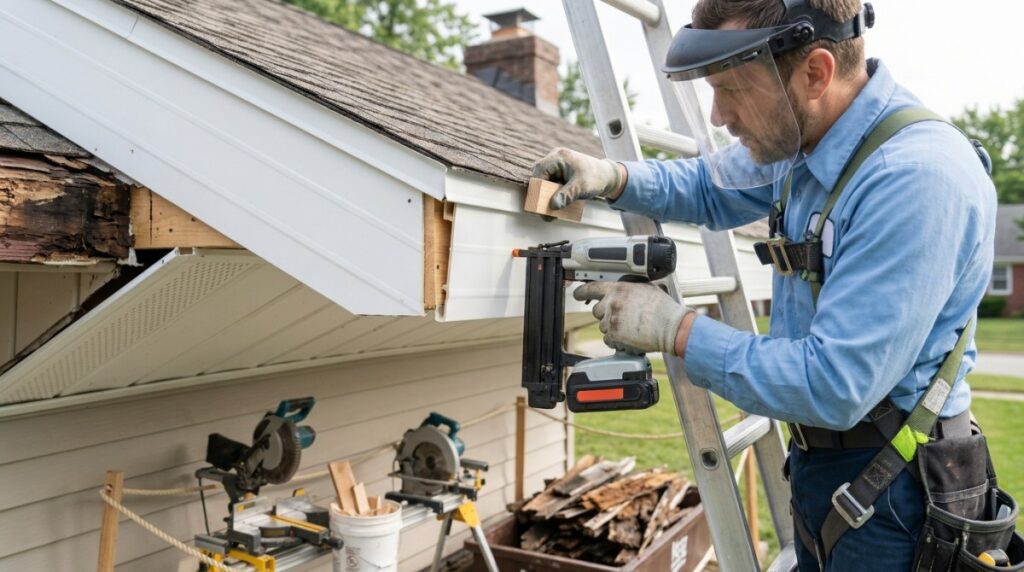
The estimate gets sequenced in a set order. First, the gutter or roofing partner fixes the pitch and the drainage. Then the carpenter replaces the soft fascia and checks the tails. After that, our crew cleans, primes and coats.
Same lesson every time. Fix the water. Repair the wood. Then protect it.
Repair vs Recoat vs Replace
Here is how we usually decide what a fascia board needs:
| Condition | Best approach | Notes |
|---|---|---|
| Paint failing, wood firm | Scrape, spot repair, prime and recoat | Fix the moisture source first |
| Small soft area, board otherwise sound | Cut back, harden and fill | Short term fix, epoxy durability is debated |
| Soft section at a joint or corner | Cut out and splice in new wood | Seal ends and prime all sides |
| Board soft along most of its length | Replace the board | The gutter usually comes off and goes back on |
| Rot at rafter tails or soffit | Carpenter or roofer repair | Structural, coat only afterward |
You’ll find rules of thumb online, like two inches of soft wood or a certain percent of the run. Those numbers aren’t sourced, and they disagree with each other. The real test is the probe, the condition of the rafter tails and whether the cause has been fixed.
Choosing Replacement Material
Wood, cellular PVC, composite and aluminum wrap all show up on Michigan homes. Each has trade-offs in cost, look and how it handles movement.
Aluminum wrap deserves a special note. Over sound wood, it can add protection. Over damaged wood, it simply hides the rot until it gets worse.
Not sure whether it’s the roof, the gutters or the board? We’ll look at the fascia and tell you which trade to call first. You can book a 5 minute call to set that up.
How a Ceramic Elastomeric Coating System Fits
Let me be honest about what our coating does and doesn’t do.
Rhino Shield is a flexible, breathable, water resistant ceramic based acrylic elastomeric coating. Fascia boards are one of the wood surfaces we coat on a residential exterior job. On sound wood, it gives a durable finish that holds up through Michigan seasons.
It doesn’t stop roof leaks. It doesn’t fix ice dams, gutter overflow or attic ventilation. Those need to be handled first.
Our 11-step coating process runs in this order: inspection, cleaning, patching and repairs, scraping, caulking, masking, full area priming, a high mil finish coat, touch ups, cleanup and a final inspection.
The coating must go on wood in acceptable condition. If fascia needs replacing, we flag it and include a replacement quote in the estimate. You can read more about how we repair surfaces before coating.
When the real cause is the roof, the gutters or the attic, we say so. We’d rather you call the right trade first than coat over a problem.
Our 25-year No Chip, Crack, or Peel warranty covers chipping, cracking, peeling and flaking under its written terms. It does not cover rot or leaks.
Cost and Timing in Michigan Seasons
Fascia repair costs depend on a few things:
- How many linear feet need work
- How many stories and how hard the access is
- Hidden damage at rafter tails and soffit
- Whether gutters need to come off and go back on
- The replacement material you choose
You’ll see wide cost ranges online that don’t match each other or Michigan labor. A real quote after a real inspection is the only number worth trusting.
For the coating side, our Rhino Shield pricing page explains it. On average, it runs about two to two and a half times a traditional paint job. A typical three bedroom home with about 2,000 square feet of wall space comes in around $13,000 to $18,000. A typical latex paint job runs $5,000 to $9,000 but usually needs repeating every five to seven years.
Timing matters. Fix leaks and ice dam causes before winter sets in. Carpentry and coating work best in dry, warmer weather, and our crews follow the manufacturer’s temperature window.
We currently advertise up to 25% off and 0% financing.
Frequently Asked Questions
How do I know if my fascia board is rotten?
Press a screwdriver into the bottom edge and the ends. If it sinks in or the wood crumbles, it’s rotten. Peeling paint, dark stains and a gutter pulling away are common warning signs too.
Can you paint over rotted fascia?
No. Paint over soft or crumbling fascia boards fails quickly and hides the damage. Probe it, cut out the bad wood, replace it and then prime and coat.
What causes fascia to rot in Michigan?
The usual causes are gutter overflow, ice dams, a missing drip edge, roof leaks and poor attic ventilation. Bare end grain and failed caulk at joints add to it. Freeze-thaw cycles make every one of those worse.
Do I need a roofer or a painter for rotted fascia?
Often both, plus a carpenter. A roofer or gutter pro handles the water source, a carpenter replaces the wood and a painter or coating contractor finishes it. The order matters.
Can ice dams damage fascia boards?
Yes. Ice dams trap water at the eave, and that water soaks into the fascia and sometimes the roof deck. Fixing attic heat loss and ventilation is the long term answer.
Can I wrap fascia in aluminum instead of replacing it?
Over sound wood, aluminum wrap can add protection. Over damaged wood, it hides the rot and lets it spread. Probe first, then decide.
Does homeowners insurance cover rotted fascia?
Policies vary. Gradual rot from long term moisture is often excluded. Check with your carrier for your specific situation.
Does the Rhino Shield warranty cover rotted fascia?
No. The warranty covers chipping, cracking, peeling and flaking under its written terms. Rot and leaks are not covered.
Talk to Us About Your Roof Edge
If you’ve spotted soft or crumbling fascia boards and you’re not sure where the water is coming from, we’re happy to take a look. Our crew will probe the fascia, check what’s behind it and tell you honestly what needs to happen first.
If the problem is the roof or the gutters, we’ll say so and point you to the right trade. No pressure either way.
We serve homeowners from Brighton and Livingston County to Ann Arbor, Royal Oak, Lansing, Grand Rapids, Traverse City and the Lake Michigan coastline. See the full list of areas we serve in Michigan, or read what other homeowners say in our Google reviews.
Schedule a free estimate or call us at 810-360-6583.
Paint less. Shield your home for decades.
Marc Mercier, Owner, Rhino Shield of Michigan, Brighton, MI. Family owned, 25+ years in home improvement, BBB A+ accredited, MI Lic #2102200455.