
By Marc Mercier, owner of Rhino Shield of Michigan. Family owned, 25+ years in home improvement.
The call usually starts the same way. “It is only a year old, and the south wall is lifting in sheets.” I tell the caller what I tell everyone: do not repaint yet. Take photos, and let us look at what is under the paint.
When a recent paint job fails early, do not paint over it. Photograph the failure, read the pattern to find the likely cause (prep, moisture, weather at application or incompatible old paint), contact the painter in writing, and fix the cause before anything goes on top.
We see this across Michigan, from Brighton and Livingston County to the Lake Michigan coastline.
The Short Answer
Document the failure with dated photos. Find the pattern: peeling to bare wood, between coats, or bubbling. Tell your painter in writing, and fix the cause before repainting. Painting over failing paint, or over a moisture problem, will fail again.
Quick Diagnosis: Read the Pattern
The pattern tells you more than the color or the brand. Use the table as a guide.
| What you see | Likely cause | What it suggests |
|---|---|---|
| New paint peels from old paint, back of the flap is chalky or dirty | Chalk or contamination on the old surface | Prep issue |
| Paint lifts down to bare wood | Moisture moving through the wall or wood, or no primer | Moisture and prep issue |
| Cracking at the edges of old layers, alligator pattern | Layers too thick, or incompatible coatings | Application or product issue |
| Failure soon after the job | Cold, damp or dew point at painting | Timing issue |
| Dark spots or mildew under or around the failure | Dirt or mold painted over, or shade and moisture | Prep or moisture |
| Failure only below a gutter, near the ground or around windows | A water source | Not a paint problem alone |
| Bubbles that are soft and wet when pierced | Trapped moisture | Moisture |
This follows general building-science logic of the kind found on InspectApedia and other references. I have not copied their text, and I do not repeat unsourced statistics.
Peel a flap and look at the back
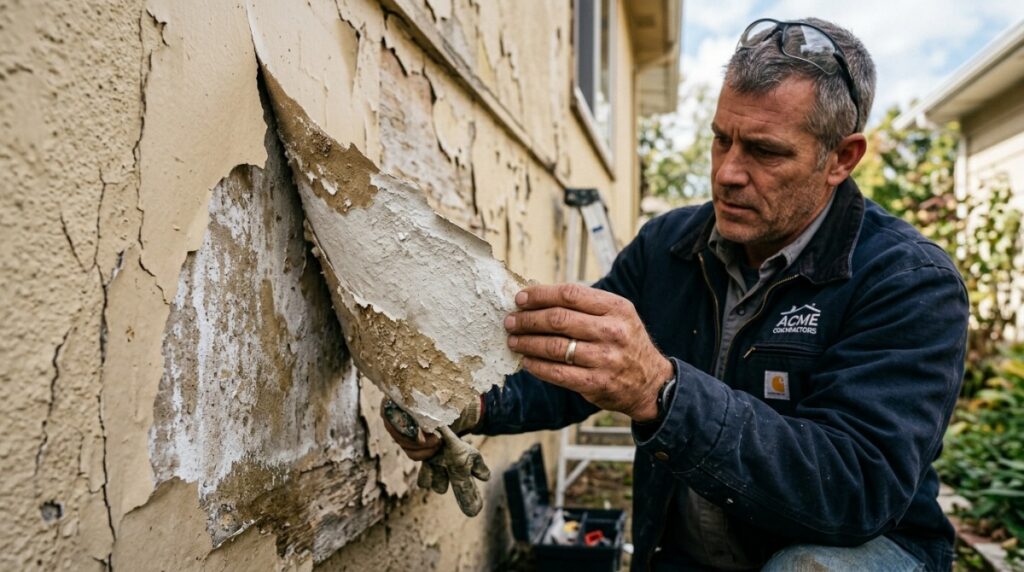
Our crew peels back a loose flap of paint and looks at the backside. If the back is clean and shows bare wood, moisture is a suspect. If the back is chalky or dirty, prep is a suspect. A thin, brittle film on the back often means layers that did not bond.
A flap tells a story. You can do this yourself, with photographs first.
If you would rather have someone look at it with you, we will come out, peel a flap and tell you what we see. No pressure. You can book a quick 5 minute call.
Why Paint Fails Early on Michigan Homes
Poor prep and chalky or dirty old paint
Paint bonds to a clean, sound surface. It does not bond to chalk, dirt or loose paint. Washing and scraping to sound edges are what make the next coat stick. Skipping them is the most common reason we find.
Painting over damp wood or trapped moisture
Dew, rain, humid days and walls that were not fully dry after washing or repair all trap water. So do gutters, flashing, ice dams and leaks. If water is entering the wall, paint will lift no matter how good it is.
No primer or spot priming
Primer seals the wood and gives the finish something to grip. Our crews prime the full area, not just spots. Bare end grain that was never primed is a classic.
Weather at application
Cold, hot sun, wind and coming rain all matter. One painter-reported rule of thumb is that water-based paint applied below about 50 degrees may not form a durable film. The product label governs. Michigan spring and fall nights can drop quickly, and Traverse City and the coastline can swing even more.
Thin coats, rushed recoats and the wrong product
Failure often starts on the sun facing wall, below a leaking gutter, or at the lower courses near the ground. Location is a clue. Thin coats and rushed recoat times also show up as early failure.
What a failed job looks like up close
When we scrape a failing area, the back of the paint tells us a lot. We often see layers at the edge like rings in a tree. A bubble that is soft and wet when pierced points to trapped moisture. A mildew shadow under the peel means the surface was not clean. A bead of caulk that has pulled away at a window shows where water got in.
We have also seen boards whose end grain was never primed. Water enters there first, and the paint above it lets go. None of these are mysterious once you know where to look. They are also not always the painter’s fault. A lot of them are the house and the weather doing what they do.
Normal wear versus failure
I want to be fair. No ordinary paint lasts forever, and Michigan weather is hard on it. Our page on why exterior paint only lasts 3 to 5 years explains the longer picture. But a job that lifts in a year or two is not normal wear.
A timeline that helps
You do not have to solve everything in a day. Here is a simple way to think about it.
- First week: Photograph, collect paperwork and check for water sources. Do not scrape or repaint.
- First month: Write to the painter, get a second opinion and fix any water source such as a gutter or flashing.
- First quarter: Choose the repair path, schedule it for a dry window and confirm the scope in writing.
Going slowly at the start usually saves money at the end. The mistake we see most is a quick repaint over a problem nobody has named.
What To Do Right Now
- Do not repaint or touch up yet.
- Photograph and video the failure with dates. Take wide and close shots, including the back of a peeled flap.
- Find your paperwork. Contract, estimate, paint product name, warranty and payments.
- Note when the paint went on and the weather you remember.
- Check for water sources. Gutters, downspouts, flashing, sprinklers and dripping AC lines.
- Contact the painter in writing. Send photos and a calm request to inspect and respond by a reasonable date. Our guide on when a painter will not honor a warranty is coming soon for the harder case.
- Get a second opinion from another contractor before deciding how to fix it. Our 7 questions to ask exterior painters can help you compare.
- If your house was built before 1978, ask any contractor about lead safe practices before scraping. The EPA Renovation, Repair and Painting program explains the rule.
What Not To Do
- Do not paint over peeling or bubbling paint.
- Do not pressure wash hard or scrape everything yourself on an older house.
- Do not delete or alter evidence. Photograph before you scrape.
- Do not make accusations. Keep messages factual.
- Do not pay final balances before the issue is acknowledged, if your contract still has money due. This is general information. Check your contract.
- Do not assume it is the painter’s fault, or that it is not. Find the cause first.
A Practical Example: Taking a Failed Job Back to Sound Surface
Here is how we handle a failed job. The homeowner often feels relief just seeing the sequence in order.
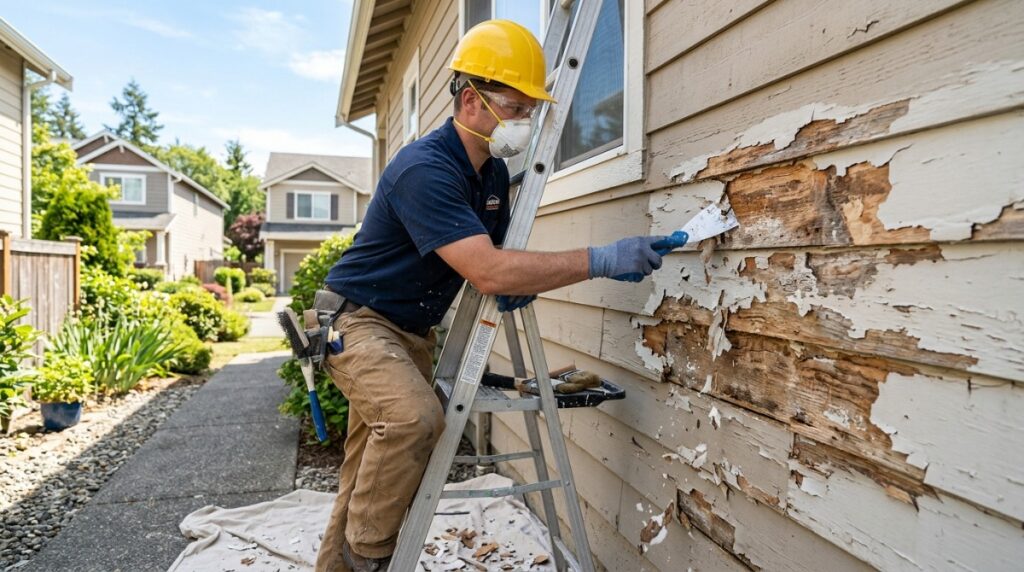
We start with an inspection and a production plan. Then we wash. We scrape loose paint back to sound edges. Layers show at the edge like rings in a tree, and that tells us how many coats are there.
Next we patch and repair rot and cracks. We caulk the seams and mask. We prime the full area. The finish coat goes on, followed by touch ups, cleanup and a final inspection with the crew leader. See the 11 step coating process.
The same steps fix a failed job and prevent another. Each one exists because of something we have seen go wrong.
Repair, Repaint or Recoat: How to Decide
| Situation | Best path |
|---|---|
| Small area, clear local cause (a gutter leak, one board) | Spot repair |
| Widespread peeling, sound wood | Full repaint after prep |
| Repeated failures on the same wall, owner wants a long interval | A different coating approach |
| Moisture source (gutters, flashing, roof, ice dam, insulation) | Fix the other trade first |
The cause decides the fix. See our page on substrate and repairs.
Where a Ceramic Elastomeric Coating Fits, and Where It Does Not
Rhino Shield is a ceramic based acrylic elastomeric coating. It is flexible, bridges hairline cracks, breathes and resists water. It also resists mold, mildew and algae and reflects UV.
It is not magic. It depends on the same prep and moisture control as any coating, which is why our process has 11 steps.
I will tell you when it is not the answer. If moisture is entering the wall, if rotted wood is not yet repaired, or if you only need a spot fix, a coating is not the first move. One house we saw needed a leaking gutter and flashing fixed by another trade first. Moisture comes first.
The 25 year “No Chip, Crack, or Peel” limited warranty is written, transferable and not prorated. It covers chipping, cracking and peeling, and our website lists flaking, under its written terms. It does not cover moisture, rot, mold or fading. See the 25 year warranty page.
What to say to your painter
Keep the message short and calm. Say when the job was done and what you see now. Attach dated photos, including a close shot of the back of a peeled flap. Ask what product, sheen and color formula were used, and ask them to inspect by a reasonable date.
Most painters want to fix a problem when they are asked politely. A factual message gives them room to do that. If they do not answer, you will have a record that you tried.
Cost and Timing in Michigan
A coating system typically costs about 2 to 2.5 times a traditional paint job. For a typical 3 bedroom home with about 2,000 square feet of wall area, that is roughly $13,000 to $18,000, or $6.50 to $9.00 per square foot. Latex runs about $5,000 to $9,000 and needs repeating every 5 to 7 years.
Our website currently shows up to 25% off and 0% financing. Confirm in your written estimate. See how much Rhino Shield costs in Michigan and the 25 year cost comparison.
The best repair window is late spring through early fall, on dry days with mild nights. Wash and dry time matters. Do not rush into fall cold.
Frequently Asked Questions
Why is my new paint peeling already?
Usually prep, moisture or weather at the time of painting. Read the pattern to find which.
Is it normal for paint to fail within two years?
Not usually. Paint should last longer than that. I will not promise a number, because it depends on the house.
Is it my painter’s fault?
Often it is prep or application. Sometimes it is moisture or weather. Get it inspected before you decide.
Can I paint over it?
No. Scrape to sound edges and fix the cause first.
What if my painter will not answer?
Document everything, write to them, and then escalate. Our upcoming guide on when a painter will not honor a warranty covers this.
Does a paint warranty cover peeling?
It depends on the written terms. Read them.
Can a coating fix a wet wall?
No. The water source must be fixed first.
Do I need a free second opinion?
It helps. Our inspection is free.
Want a Second Opinion on Your Paint?
If a recent paint job fails early on your house, you do not have to sort it out alone. Schedule a free estimate or a 5 minute discovery call. Our crew will look at the failure, tell you the cause plainly, and suggest what to do, even if that means calling someone else first.
Call us at 810-360-6583. We are a family owned, BBB accredited A+ business in Brighton with MI License #2102200455, and you can see our 4.8 star rating on our Google Business Profile.
We serve Livingston County, Ann Arbor, Lansing, Grand Rapids and many other communities. See the full list on our areas we serve page.