

By Marc Mercier, owner of Rhino Shield of Michigan. Family owned, 25+ years in home improvement. This is general information, not legal advice.
A homeowner pulls a folder out of a bag and sets it on the kitchen table. Inside is a contract, a one page warranty and a stack of photos. The paint on the north wall is lifting, and the painter has stopped answering the phone.
I do not start by criticizing anyone. I ask a simpler question: can I see the paper?
If your painter will not honor a warranty in Michigan, start with the paperwork. Read the written warranty, document the problem with dated photos, send a calm written request with a reasonable deadline, and then use Michigan resources such as the Attorney General’s Consumer Protection Team, LARA and small claims court. I am a contractor, not a lawyer, so treat this as a guide to what I have seen.

The Short Answer
Read the written warranty, photograph the problem, and send a written request with a reasonable deadline. Keep copies of everything. If the painter does not respond, file a complaint with the Michigan Attorney General or LARA, and consider small claims court. This is general information, not legal advice.
Quick Diagnosis: Why the Painter Said No
The first thing I look at is what you were told. The words matter, because each answer points to a different next step.
| What you were told | What it may mean | What to do |
|---|---|---|
| “It is not covered” | An exclusion or limit in the warranty | Read the exact language and ask them to point to it in writing |
| “That is moisture or maintenance, not our work” | A dispute over the cause | Get an independent opinion on the cause |
| “The warranty expired” | A question about dates | Check the term and the start date in writing |
| “We only cover materials” | A split between labor and product | Ask who covers labor |
| “Call the paint maker” | Product warranty versus workmanship warranty | Ask who is responsible for application defects |
| No answer at all | Nonresponse | Move to written notice |
| Business closed or number disconnected | The company may be gone | See the section on what to do if the painter is gone |
What the paper usually looks like
Here is what we see more often than you might expect. The warranty is vague, unsigned, or missing. A one page sheet may name the paint maker but not who handles labor. An old estimate may not list a product name at all.
That is why a specific written warranty matters. At Rhino Shield of Michigan, the written copy of our warranty is delivered after completion and final payment, so a homeowner is never left with a promise and no paper. Whatever contractor you hire, ask to see the terms before you sign.
What Your Warranty Actually Is
Not every warranty is the same thing. The two you will run into most are a workmanship warranty and a product warranty.
A workmanship warranty
This covers how the work was done. Prep, priming, application and coverage all fall here. Check who stands behind it and for how long. A contractor’s workmanship warranty is only as good as the contractor.
A product warranty
This covers the paint itself. It often provides replacement product only, not labor. If you call the paint maker and they offer a few buckets of paint, that is likely what the warranty says.
A checklist for reading the paper
Before you do anything else, read the warranty with this list in hand:
- Who is the warrantor? The contractor, the manufacturer, or both.
- What is covered? Peeling, cracking, blistering, fading. Each warranty names its own list.
- What is excluded? Moisture, rot, settling, cleaning products, normal wear.
- What maintenance is required? Some warranties ask for washing or touch ups.
- How do you file a claim? By letter, by phone, by email.
- What are the time limits? The term and the deadline to report a problem.
- Is it transferable? This matters if you sell the home.
- Is it written and signed? A verbal promise is harder to prove.
As an example of written terms, the Rhino Shield 25 year “No Chip, Crack, or Peel” warranty is written, limited, transferable and not prorated. Valid claims are handled with service labor per the warranty labor terms and replacement product from the manufacturer through the dealer. It covers chipping, cracking and peeling, and our website lists flaking as well. It is a limited warranty, and I never want to overstate it. You can read the terms on our 25 year warranty page.
What To Do Right Now
You do not have to solve this in a weekend. Work through it in order.
- Gather your paperwork. Contract, estimate, warranty, receipts and the product name.
- Photograph and video the problem with dates. Take wide shots and close shots.
- Write a short timeline. When the work was done, when you noticed the problem and every contact since.
- Send a written request. Use email and a mailed copy. Describe the issue, cite the warranty, say what you want (an inspection and a repair) and set a reasonable date.
- Keep every message factual. No threats, no insults.
- Get an independent opinion on the cause and the fix.
- Check the license question. Michigan’s home repair guidance says projects over $600 generally need a contractor licensed by LARA. LARA can help you work out whether yours did.
- If nothing happens, move to the Michigan resources below.
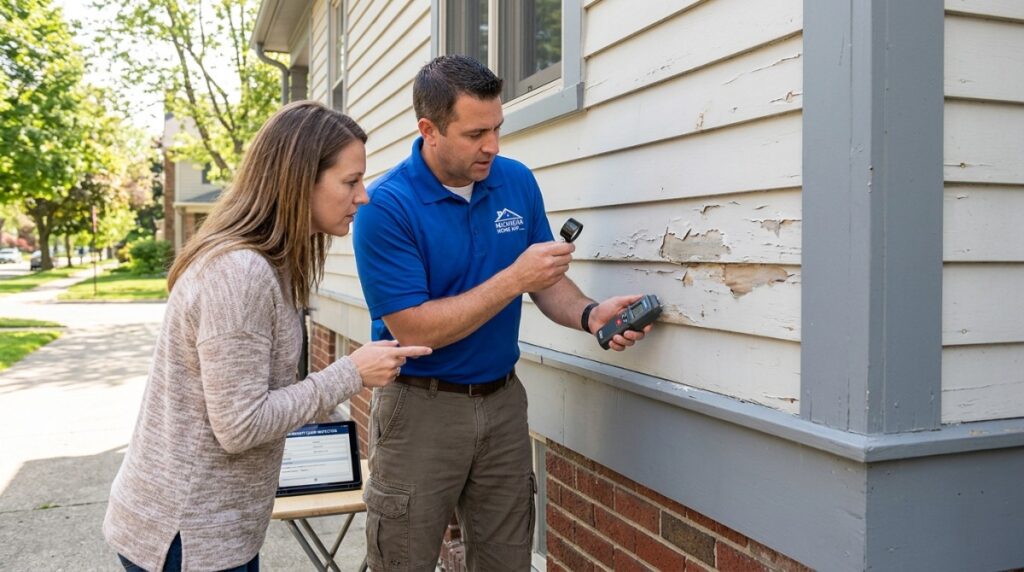
When we walk up to a failing wall, the most useful thing a homeowner can hand us is a folder of dated photos. It tells us how the problem started and how fast it is moving. It also gives you a record that does not depend on anyone’s memory.
If you want an independent look at what is happening on your walls, we will inspect it and explain what we see. It will not cost you anything. You can book a quick 5 minute call. If the paint failed early and you are not sure why, you may also want to read the questions in our guide to hiring exterior painters in Michigan.
Michigan Resources: Where to Take It Next
This is general information. Laws and numbers can change, so confirm details with the state or an attorney.
Attorney General Consumer Protection Team
If the contractor was not required to be licensed, you can file a written complaint with the Michigan Attorney General’s Consumer Protection Team. The Attorney General’s office lists a mailing address of P.O. Box 30213, Lansing, MI 48909, a phone line at 517-335-7599 and a toll-free line at 877-765-8388. There is also an online complaint form. Check the Attorney General’s home improvement notice for the current details.
LARA
For a dispute over work that required a license, file a written complaint with LARA, the Michigan Department of Licensing and Regulatory Affairs. Its website explains the complaint form and can help you determine whether your project needed a licensed contractor. You can also check a contractor’s license and discipline status there.
Better Business Bureau
The state suggests checking the Better Business Bureau and the Attorney General for a contractor’s complaint history. You can also file a BBB complaint. We are BBB accredited with an A+ rating, and I would tell you to look up any contractor you hire.
Small claims court
Michigan’s small claims limit is $7,000 for money claims, effective January 1, 2024, under MCL 600.8401. It is a lower cost route for smaller disputes. Rules and fees are set by the court, so check your local district court.
Time limits
Michigan’s general limitation period for breach of contract is six years under MCL 600.5807(9), counted from when the claim accrued. Other kinds of claims can have different periods. The practical point is simple: act promptly, because it protects your options.
When to talk to an attorney
Consider an attorney for larger amounts, contracts with dispute clauses, or any safety issue. A short consultation can be worth the cost.
What Not To Do
- Do not repaint or repair before documenting. Photograph first.
- Do not make threats or post angry reviews before you have sent written notice.
- Do not withhold or stop payment without reading your contract. Michigan guidance says to try to settle disputes before final payment and to make final payment only when you are satisfied and have proof that subcontractors and suppliers were paid. If money is already paid, rely on the written steps. This is general information.
- Do not accept verbal promises. Ask for them in writing.
- Do not wait years. Dates matter.
- Do not assume the paint maker’s warranty covers labor.
- Do not sign a release without reading it.
What If the Painter Is Gone or Out of Business?
It happens. A phone goes dead, a website disappears, or a company closes and reopens under another name.
Here are the options, stated as options and not legal conclusions. Check LARA and Michigan business records to see the company’s status. The paint manufacturer’s warranty may still apply to the product. Keep your documentation. Consider filing a complaint. You can also hire another contractor to make the repair and keep every receipt.
One more point for sellers. A transferable warranty stays with the home if you sell, which can matter to a buyer. Ours is transferable, and I would ask any contractor the same question.
A Practical Example: From Denial to Plan
Here is a scenario we have seen, told with no names.
A homeowner came to us after a claim was denied. The painter said the failing area had a moisture source, and the warranty excluded moisture. The homeowner was frustrated. They felt the paper was just a way to say no.
We looked at the wall. The peeling was confined to one side, directly under a gutter that overflowed. The cause was clear. Water from the gutter was running down the wall, and the paint could not hold.
We explained why that mattered. It mattered to the claim, because moisture was an exclusion. It also mattered to the repair, because repainting without fixing the gutter would fail again.
The plan went in order. The homeowner fixed the gutter first. Then they sent a written request for the part of the work that was covered. Finally, they decided whether to recoat the entire wall so the color and finish matched.
The homeowner felt frustrated at first, then clear. A clear cause and a calm written request settle many cases. Even when they do not, you have built a record.
Substrate repairs come before coating. Our page on substrate and repairs explains how we handle that, and our 11 step coating process shows where each repair fits.
Repair, Recoat or Replace the Painter: How to Decide
| Situation | Best path |
|---|---|
| Small area, clear covered cause | Push the claim and ask for the repair in writing |
| Cause is moisture or another trade | Fix the cause, then repair and document |
| Widespread failure, painter unresponsive | Get a second contractor and keep receipts |
| Cost to fix is above your small claims comfort | Talk to an attorney about your options |
If the failure is widespread, the contractor is unresponsive and the cost to fix is high, a different contractor and a written claim for the cost may make sense. This is not legal advice. For an independent opinion on the failure itself, our inspection is free.
Where a Ceramic Elastomeric Coating Fits, and Where It Does Not
A long term coating still needs good prep, repairs and moisture control. That is the point of the warranty conversation too. A warranty is only as strong as the work and the wall behind it.
Rhino Shield is a ceramic based acrylic elastomeric coating. It is flexible and breathable. Our 11 step process and written 25 year “No Chip, Crack, or Peel” limited warranty are one example of specific, written terms. The warranty covers chipping, cracking and peeling, and our website lists flaking too, under its written terms. It does not cover fading, mold, rot, leaks or moisture problems.
I will be honest about when it is not the answer. If the wall has a leak or rot, repairs come first. If the real fix is a gutter, flashing or a roof repair, Rhino Shield is not the answer yet. You can also read how long Rhino Shield lasts.
Frequently Asked Questions
Can I make a painter honor a warranty?
You can ask clearly and in writing. Gather the paperwork, document the problem, send a request with a deadline and keep copies. If that does not work, there are state resources and small claims court.
Do painters in Michigan need a license?
State guidance says projects over $600 generally need a contractor licensed by LARA. Ask LARA whether your project required one.
How much can I sue for in Michigan small claims?
The limit is $7,000 for money claims, effective January 1, 2024.
How long do I have to bring a claim?
Michigan’s general contract period is six years. Other claims differ, so act promptly and confirm with an attorney.
Does the paint company’s warranty cover the painter’s labor?
Often not. Many product warranties provide replacement product only. Read the paper.
Who do I complain to?
The Attorney General’s Consumer Protection Team if no license was required, LARA if one was, and the BBB.
What if my warranty was only verbal?
It is harder to prove. Document everything now and ask for the terms in writing.
Can you inspect my failing paint?
Yes. We offer a free estimate and inspection.
Need a Second Opinion on What Went Wrong?
If your painter will not honor a warranty in Michigan, you do not have to sort it out alone. Schedule a free estimate or a 5 minute discovery call. Our crew will look at the failure, explain the likely cause plainly and help you understand what repair makes sense. It is a neutral inspection, not a pitch against any other painter.
Call us at 810-360-6583. We are a family owned, BBB accredited A+ business in Brighton with MI License #2102200455, and you can see our 4.8 star rating on our Google Business Profile.
We serve Brighton, Livingston County, Southeast Michigan, Ann Arbor, Lansing, Grand Rapids and Traverse City. See the full list on our areas we serve page.