
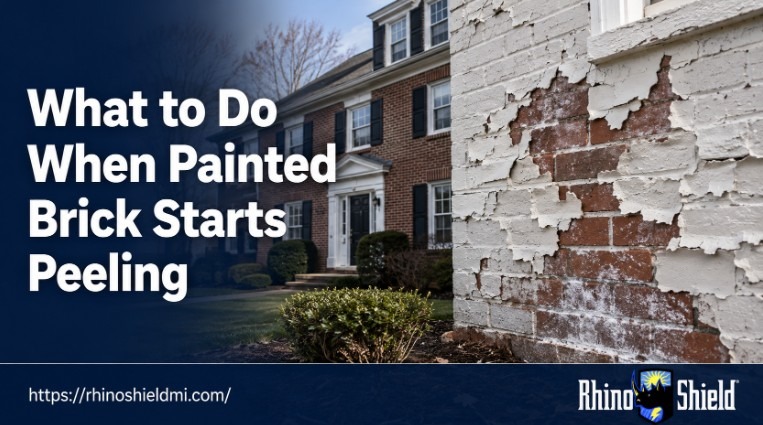
It is spring, and the painted brick on a colonial is lifting in a patch about two feet above the ground. More paint is letting go along the chimney. One of our crew members brushes the back of a loose flake and finds white powder on the brick side.
I tell homeowners this all the time: the brick is telling you where the water is going.
When painted brick starts peeling, it is usually because moisture or salts are trapped behind the paint, or the brick was not clean, dry and sound when it was coated. Find the water first. Fix the wall. Remove only the loose paint. Then recoat with a breathable system.
The Short Answer
Painted brick starts peeling when moisture or salts get trapped behind the paint. Find the water source, repair mortar and flashing, let the wall dry, remove loose paint and white deposits, then prime and recoat with a breathable system. Coating a wet wall will only fail again.
Quick Diagnosis: What Your Peeling Brick Is Telling You
Where the paint is peeling matters as much as how it looks.
| What you see | Likely cause | Next step |
| White powder under the flakes | Efflorescence, salts carried by moisture | Find where the water is entering |
| Peeling at the lowest courses | Ground moisture, splash, sprinklers or grade | Fix the spray, the grade and the downspout |
| Peeling around a chimney, parapet or under rooflines | Roof, flashing, coping or open mortar | Have the roof and flashing checked first |
| Bubbles first, then peeling in the sun | Heat or a film trapping moisture | Cut one open and look, then dry the wall |
| Peeling along mortar lines | Failed pointing | Repoint before any coating |
| One patch on a wall backing onto a bathroom or basement | Interior or foundation moisture | Trace the moisture inside |
| Pieces of the brick face coming away with the paint | Spalling | Call a mason, not a painter |
A moisture check beats a guess
Do not rely on touch to decide whether a wall is dry. Brick can feel dry on the surface and still hold water deeper in. A moisture meter gives you a real reading, and it is worth using before any coating goes on.
Why Painted Brick Peels, and Why Michigan Makes It Worse
Trapped moisture and efflorescence
Brick and mortar contain natural salts. When water gets into the wall, it dissolves those salts and carries them toward the surface. As the water evaporates, the salts stay behind.
That process has a name: efflorescence. Wikipedia’s entry on efflorescence describes it as salt migrating to the surface of a porous material, where it forms a white deposit.
Under paint, that deposit becomes a problem. The paint ends up sitting on a salt film instead of on the brick, so it has nothing solid to hold. The coating lifts and peels.
In the field, we see a crusty or powdery white layer on the back of flakes. Then we trace it back to the source, often lower courses near a downspout or a sprinkler, or around the chimney.
Coatings that do not breathe
Brick is porous. Water vapor naturally moves through it and out into the air. A coating that blocks that movement can trap moisture inside the wall.
This does not mean every painted brick home is in trouble. Many do just fine when the wall is dry and the right system is used. But a heavy, film forming paint over a wall that holds water is a recipe for peeling. A breathable coating lets vapor escape while still shedding liquid water.
Water entering from above, below or behind
Water finds brick in more places than people expect. Check these:
- The roofline and the chimney
- Gutters and downspouts
- Flashing and coping at parapets and chimney caps
- Window sills
- Sprinklers spraying the wall
- Soil or mulch piled against the base
- Cracked or open mortar joints
- Moisture coming from inside the house or the basement
Here is a scene we run into. We find open mortar at a chimney or a parapet. Water has been getting in there for years. The paint on the wall below is only the first thing to show it.
Michigan winters push this further. Water gets in during a thaw, freezes in the wall and expands. Then a warmer spell comes and the cycle repeats. By spring the paint has let go.
Prep and application mistakes
A lot of peeling traces back to what happened before the coat went on:
- Paint over dirt or chalky residue
- Acid wash residue that was not rinsed or neutralized
- New masonry painted before it had time to dry out
- Thick buildup from too many coats
- The wrong primer for alkaline mortar and brick
Each of these is easy to avoid with the right process.
Freeze and thaw
When water enters brick and freezes, it expands. That can break the bond between the brick and its coating, and in worse cases it can break the brick face itself. This is called spalling. If you see brick faces coming away with the paint, call a mason. That is not a paint problem.
What To Do Right Now
- Photograph the wall and the pattern. Note where the peeling starts.
- Look for water sources. Check the roofline, chimney, gutters, downspouts, sprinklers, grade, caulk and flashing.
- Check the mortar. Press a key or a screwdriver gently into the joints. Note any that crumble.
- If your house was built before 1978, treat the paint as possible lead paint. The EPA Renovation, Repair and Painting program requires lead safe work practices for paid work in these homes.
- Brush white powder off with clear water and a stiff brush. Do not reach for acid casually.
- Remove loose and blistered paint gently by hand. Avoid aggressive scraping on the brick face.
- Let the wall dry fully before any coating. Use a moisture meter if you can.
- Call a mason if joints or brick faces are failing. Masonry repair comes before painting.
What Not To Do
- Do not paint over peeling paint. It will peel again.
- Do not seal a wet wall with a coating that cannot breathe. You will trap the water.
- Do not blast the wall with a high pressure washer. It can force water deeper into the brick and damage mortar. See our article on whether pressure washing can damage exterior paint.
- Do not use muriatic acid without proper rinsing and neutralizing. A DIY acid wash is not automatically safe.
- Do not sandblast brick to remove paint. It can destroy the face of the brick.
- Do not skip primer on chalky or porous brick. It needs something to bond to.
A Practical Example: Repoint First, Then Coat
Here is how one of these jobs goes, in the order we do it.
An owner calls because the paint on a brick wall is peeling. They want us to coat it right away. We look first. We find open mortar joints around the chimney and a downspout dumping at the base of the wall.
I explain that masonry repair and drying come first. The owner agrees, and a mason repoints the failed joints. The downspout gets redirected.
Then the wall has time to dry. We wash it, brush off the efflorescence with clear water and a stiff brush, and remove the loose paint by hand. We prime the whole area and caulk where it is needed. Only then does the finish coat go on.
The homeowner gets the whole plan in writing, so they know what is being done and why.
If you want a second opinion before you spend money, send us photos of the peeling area and the roofline above it. We will tell you honestly what we see. You can also book a quick 5 minute call, and see some of our finished homes on our Our Work page.
Repair, Recoat, Strip or Replace
| Situation | Best path |
| Small patch peeling, cause fixed, brick sound | Remove loose paint, prime, recoat |
| Wide peeling with several failed layers | Remove failed paint, prep and recoat |
| Crumbling mortar | Repoint first |
| Spalled or soft brick | Mason repair or replacement, not paint |
| Owner wants natural brick again | Strip only the failed paint, understanding that full removal can damage the face |
Stripping painted brick all the way back is a big decision. Paint removal can scar the brick, so I tell owners to remove only what has failed when the rest is sound.
Our page on substrate and repairs explains how we prepare brick, block, stucco and wood before any coating goes on.
Where a Ceramic Elastomeric Coating System Fits, and Where It Does Not
I have told owners no on more than one brick wall. On one, the brick faces were already crumbling. Coating it would have looked good for a few months and then come apart. I sent the owner to a mason first.
Rhino Shield coats brick and block. It is a ceramic based acrylic elastomeric coating system. It is flexible, it bridges hairline cracks, it is breathable so trapped moisture can escape, and it is water resistant.
It is also a coating. It does not stop water entering from a leaking roof, open mortar or bad flashing, and it does not repair spalled brick.
Our 11 step coating process washes the wall, patches repairs, scrapes loose paint, caulks seams, primes the full area and applies a ceramic finish at high mil thickness. You can read more about the product on the what is Rhino Shield page, and see outside lab results on our testing and data page.
It comes with a written 25 year “No Chip, Crack, or Peel” limited warranty. It is transferable and not prorated, and the terms are in writing. Read the details on our 25 year warranty page.
Cost and Timing in Michigan
Masonry work is separate from coating, and it is often needed first. Repointing, flashing and chimney repairs are priced by the trade that does them.
For a coating system, a typical 3 bedroom home with about 2,000 square feet of wall area runs roughly $13,000 to $18,000. That is about two to two and a half times a traditional paint job, which can cost $5,000 to $9,000 and usually needs repeating every 5 to 7 years. See our pricing page and our guide on how much Rhino Shield costs in Michigan.
Timing depends on drying. Brick needs dry weather and enough time to lose moisture after any wash or repair. Michigan work happens in warm, dry stretches, so follow the product label and let the wall tell you when it is ready.
Frequently Asked Questions
Why is my painted brick peeling?
Usually moisture, salts, a coating that does not breathe, or poor prep. The source of the water is the first thing to find.
Can I repaint peeling brick?
Yes, once the water source is fixed, the wall is dry and the loose paint is removed.
What is the white powder under the peeling paint?
It is efflorescence, salts left behind when moisture moves through the brick and evaporates. It signals water movement, not only a paint defect.
Do I have to strip painted brick?
Usually not. Remove the failed paint and keep what is sound. Full stripping can damage the brick face.
Does painted brick need to breathe?
Yes. A coating should let water vapor escape while shedding liquid water.
Will an elastomeric coating peel off brick?
Not if the wall is dry, sound and primed. No coating works over a wet or failing wall.
What causes brick to spall?
Trapped water that freezes and expands. If you see brick faces coming off, call a mason.
Does the Rhino Shield warranty cover peeling on brick?
It covers chipping, cracking and peeling under its written terms. It does not cover moisture sources or brick damage, so read the written copy.
Get a Moisture Check Before You Repaint
If painted brick starts peeling on your house, you do not have to guess what is going on behind it. Schedule a free estimate and we will check the wall for moisture and look at the roofline and mortar in person. No pressure. If the answer is a mason first, we will tell you.
Call us at 810-360-6583. We are a family owned, BBB accredited A+ business with MI License #2102200455, and you can see our 4.8 star rating on our Google Business Profile.
We serve Brighton, Howell, Southeast Michigan, Ann Arbor, Royal Oak, Birmingham, Grand Rapids and many other communities. See the full list on our areas we serve page.