
By Marc Mercier, owner of Rhino Shield of Michigan, Brighton, MI. Family owned, 25+ years in home improvement.
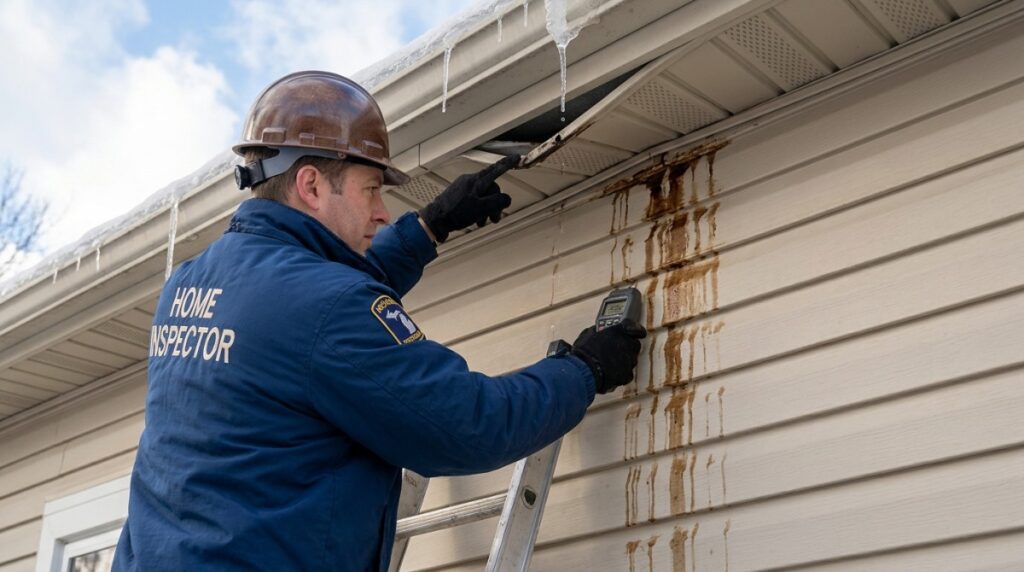
It is late winter, and I am standing at the corner of a house, looking up at the eave. Brown streaks run down the siding from the soffit. The gutter is bent and half full of ice. The homeowner tells me it started as a little icicle.
I look at the soffit first. Then I look at the snow line on the roof. The stain on the wall is only the messenger.
Ice dams stain exterior walls when meltwater backs up under the roof edge and runs into the soffit and the wall. The fix starts with the heat loss in the attic and the damage at the roof edge. Then you check for wet materials, and only after that do you clean, prime, and refinish the wall.
The Short Answer
Ice dams stain exterior walls because meltwater backs up under the roof edge, seeps into the soffit and wall, and carries tannins and rust out onto the siding. The lasting fix is attic air sealing and insulation. After that, repair wet materials, then clean, prime, and refinish the wall.
That order matters. If you refinish first, the stains come back with the next thaw.
Quick Diagnosis: Reading the Stains
The pattern of a stain tells a story. My rule on every estimate is to read where the stain starts before touching anything.
| Where the stain is | What it usually means | Next step |
|---|---|---|
| Streaks starting at the soffit and running down | Water coming through the roof edge | Check the attic and the roof edge |
| Brown staining on siding laps below the eave | Water traveling behind the siding | Look for wet sheathing |
| Rust dots at nail heads | Fasteners rusting where water has run | Note it, then check for moisture |
| Stains on a gable end or in random spots | Moisture moving through the wall | Look inside and check for other sources |
| Peeling paint under the eave | Repeated wetting at the roof edge | Scrape later, fix the water first |
| Soft or swollen fascia or soffit | Wood has stayed wet | Probe it and plan repair |
| Ceiling marks inside near the wall | Water has come inside | Check the attic and talk to your insurer |
| Green or dark growth on the wall | Algae or mildew, a different problem | Treat the moisture, then clean |
Here is how that reads in the field. Streaks that start at the soffit and run straight down point to roof edge water. Stains on a gable end or in scattered spots may be moisture moving through the wall itself. The pattern tells the story.
Ice dam stain versus condensation stain
Not every winter stain is an ice dam. A siding article from HomesMSP explains that stains can form when water moves through wood sheathing and pulls out tannins on its way. It also separates ice dam stains from condensation stains. Humidity inside the house and poor ventilation can cause winter wall stains too. If your stains do not line up with the roof edge, ask about indoor humidity and ventilation as well.
Why Ice Dams Stain Walls
The cycle starts inside the house. Heat escapes from the living space into the attic and warms the roof deck. Snow on the roof melts. The meltwater runs down to the colder eave, where it refreezes. Ice builds up into a dam. Water behind the dam has nowhere to go but under the shingles.
Michigan State University Extension describes the root cause as heat leaving the home and melting snow on the roof. The State of Michigan’s MI Ready page says the same, that heat escaping into the attic warms it above freezing, snow melts and runs to the cold eaves and gutters, then refreezes after repeated cycles and builds into a dam. Water can then back up under the shingles.
On a cold morning you can sometimes see it from the yard. Snow melted off the roof over the living space, and thick snow and ice sitting at the edges. That picture is the heat loss cycle.
Tannins and rust: why the stains are brown
Wood contains tannins. When water passes through wood, it can pick them up and carry them out to the surface. Rust comes from fasteners and metal parts the water touches. That is why the stains look brown or orange and why they run in streaks.
Where the water goes: soffit, fascia, sheathing, behind siding
Meltwater that gets past the roof edge can wet the soffit and fascia. From there it can run down inside the wall cavity or behind the siding, soak the sheathing, and show up on the face of the wall far below where it entered. That is why the stain can sit a few feet away from the leak.
Michigan Winters and Ice Dams
Michigan gives ice dams a lot to work with. We get big temperature swings, lake effect snow, heavy snow loads, and long thaws followed by hard freezes. Many older homes here have thin attic insulation and air leaks at the ceiling.
A cold snap is different from a thaw. During a thaw, snow melts, runs, and refreezes at the eave as soon as the temperature drops. That swing is when dams grow.
Livingston County, Southeast Michigan, Ann Arbor, and Grand Rapids all see it. Traverse City and the Lake Michigan coastline carry some of the heaviest snow in the state. I will not quote local statistics, because I would rather not guess, but the pattern holds across the lower peninsula.
What to Do Right Now
You do not need a ladder for most of this. In fact, please stay off icy roofs.
Step 1. Take dated photos and note where stains start
Photograph the stains from the ground. Write down where each streak begins. That information will help any contractor you call.
Step 2. Check inside
Look at ceilings and the top of walls for stains. In the attic, look for damp or stained insulation, frost on the underside of the roof deck, and daylight at the eaves. Daylight where it should not be means air is moving.
Step 3. Keep snow load down from the ground
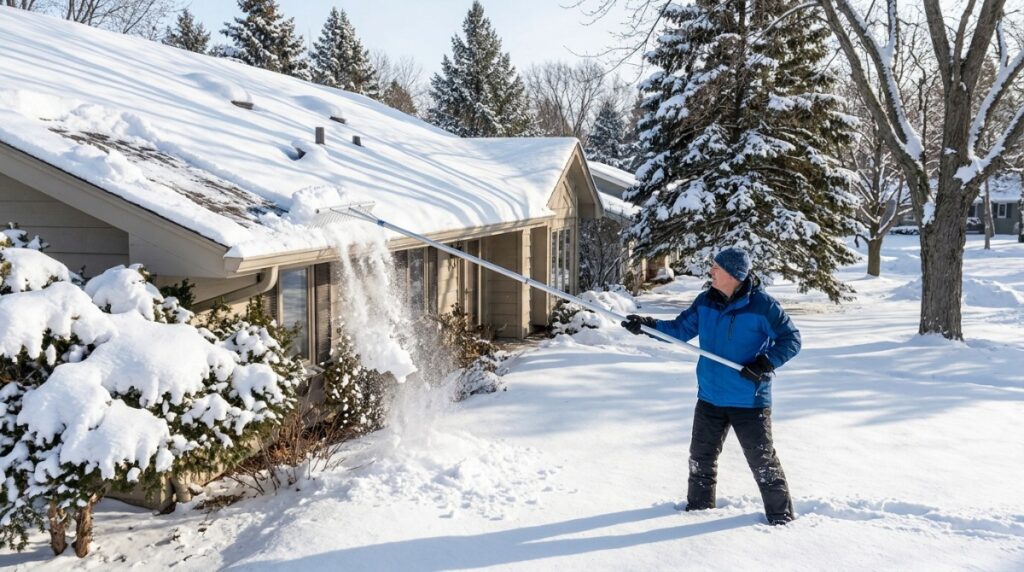
A long handled roof rake, used from the ground, helps lower the risk and the roof load. The MI Ready page recommends it. Do not climb up to do it.
Step 4. For an existing dam, call a professional
Sources disagree about quick fixes. One West Michigan news piece describes calcium chloride in a stocking laid across the dam. A Boston Globe article quotes a removal pro who calls steam the safest approach and warns against salt. Because experts do not agree, I recommend the lower risk path. Use the roof rake from the ground and call a professional who uses steam or another gentle method.
Step 5. Dry the area and keep gutters clear after the thaw
Once it warms up, clear the gutters and downspouts so meltwater can drain. Let wet areas dry before you do anything else to them.
Step 6. Tell your insurer if there is interior water damage
If water has come inside, contact your insurance company and ask what your policy covers. This is general information, not insurance or legal advice.
If you are not sure who to call first, you can book a 5 minute call. We will look at the stained wall with you and tell you whether you need an insulation contractor, a roofer, or us.
What Not To Do
- Do not chip ice with a hammer or a metal tool. It damages shingles, gutters, and siding.
- Do not climb onto an icy roof. No stain is worth that.
- Do not paint over wet or stained wood and call it fixed. The stain bleeds through and the cause is still there.
- Do not caulk shut the soffit or block the vents. The attic needs to breathe.
- Do not treat heat cables as the only fix. They can help water find a path, but they treat the symptom.
I think about one homeowner who took a hammer to the ice at the eave. He did get ice off. He also cracked shingles and left dents in the aluminum trim. When our crew got there in spring, the fascia behind the damage was already soft. I told him what I tell everyone. Gentle methods cost more patience, but they cost far less than repairs.
The Real Fix: Attic Air Sealing and Insulation
This is where the lasting solution is. It is not our trade, and I want to say so clearly.
Michigan State University Extension says the answer is almost always a combination of improved insulation and air sealing in the attic. The idea is to keep the heat in the house and out of the roof deck. Seal the air leaks from the living space into the attic first. Add insulation, especially near the roof edge, where it is often thin. Then make sure the attic is vented from soffit to ridge.
The MI Ready page recommends insulation of at least R-30 in the attic, with R-38 preferable in northern climates, and airflow from the soffit vents through the attic and out the roof vents. It also suggests talking to a reputable roofing or insulation contractor.
Pacific Northwest National Laboratory puts air sealing first and notes that ventilation alone is not enough. I agree with that order.
An insulation contractor or an energy auditor handles this work. Get quotes from licensed contractors. Thin insulation near the roof edge is the weak point I see most often.
A Practical Example: From Stained Eaves to Finished Walls
Here is how a good job runs.
An insulation contractor air seals the attic and adds insulation. A roofer repairs the damaged roof edge. Then we come in.
Our crew inspects the wall and the trim. We replace rotted trim where it needs it. We clean the siding and scrape loose paint. We caulk open joints. Where stains remain, we treat them with a stain blocking primer. Then we prime the whole area and apply the finish coat.
We follow our coating process from inspection to final walkthrough. The key is the order. Heat loss first. Roof edge second. Wet materials third. Refinishing last.
Clean, Repair, Recoat, or Replace: How to Decide
| Condition | Best move |
|---|---|
| Light staining on sound siding | Clean, prime, and refinish |
| Peeling paint over dry, solid wood | Scrape, prime, and coat |
| Soft or swollen trim, fascia, or soffit | Repair or replace first |
| Wet sheathing or framing | Remediation by a qualified contractor |
| Vinyl with warped panels | Panel replacement may be needed |
If you find soft trim or fascia, that is a separate repair, and a carpenter or roofer usually comes before a painter.
Where a Ceramic Elastomeric Coating Fits (and Where It Doesn’t)
I want to be clear. Rhino Shield does not stop ice dams. It does not repair a roof, insulation, or wet framing.
After the attic and the roof are fixed and the wall is dry and sound, it provides a flexible, breathable, water resistant finish. Rhino Shield is a ceramic based acrylic elastomeric coating, and it goes on over surfaces we have prepared, with full area priming. See our substrate and repairs page for how we handle damaged areas.
It is not the answer when there is an active leak, wet sheathing, rotted fascia that has not been replaced, or an attic that will cause the same problem next winter.
The 25-year No Chip, Crack, or Peel warranty covers chipping, cracking, and peeling under its written terms. It does not cover ice dam damage, leaks, rot, or staining.
Cost and Timing in Michigan
Air sealing and insulation costs vary a lot from home to home, so I will not guess. Get quotes from licensed contractors. Roof edge and trim repairs depend on the scope.
For the coating, see our pricing page. Rhino Shield runs about 2 to 2.5 times the cost of a traditional paint job, and it is built to last far longer between repaints.
Timing helps. If you can, schedule attic work in the off season. Schedule exterior refinishing in warm, dry months. Wood has to be dry before it is primed.
Frequently Asked Questions
What do brown stains below my roof edge mean?
They usually mean water has come through or behind the roof edge and carried tannins and rust onto the siding. Meltwater from an ice dam is a common cause in Michigan.
Can I paint over ice dam stains?
Not by themselves. The stains can bleed through, and the cause remains. Fix the heat loss and any leaks first, then use a stain blocking primer and refinish.
Is it safe to chip ice off my roof?
No. Chipping can damage shingles and trim, and an icy roof is dangerous. Use a roof rake from the ground and call a professional for an existing dam.
Do heat cables or salt solve ice dams?
Sources disagree on salt, and cables treat the symptom. Insulation and air sealing in the attic are the lasting fix. For now, use a roof rake from the ground and a professional for removal.
How do I stop ice dams from coming back?
Seal air leaks into the attic, add insulation, and make sure the attic is vented from soffit to ridge. MI Ready suggests at least R-30 insulation, and R-38 in northern climates. Keep gutters clear.
How do I know if water got into my walls?
Look for stains inside on ceilings and wall tops, damp insulation in the attic, soft fascia or soffit, and peeling paint under the eave. A professional can test for moisture.
Will a coating cover or prevent ice dam damage?
No coating stops ice dams or repairs a roof. A coating protects a sound wall once the cause is fixed.
Does homeowners insurance cover ice dam damage?
Policies vary. Check your policy and talk to your agent. This is general information, not insurance or legal advice.
Stains on Your Walls After Winter? Call Us
If you have stains under your eaves, you do not have to guess what they mean. Schedule a free estimate and we will look at the wall and the roof edge and tell you honestly who should come first. Sometimes the first call is an insulation or roofing contractor. We will say so. Get opinions from licensed contractors for any roof or attic work.
Call us at 810-360-6583. We are a family owned, BBB accredited A+ business with MI License #2102200455, and you can see our 4.8 star rating on our Google Business Profile.
We serve Brighton, Livingston County, Southeast Michigan, Ann Arbor, Grand Rapids and many other communities. See the full list on our areas we serve page.