
By Marc Mercier, owner of Rhino Shield of Michigan, Brighton, MI. Family owned, 25+ years in home improvement.
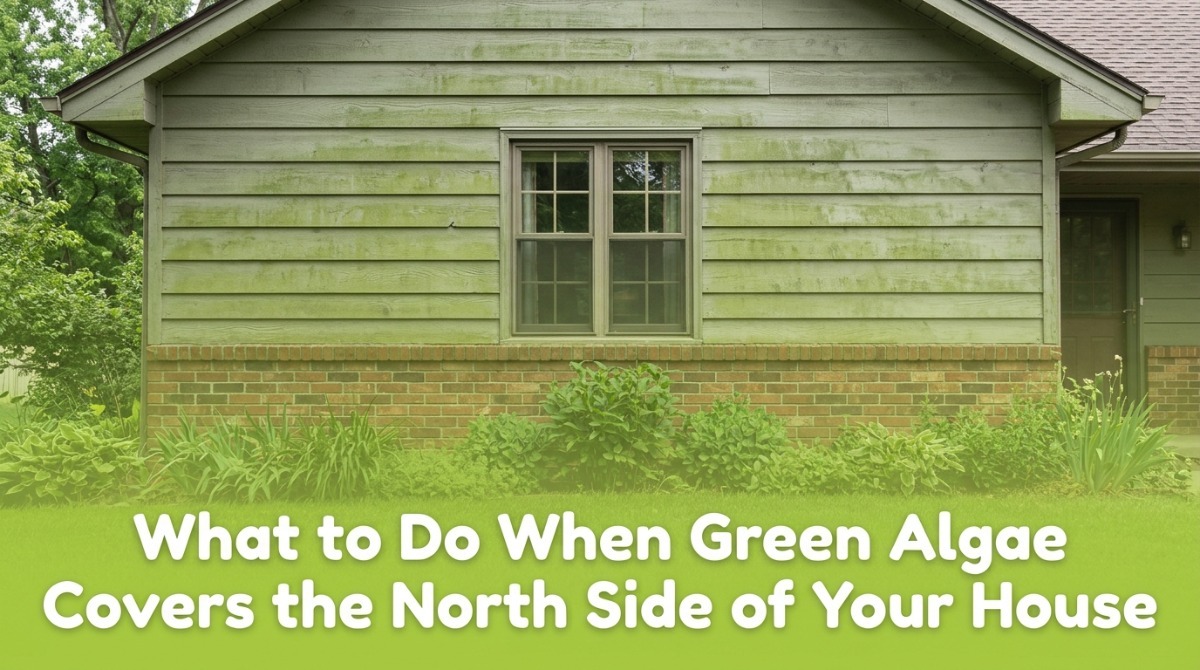
I am standing at the north corner of a house on an inspection. The south and west walls look fine. The north wall has a green film across the bottom third and along the lap lines. The homeowner says she washed it last year.
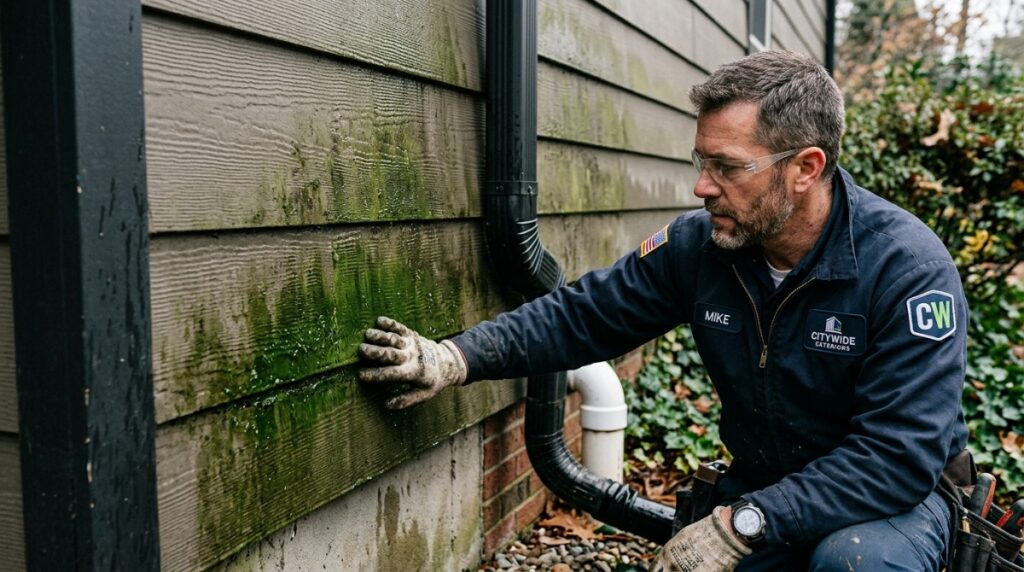
I run a hand across it. Then I look up at the gutter and the tree. Those are the first two things I check, before I think about any product.
Green algae on the north side of the house is almost always algae feeding on a wall that stays wet. Fix the water sources, clean the wall gently, let it dry, and only then decide whether a protective coating makes sense. I have looked at this on Michigan homes for years.
The Short Answer
Green algae grows on the north side because that wall gets little direct sun, so rain and dew stay on the surface longer. Dirt and pollen feed it. To fix it, correct water sources like gutters, wash gently with a soft brush, let the wall dry, then protect it.
Most walls need a wash and a gutter fix, not a new coating.
Quick Diagnosis: What Is That Green Stuff?
Not every stain on a north wall is algae. Look at the color, the texture and the location.
| What you see | What it likely is | First step |
|---|---|---|
| Slick green film | Algae | Wash gently and fix the water source |
| Powdery green on the shaded lower wall | Algae with dust and pollen | Wash gently and let it dry |
| Black or dark spots | Mildew or mold | Wash carefully with protection |
| Orange or rust streaks | Rust from a fastener or metal | Find the source of the rust |
| Brown streaks below the roof edge | Runoff, tannins or a gutter issue | Check the gutter and roof edge |
| White crust on masonry | Salts, not algae | See the note below |
Eyes cannot always tell algae from mold. InspectApedia notes that algae and mold are often hard to tell apart by sight, and that gutters spilling onto a wall and missing wall insulation can feed the same stains. You can read its page on algae and mold stains on exteriors. So treat any growth with care, whatever you call it.
The wipe test
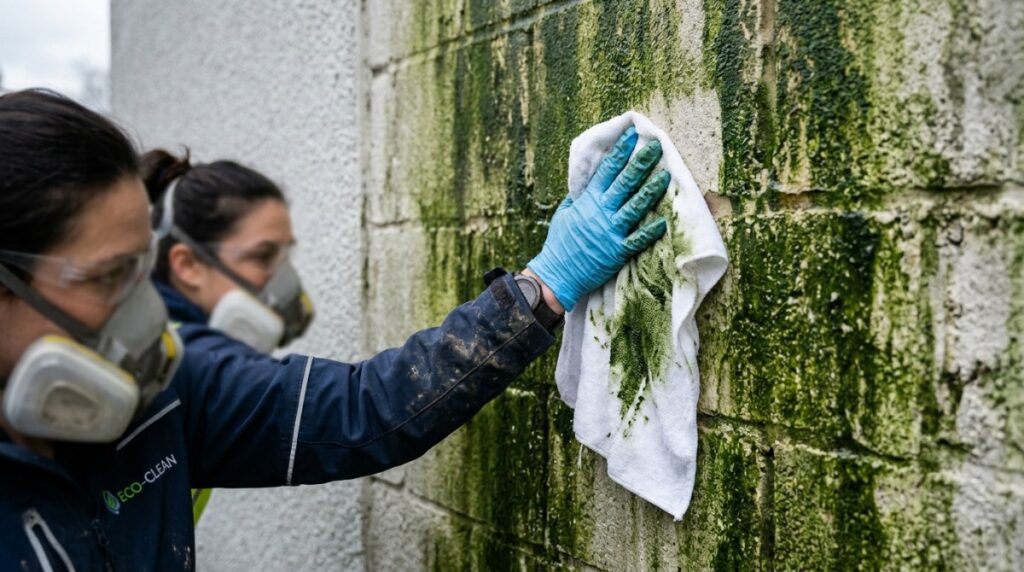
A crew member wipes a patch with a damp cloth. Slick green that comes off on the cloth is usually algae. A dark spotted pattern that does not wipe off points to mildew or mold and needs more care. It takes a minute, and it tells you how gentle to be.
Algae, mildew and mold in plain English
Algae is a green, slimy film that loves water and shade. Mildew is a flat, often dark growth that shows up on damp surfaces. Mold is a broader word for fungal growth. All three need moisture and something to feed on.
When it is not algae at all
White crust on brick, block or stucco is usually salt, not algae. That is a different problem with a different fix. I will cover it in a separate post on white deposits on brick once it is published. Rust streaks and brown tannin stains also need their own handling.
Why It Grows on the North Side in Michigan
Algae needs three things: spores, food and moisture. The spores are everywhere in the air. Food is dirt, pollen and tree debris. Moisture is what you can change.
Shade and slow drying
Ask the Builder explains the spores, food and moisture model and notes that a wall with no direct sun stays damp longer. Our crews see the same thing. The green stops right where the sun reaches. A north wall has no morning sun to dry it, so the surface film never fully dries out.
On inspection, I find the growth is heaviest below a downspout or a hedge. That teaches me the root cause is moisture, not neglect. The homeowner is usually doing the right things. The wall just stays wet.
Michigan seasons
Michigan has a wet spring, long damp shoulder seasons and snow that sits against north walls into March. Near Grand Rapids and the Lake Michigan coastline, lake effect moisture adds more. In Southeast Michigan and Ann Arbor, mature trees block what little sun the north side gets.
Food on the wall
Dirt, pollen, tree debris and old chalky paint all feed growth. A wall with a worn finish holds more of it than a smooth, sound one.
Water you are adding
Gutters that overflow, downspouts that dump against the wall, sprinklers that spray the siding and shrubs pressed against it all add water. Those are the parts you can fix this weekend.
What a damp wall feels like
Our crews use a simple habit. They put a hand flat on the north wall at 8 a.m. and again at 2 p.m. In the morning the siding feels cool and slightly clammy. By afternoon it may be dry, or it may not be. If it is still damp at 2 p.m. two days after a rain, that wall is holding water.
You can do the same on your own house. It costs nothing, and it tells you whether you are fighting a surface film or a wet wall.
What to Do Right Now
Step 1. Fix the water first
Look at gutters, downspouts, grade and sprinklers. Trim back shrubs and low branches so air can move. Clean the gutters and extend downspouts away from the wall. These steps cost little and often make the biggest difference.
Step 2. Test a hidden spot
Pick a small area that is out of sight. Try your cleaner there first. Wait, rinse and look. This is especially important on thin vinyl and aluminum.
Step 3. Wash gently
Use a soft brush and a cleaner suited to your siding. An oxygen based cleaner or a mild detergent solution is a sensible start. Let it sit for the time the label says, scrub lightly, and rinse from the top down at low pressure. Protect plants, wear eye protection, and take care on ladders.
Step 4. Rinse downward and let the wall dry fully
Do not rush this. A wall that is still damp will grow again sooner.
Step 5. Look at what the cleaning revealed
A clean wall shows things the green was hiding. Look for failed caulk, chalky paint and bare wood. Those are the next things to deal with, and they are easy to miss from the yard.
If you would rather have someone look at the wall first, we are glad to. You can book a quick 5 minute call.
What Not to Do
- Do not pressure wash at close range or upward under the laps. Water gets behind the siding. See whether pressure washing can damage exterior paint.
- Do not mix chlorine bleach with ammonia or acids. That is a general safety fact, and it can make dangerous fumes.
- Do not let runoff soak plants.
- Do not paint over a film. Paint over algae fails.
- Do not scrub aluminum or thin vinyl hard.
Here is the shape of a story we have seen. A wall was blasted with a pressure washer. It looked clean at first. Later, when our crew pulled a piece of trim, we found water staining on the inside edge and wet sheathing behind a lap. I told the homeowner what I will tell you: gentle cleaning matters, because water can end up where you cannot see it.
A Practical Example: One Damp North Wall, Start to Finish
Here is how we handle a chronically damp wall.
First, the crew checks gutters and grade. If water is landing on the wall, that gets fixed or flagged before anything else. Then we clean. This is step two of our process, so we do it on nearly every project.
After cleaning, we let the wall dry for a day or more. We do not coat a wet wall. Then we patch and caulk. This is where the cleaning often reveals what the green was hiding: old caulk failures, chalky paint and raw wood at the bottom of the wall.
Next comes priming, and then the finish coat. Throughout the process, our crew leader checks the work. You can see each step in our 11 step coating process.
At the bottom of the wall, the crew finds things the homeowner could not see from the yard. Soft spots. Open seams. Splash marks where soil and water hit the lowest courses.
The lesson is why cleaning alone never held. Without drying, repairs and protection, the same conditions bring the same green back.
Clean, Recoat or Replace: How to Decide
| Wall condition | Best move | Why |
|---|---|---|
| Sound surface with a light film | Clean and maintain | The wall is fine and just needs a wash |
| Chalking or flaking paint with algae | Clean, repair and recoat | The finish is worn and holds growth |
| Soft or rotted wood | Repair or replace first | A coating cannot fix damaged wood |
| Failing vinyl or warped panels | Replacement may be better | Gauge and condition decide |
Our page on substrate and repairs explains how we prepare each surface before coating.
Where a Ceramic Elastomeric Coating Fits, and Where It Does Not
Let me say this plainly. Rhino Shield is a coating, not a cure for a damp wall.
Fix the gutters, grade and trees first. After that, a breathable, water resistant coating that resists mold, mildew and algae can help a chronically damp wall stay cleaner longer. It will not make shade disappear. You can read more about what Rhino Shield is.
The 25 year “No Chip, Crack, or Peel” limited warranty covers chipping, cracking and peeling, and our website lists flaking too, under written terms. It does not cover algae or staining. See the 25 year warranty page.
When is it not the answer? A healthy, recently painted wall with a light film just needs a wash. I will tell you that at the front door.
How the substrate changes the cleaning
Not every wall takes the same treatment. Painted wood and fiber cement such as Hardie Plank handle a soft brush and a gentle cleaner well. Brick and stucco are porous, so they hold algae in the surface and need low pressure. Thin vinyl and aluminum need the lightest hand of all, because hard scrubbing can scratch or dent them. When in doubt, go gentler and test first.
Cost and Timing in Michigan
Cleaning your own wall costs little. Professional washing varies with house size and access, so I will keep that general.
For a full coating, a typical 3 bedroom home with about 2,000 square feet of wall area runs roughly $13,000 to $18,000. That is about 2 to 2.5 times a traditional paint job, which usually costs $5,000 to $9,000 and needs repeating every 5 to 7 years. See our pricing page for more.
Cleaning works best in the warm, dry stretch from late spring through early fall. Coating needs consistent temperatures and dry surfaces, so most exterior work is scheduled in the warm months.
Frequently Asked Questions
Is green algae on siding harmful to my house?
It is mostly cosmetic at first. A chronically wet film can hold moisture against the wall and hide paint failure underneath, so it is worth dealing with.
Can I use bleach to remove algae from siding?
You can, but be careful. Dilute it, protect plants, and never mix it with ammonia or acids. An oxygen based cleaner is often a safer place to start. Test a hidden spot first.
Will pressure washing damage my siding?
It can. High pressure or spraying upward can force water behind the laps. Use a soft brush and low pressure.
How often should I clean the north side of my house?
It depends on shade and moisture. Fixing the water source matters more than any schedule.
Can I paint over algae?
No. Clean it off, let the wall dry, and then paint.
Does algae mean there is water inside my wall?
Not usually. Most of the time it is surface moisture. If siding is soft or inside walls smell damp, get an inspection.
Will a coating stop algae from coming back?
A coating can help resist growth. Shade and moisture still matter, and the warranty does not cover algae.
How do I know if the green stuff is mold?
You often cannot tell by looking. Treat it carefully either way, and use the wipe test as a guide.
Talk to Us About Your Wall
If green algae covers the north side of your house, you do not have to guess what to do. Schedule a free estimate or a 5 minute discovery call. Sometimes the honest answer is a good wash and a gutter fix, and I will tell you so.
Call us at 810-360-6583. We are a family owned, BBB accredited A+ business in Brighton with MI License #2102200455, and you can see our 4.8 star rating on our Google Business Profile.
We serve Brighton, Livingston County, Ann Arbor, Grand Rapids, Traverse City and many other communities. See the full list on our areas we serve page.