
By Marc Mercier, owner of Rhino Shield of Michigan. Family owned, 25+ years in home improvement.
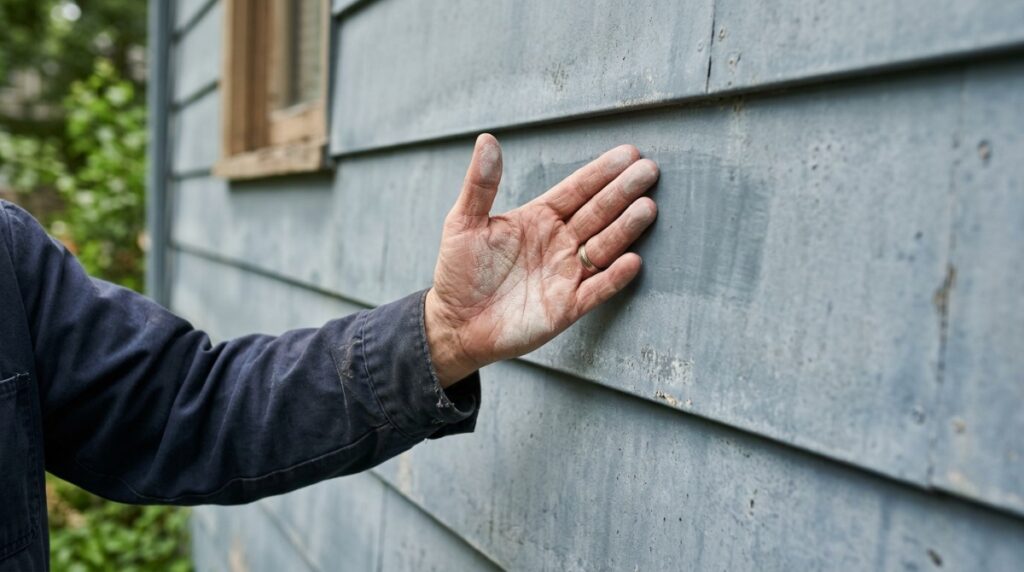
A homeowner meets us at the front of a mid-century house. She runs her hand along the wall to show us the problem and comes away with a pale smear on her palm. A lot of the people who call us do exactly this.
I tell them what I usually say in the first 30 seconds. When aluminum siding leaves chalk on your hands, the factory finish is wearing out at the surface. It is almost always fixable. The question is what is underneath.
The powder is usually cosmetic. Wash it all off, test again, repair any damage, then prime and recoat if the metal is sound.
The Short Answer
Aluminum siding leaves chalk because the baked-on factory finish breaks down from sun and weather. It is usually cosmetic. Wash all the powder off, check the metal for dents, pits and loose panels, then prime and recoat sound siding. Paint will not stick to powder. Replace only badly damaged panels.
Quick Diagnosis: How Bad Is Your Chalk?
Try the hand test first. Rub a dry palm or a dark cloth on a shaded area of the wall. Then rub a sun facing area. Compare what comes off.
Do it on more than one spot. On one house, our crew rubbed three patches on a single wall: under an eave, mid-wall and near the ground. Each one gave a different result. You have to judge the whole house, not one spot.
| What you see | What it likely means | Usual next step |
|---|---|---|
| Light dust on a dry palm, color still visible | Surface chalking | Wash, then decide on a sealer or recoat |
| Heavy powder, faded color, streaks below windows | Advanced oxidation | Wash, test again, prime and recoat |
| Bubbling, flaking, pitting or bare gray metal | Finish failure or corrosion | Repair or replace panels first |
| Powder plus dents, loose panels or open seams | A siding problem beyond the finish | Repairs come before coating |
If you would rather have someone look at it, our crew will do the hand test with you and tell you plainly what they see. No pressure. You can book a quick 5 minute call.
Why Aluminum Siding Turns to Powder in Michigan
UV and the factory finish
Aluminum siding usually has a baked-on enamel finish. Sunlight slowly breaks down the resin that holds the pigment. Once that happens, the color comes loose as powder. Darker colors tend to chalk faster.
South and west walls versus north walls
Our crews feel the difference in their hands. On the shaded side of a house the surface is smooth and the finish is intact. On the south wall the same hand comes away pale.
Sun exposure drives the chalk. That is why one wall can look fine while the next one smears.
Chalk color often matches the siding color. White siding gives a white powder. A green or tan house gives a tinted one. When the powder on your hand matches your wall, you are looking at the finish itself, not at something that landed on it.
South and west walls get the longest hours of direct sun in Southeast Michigan. In July those walls run hot, and then they cool fast at night. That daily swing adds to the wear. North walls stay cooler and damper, so they hold dirt and algae more than chalk. Both can look bad, but they need different handling.
Rain runoff and Michigan weather
Rain carries loose pigment down the wall. That is why you see white or colored streaks below windows and seams.
I do not say that freeze-thaw causes chalking. What I will say is that Michigan’s temperature swings add stress to a finish that is already thinning from the sun.
Age
Many homes in Royal Oak, Berkley, Grosse Pointe, Ann Arbor and Lansing still wear siding that is decades old. A finish has a lifespan, like any coating.
Older aluminum was often repainted once or twice over the years. Each repaint adds another layer that can chalk, peel or hold dirt. When we see heavy chalk on an older house, we ask what was done to it before. Sometimes the answer is nothing. Sometimes there is a layer of paint that was put over powder, and that layer is now lifting. The history of the wall changes how we prep it.
The siding itself is rarely the problem. Aluminum does not rot like wood. It can dent and it can corrode in rare spots, but the metal underneath a chalky finish is often in good shape. That is why a careful inspection matters before anyone talks about replacement.
Is the Chalk Dangerous or a Sign of Rot?
Chalk itself is weathered paint film. It is a cosmetic problem. Still, wash your hands after touching it, and keep children and pets from rubbing against it.
What is not cosmetic: pits, bubbling, flaking, and bare metal that is gray or white and crusty. Those point to a failing finish or corrosion.
Moisture behind the siding is a separate question worth checking. Look at gutters, flashing and leaks. A coating cannot fix a water source.
What To Do Right Now
- Do the hand test on several walls.
- Photograph the chalk and any damage.
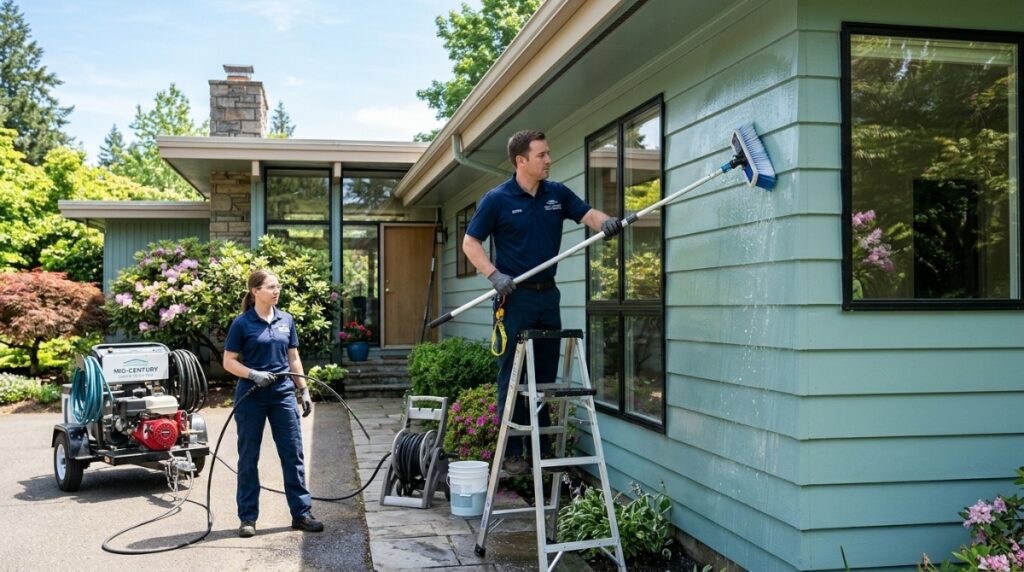
- Wash a test patch. Use a mild detergent solution and a soft brush. Rinse, let it dry, then rub again. If powder keeps coming up, a stronger prep is needed.
- If you use a pressure washer, keep it low. Use a wide tip and angle it down so water does not get behind the laps. Competitors suggest staying under about 1,500 PSI. Treat that as general guidance, because a crew’s judgment matters. See can pressure washing damage exterior paint.
- Look at gutters, downspouts and window flashing.
- If the house was built before 1978, do not scrape or sand painted surfaces yourself. The EPA Renovation, Repair and Painting program requires lead safe work practices for paid work in older homes.
- Call for an inspection if you are unsure.
What Not To Do
- Do not paint straight over chalk. The paint bonds to the powder and peels.
- Do not use oil-based paint on aluminum. Metal expands and contracts with temperature.
- Do not blast with high pressure or hold the tip close to the siding.
- Do not skip primer. Aluminum is slick, and powder leaves a poor surface.
- Do not mix bleach with ammonia-based cleaners or vinegar.
- Do not paint in direct hot sun.
- Do not hide dented or loose panels under new color.
- Do not rely on a “chalk sealer” without checking the product label and warranty.
A Practical Example: From First Wash to Final Inspection
Here is how our crew works through a chalky aluminum house.
We start with an inspection and a production plan. Then we wash. The runoff tells a story. Clean water means the chalk is coming off. Some spots show bare metal gleaming under the first rinse. Powder lifts off in sheets under a soft brush.
Then we stop and look. We usually find a few dented lower panels from lawn equipment or snow shovels, and some seams that have opened. We point these out to the homeowner and explain what a coating can and cannot hide.
The homeowner feels relief when we say the siding is salvageable. Then respect, when we say which panels are not.
After the repairs we caulk the seams, mask, and prime the full area. The finish coat goes on, followed by touch ups, cleanup and a final inspection with the crew leader. You can see the full list on our 11 step coating process page.
The lesson is the order. Wash, test, repair, then coat.
A few details are worth passing on. We keep the wash at low pressure and angle it down, so water does not get behind the laps. We rub-test again after the wall dries, because a wall that looked clean when wet can still give up powder. If it does, we wash again. We would rather repeat a step than coat over a surface that is not ready.
We also walk the house with the homeowner before we coat. We show them every dent, every open seam and every loose panel we found. Nothing gets hidden under new color. That conversation is often what people remember most, because they expected a sales pitch and got a list of what is real.
Repair, Recoat or Replace: How to Decide
| Option | When it fits |
|---|---|
| Wash and seal | Color is still good and chalk is light |
| Recoat | Metal is sound and chalk is moderate to heavy |
| Replace | Panels are dented, pitted, bowed or loose across large areas |
Houses with aluminum siding and wood trim need trim rot repaired first. Our page on substrate and repairs shows how we handle that.
Sellers sometimes ask whether to recoat before listing. If the metal is sound, a recoat can improve curb appeal at a lower cost than new siding.
Where a Ceramic Elastomeric Coating Fits, and Where It Does Not
Rhino Shield is a ceramic based acrylic elastomeric coating. It is flexible and breathable. It resists mold, mildew and algae and reflects UV. On metal, it goes on after the wash and a rust-inhibiting primer.
We inspect aluminum case by case. We do not promise results before we see the siding.
It is not the answer when panels are heavily damaged, when there is an active leak, or when an owner simply wants a quick color refresh and a cheaper approach is enough. I would rather say that now than after you have paid.
The 25 year “No Chip, Crack, or Peel” limited warranty is written, transferable and not prorated. It covers chipping, cracking and peeling, and our website lists flaking, under its written terms. The written copy comes after completion and final payment. It does not cover chalking, fading or corrosion. We do not promise warranty coverage on aluminum without an inspection. Read the terms on our 25 year warranty page.
For a broader look at siding materials, Wikipedia’s overview of cladding covers the main types.
A time we advised against coating
A homeowner once asked us to coat a wall that had a slow leak above a window. The siding looked chalky, but the real problem was water getting behind it. We told them to have the flashing fixed first and call us after. A coating would have made the wall look better for a season while the leak kept going.
That is the kind of answer a family business should give. It costs us a job today and earns trust later.
Cost and Timing in Michigan
A coating system typically costs about 2 to 2.5 times a traditional paint job. For a typical 3 bedroom home with about 2,000 square feet of wall area, that is roughly $13,000 to $18,000. Latex runs about $5,000 to $9,000 and needs repeating every 5 to 7 years.
Aluminum jobs are quoted after inspection. Our website currently advertises up to 25% off and 0% financing. Confirm the terms in your written estimate.
See our pricing page and how much Rhino Shield costs in Michigan.
The exterior season runs roughly spring to early fall. Wash and dry time matters, and cold nights limit coating work. The crew checks temperature and moisture before coating.
Frequently Asked Questions
Why does my aluminum siding leave chalk on my hands?
The baked-on factory finish has oxidized from sun and weather. The powder is the pigment coming loose.
Can you paint over chalky aluminum siding?
Not without washing and priming. Paint over powder will not bond.
Do I need to replace chalky aluminum siding?
Usually not. Replace only panels that are dented, pitted, bowed or loose.
Is it safe to pressure wash aluminum siding?
Use low pressure, a wide tip and a careful downward angle so water does not get behind the laps.
Should I prime aluminum siding?
Yes, almost always. Aluminum is slick and powder leaves a poor surface.
How long does a repaint last?
It depends on prep and product. We avoid quoting numbers we cannot back up. Ask for any estimate in writing.
Could my older home have lead paint under the siding?
Possibly, if it was built before 1978. See the EPA rule above before scraping or sanding.
Does your coating cover aluminum siding?
We coat metal after a rust-inhibiting primer. We assess aluminum by inspection.
Ready to Look at Your Siding?
If aluminum siding leaves chalk on your hands, you do not have to guess what comes next. Schedule a free estimate or a 5 minute discovery call. We will give you an honest look, even if the right answer is to repair or replace.
Call us at 810-360-6583. We are a family owned, BBB accredited A+ business in Brighton with MI License #2102200455, and you can see our 4.8 star rating on our Google Business Profile.
We serve Brighton, Livingston County, Southeast Michigan, Ann Arbor, Lansing and Grand Rapids. See the full list on our areas we serve page.