
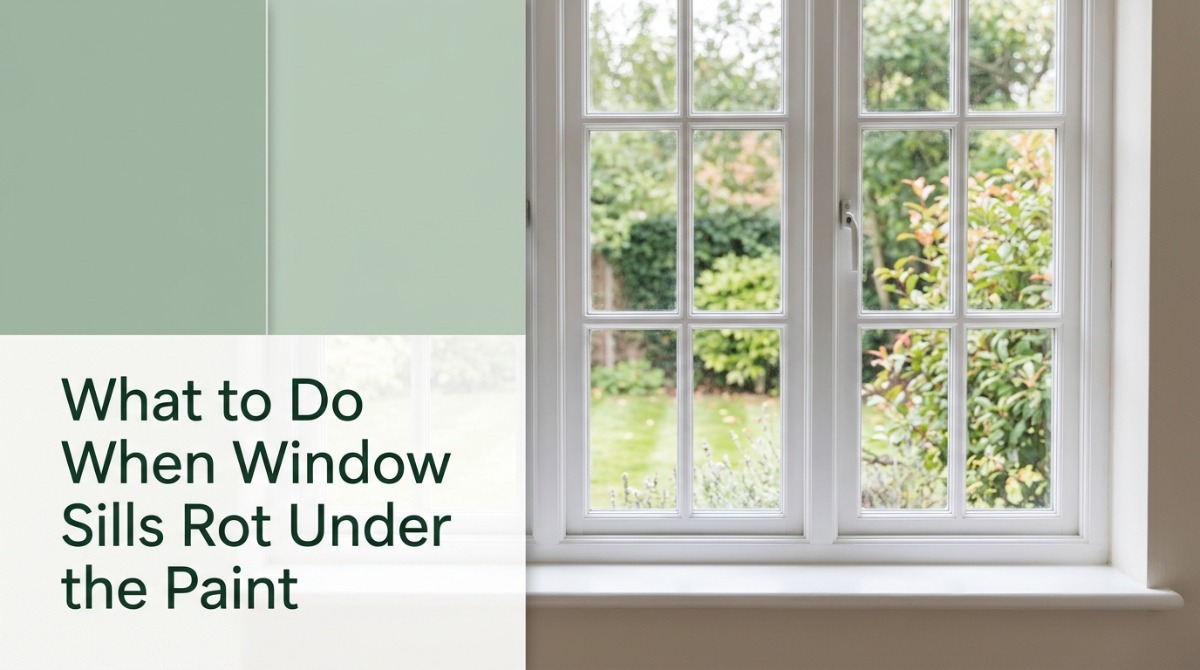
On a recent estimate, one of our crew leaders stopped at a front window. The sill looked smooth and freshly painted. He pressed his thumb into the front edge, and it gave.
The homeowner said they had painted it the year before. So the crew leader slid a putty knife along the joint where the sill meets the frame. Under the paint was a gap. Water had been getting in there, quietly, for a long time.
That’s how window sills rot under the paint. The surface looks fine while the wood underneath goes soft.
If you’re dealing with this, here is the short version. Probe the sill and the frame to learn how far the rot goes. Find the water path, whether that’s joints, caulk, flashing, slope, gutters or condensation. Repair small damage or replace the sill. Then caulk, prime and recoat. Don’t just repaint.
I’m Marc Mercier. My wife Sheryl and I run Rhino Shield of Michigan in Brighton, and our crews check a lot of window sills every season. Here is what we look for and how we decide what a sill needs.
The Short Answer: What to Do When Window Sills Rot Under the Paint
What should you do when a window sill is rotting under the paint?
Probe the sill, ends and frame to see how deep the rot goes. Fix the water path, such as failed caulk, flashing or poor slope. Fill very small soft spots with exterior epoxy, but replace the sill if the damage is broad. Never paint over soft wood. Prime and recoat when dry.
The sill is usually the first place a window shows trouble. It’s not always the only place.
Quick Diagnosis: Is It Only the Sill?
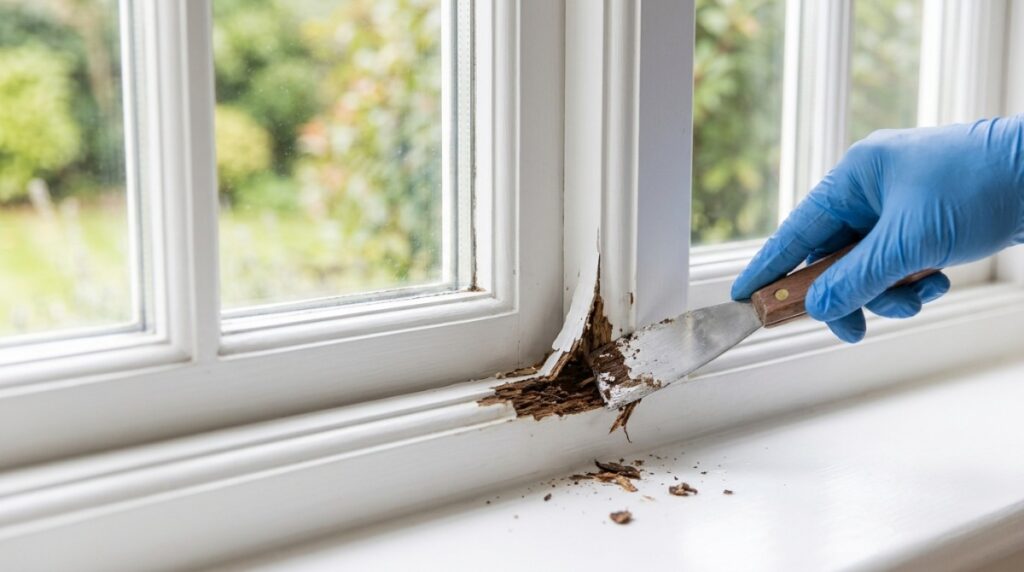
Our crews start with a thumb press along the front edge. Then they probe the ends, the corners and the joint with the frame. They also look inside the house, because interior stains tell you a lot.
Here is how to read what you find:
| What you see | What it means | Next step |
|---|---|---|
| Paint bubbling or cracking, wood firm | Moisture is getting under the paint | Find the water path, dry, prime and recoat |
| Soft front edge | Early rot where water sits and drips | Cut back and fill if small, replace if broad |
| Soft ends or corners where sill meets casing | Water entering at the joints | Check caulk and flashing, repair or replace |
| Sill with no slope or standing water after rain | Sill can’t shed water | Replace or rebuild the slope |
| Dark staining on siding below | Water running off and soaking in | Check sill, flashing and drip edge |
| Stains or peeling on the interior sill or trim | Water may be reaching the wall | Call a carpenter or window specialist |
| Gap between sill and frame hidden by paint | Paint is bridging an open joint | Open, clean and properly seal the joint |
Bubbling paint on a sill is often the first clue. Our post on exterior paint that’s bubbling explains why moisture pushes paint up from behind.
How to Probe a Sill
Press your thumb along the front edge first. Then use a screwdriver or awl at the ends, the corners and the joint where the sill meets the frame.
Test a few inches past any soft spot. Check the casing and frame too, not just the sill.
Keep in mind, a screwdriver tells you how deep the surface rot goes. It can’t show damage hidden behind the sill. That’s why we also check inside, and a moisture meter helps.
Signs the Frame or Wall Is Involved
If you notice any of these, the problem may reach past the sill:
- The sash sticks or won’t close smoothly
- The frame feels soft, not just the sill
- Water stains on the interior sill or wall below the window
- A musty smell near the window
That’s the point to bring in a carpenter or a window specialist.
Why Window Sills Rot Under the Paint in Michigan
On sills that have been caulked and painted again and again, our crews see the same things. Layers of paint bridging a gap. Hairline cracks at the ends where water gets in. And a sill that has lost most of its slope over the years.
A flat sill holds water. Wood that holds water eventually rots.
A Flat Surface That Holds Water
Most trim is vertical, so water runs off. A sill is horizontal or close to it. Rain, snowmelt and dew sit on top and soak in, especially along the front edge.
Once the slope is gone, water pools instead of shedding.
Joints, Cracks and End Grain
Water slips in at the ends of the sill, under the casing and along the joint with the frame. The cut ends of the sill act like straws and pull water deep into the wood.
Here’s the tricky part. Paint and caulk can cover a gap so well that it looks sealed. But water still finds its way in, and now it can’t dry out.
Flashing and the Water Path
A sill is supposed to send water out and away from the wall. Behind it, a sloped piece of flashing or a sill pan does the same job for any water that gets past the surface.
When that flashing is missing or lapped the wrong way, water runs behind the sill and into the wall. This Old House has pointed out, through its master carpenter, that flashing is often the real culprit rather than the window itself. We find the same thing in the field.
Michigan Weather
Freeze-thaw cycles open small cracks wider each winter. Wet springs keep sills damp for weeks. Snow banked against lower windows soaks the wood slowly.
If you’ve seen paint fail fast after the cold months, our guide on paint that peels after one Michigan winter covers that pattern.
Condensation and Other Sources
Not all water comes from outside. Winter condensation on the glass runs down onto interior sills.
Other common sources include gutters overflowing above the window, lawn sprinklers hitting the glass and storm window weep holes clogged with paint or debris.
What the Moisture Numbers Say
The USDA Forest Products Laboratory puts the decay threshold at roughly 30 percent moisture content. Air dried wood usually stays at or below 20 percent, where decay doesn’t happen.
For painting, Dunn-Edwards technical guidance gives 15 percent as the upper limit for exterior wood. A wet sill needs to dry before anything goes on it.
What To Do Right Now
A few simple steps now can slow the damage and make the repair easier.
1. Probe and Photograph
Mark the soft areas and take dated photos. That record helps you see if the rot is spreading, and it helps contractors quote accurately.
2. Stop the Water
Remove failed caulk and re-seal open joints with a sealant suited to that joint. Clear the gutters above. Open up clogged weep holes on storm windows. Turn sprinklers away from the house.
3. Dry the Wood
Don’t fill or paint damp wood. It traps the moisture inside. A pin moisture meter is inexpensive and tells you when the wood is ready.
4. Safety First
If your home was built before 1978, old paint on the sills may contain lead. Window sills are a common spot for it. The EPA’s Renovation, Repair and Painting Program requires certified firms for paid work that disturbs painted surfaces in those homes.
If you’re working on it yourself, follow lead safe practices before scraping or sanding.
5. Decide How Far to Go
Use the repair table further down. The condition of the sill, the frame and the water path decide the answer.
What Not To Do
These are the mistakes we see most often on sills:
- Painting over soft wood. It hides the rot and fails again.
- Filling deep rot with caulk. Caulk can’t rebuild wood.
- Filling wet wood. You seal the moisture in.
- Adding more paint to hide a gap. The gap at the frame joint needs real sealing, not another coat.
- Sealing so tight that water can’t escape. Any water that gets in needs a way out.
- Dry scraping or sanding old paint. On older homes, take lead precautions first.
Practical Example: Sorting Sills on an Estimate
On a typical estimate, our crew presses on every sill around the house. Not just the ones that look bad.
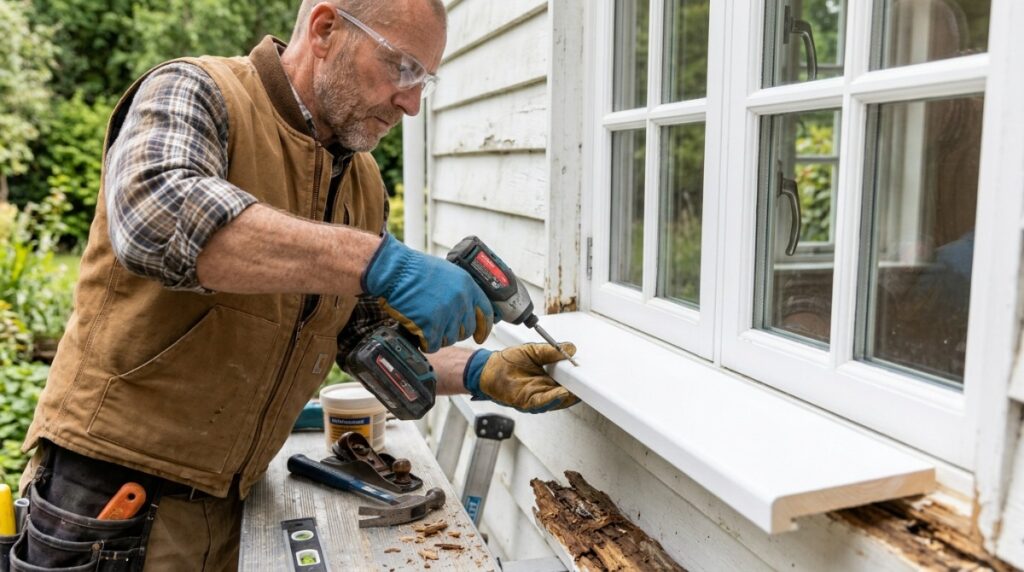
Then they sort them into groups. Most sills only need patching, fresh caulk and coating. A couple usually need replacement. Now and then, one window has a soft frame too, and that one goes to a carpenter first.
Where it’s visible, the crew checks flashing and the joints at each sill. Those notes go on the estimate so the homeowner can see the cause, not just the damage.
Then the work gets sequenced. Carpentry first. Cleaning, caulking and priming after. The coating goes on last.
The lesson we share is simple. Look at the joints. Check the slope. Fix the water path. Then protect the wood.
Repair vs Recoat vs Replace
Here’s how we usually decide what a sill needs:
| Condition | Best approach | Notes |
|---|---|---|
| Paint failing, wood firm | Scrape, spot repair, prime, caulk and recoat | Fix the water path first |
| Small shallow soft spot, rest of sill sound | Harden and fill with exterior wood hardener and epoxy | Keep to small spots |
| Rot along the front edge or one end | Cut back to sound wood and splice in new material | Seal and prime all cut faces |
| Soft over much of the sill, lost slope or recurring | Replace the sill | Check flashing and sheathing behind it |
| Rot into the frame, casing, sheathing or wall | Carpenter or window specialist first | A coating is not a fix |
You’ll find different rules online about when to replace. Some say 10 percent of the sill, some say 10 to 15 percent of the window’s wood, others say a quarter or more. None of them cite a source, and they don’t agree.
The better test is practical. Is the sill still sound? Is the frame sound? Has the water path been fixed? If any answer is no, replacement is usually the lasting choice.
On epoxy, the National Park Service notes in its preservation guidance on exterior woodwork that professionals still disagree about its long term performance. It’s a good tool for small spots, not for a sill that’s soft across its width.
Choosing Replacement Material
Primed wood, cedar and cellular PVC are all used for replacement sills. This Old House has shown cellular PVC as a replacement option because it doesn’t rot. Each material has trade-offs in cost, look and how it takes paint, so ask your carpenter what fits your windows.
When the Window Itself Needs Work
If the frame, sash or glass seals are failing, a window company should take a look. Sometimes repairing the sill is enough. Sometimes the whole unit is at the end of its life.
If you’d like someone to press on every sill and tell you what’s sound, we do that on every free estimate. You can book a 5 minute call to get started.
How a Ceramic Elastomeric Coating System Fits
I’ll be honest about what our coating can and can’t do here.
Rhino Shield is a flexible, breathable, water resistant ceramic based acrylic elastomeric coating. It bridges hairline cracks and resists mold, mildew and algae. On sound sills and trim, it gives a finish that holds up through Michigan winters.
It does not fix a flashing problem. It does not repair a rotted frame. And it can’t replace a window that’s failing.
Our 11-step coating process includes inspection, cleaning, patching and wood rot repairs, scraping, acrylic elastomeric caulking at windows, masking, full area priming and a high mil finish coat.
The coating has to go on wood in acceptable condition. Our applicators repair or patch where they can. If a sill needs replacing, we flag it and include a replacement quote in the estimate. You can read more about how we repair surfaces before coating.
When flashing, the frame or the wall framing is the real issue, we say so. That work needs to happen first.
Our 25-year No Chip, Crack, or Peel warranty covers chipping, cracking, peeling and flaking under its written terms. It doesn’t cover rot or leaks.
Cost and Timing in Michigan Seasons
You’ll see sill repair prices online all over the map. Most aren’t sourced, and few are based on Michigan work.
What actually drives the cost:
- How many sills need work
- How much carpentry each one needs
- Access and height, especially upper floor windows
- Hidden damage at the frame or wall
- The replacement material you pick
On our estimates, wood replacement is listed on its own line so nothing is hidden.
For the coating, our Rhino Shield pricing page lays it out. On average, it’s about two to two and a half times the cost of a traditional paint job. A typical three bedroom home with about 2,000 square feet of wall space runs around $13,000 to $18,000. A typical latex paint job costs $5,000 to $9,000 but usually needs repeating every five to seven years.
Timing matters. Repair leaks and re-caulk before winter. Carpentry and coating work best in dry, warmer weather, and our crews follow the manufacturer’s temperature window.
We currently advertise up to 25% off and 0% financing.
Frequently Asked Questions
Why do window sills rot under the paint?
Sills are flat, so water sits on them and soaks in. It enters at joints, cracks and end grain, often behind paint that looks intact. Missing or poorly lapped flashing makes it worse.
Can I paint over a soft window sill?
No. Paint over soft wood fails again and hides the damage. Probe it, repair or replace the bad wood, then prime and recoat.
Does epoxy work on a rotted window sill?
For small, shallow spots with good prep, yes. Professionals still disagree on how well it lasts long term. If the rot runs across the sill, replacement is the better choice.
How much rot means I need a new sill?
Online rules range from 10 percent to a quarter or more, and none are sourced. The better question is whether the sill and frame are still sound and whether the water path is fixed.
Is sill rot a sign of a leak in the wall?
It can be, especially when flashing is missing or failing. Check the frame, look for stains inside and have the sheathing checked if anything looks off.
Does homeowners insurance cover window sill rot?
Policies vary. Gradual rot from long term moisture is often excluded. Check with your carrier about your specific situation.
Does the Rhino Shield warranty cover rotted sills?
No. The warranty covers chipping, cracking, peeling and flaking under its written terms. Rot and leaks are not covered.
Do I need to worry about lead paint on old window sills?
On homes built before 1978, yes. Sills are a common place for old lead paint. Paid work requires an EPA certified firm, and DIY work should follow lead safe practices.
Talk to Us About Your Windows and Sills
If your window sills rot under the paint and you’re not sure how far it goes, we’re glad to take a look. Our crew will check every sill, explain what they find and tell you if a carpenter or window company should come first.
No pressure. Sometimes a straight answer is all you need.
We serve homeowners from Brighton and Livingston County to Ann Arbor, Royal Oak, Lansing, Grand Rapids, Traverse City and the Lake Michigan coastline. You can read more in our full FAQ or see what other homeowners say in our Google reviews.
Schedule a free estimate or call us at 810-360-6583.
Paint less. Shield your home for decades.
Marc Mercier, Owner, Rhino Shield of Michigan, Brighton, MI. Family owned, 25+ years in home improvement, BBB A+ accredited, MI Lic #2102200455.