
By Marc Mercier, owner of Rhino Shield of Michigan, Brighton, MI. Family owned, 25+ years in home improvement.
A crew arrives to estimate a house with a painted block foundation. It rained the night before. The lower course is dark, and the paint near the base is blistering. The homeowner is sure the paint is the problem.
Our crew leader does not start at the wall. He walks the downspouts.
That is the theme of this whole post. Look up before you look down.
A basement block wall damp outside is usually telling you where water is collecting. Check the gutters, downspouts, soil slope, and splash-back before you touch the wall. Call a drainage or waterproofing pro if the inside is wet too. And coat the block only after the moisture source is fixed.
The Short Answer: Why a Block Wall Looks Damp and What to Do First
A damp block wall usually means water is collecting at the foundation. Common causes are overflowing gutters, short downspouts, soil sloping toward the house, splash-back and porous block soaking up rain. Fix the water source first, then repair mortar and coat the block only if the wall is sound and the source is under control.
A basement block wall damp outside is a signal to fix the water first, the wall second, and the coating last.
Quick Diagnosis: What Is the Wall Telling You?
Where the dampness sits tells you a lot. Use this table as a first pass.
| What you see | Likely cause | What to check first |
|---|---|---|
| Dark band along the bottom course | Splash-back, wicking from wet soil, or mulch against the block | Soil height, mulch, grade |
| Uniform dampness across the wall after rain | Porous block absorbing rain | Gutters and roof overflow |
| Vertical streak under a downspout | Downspout dumping water on the wall | The elbow and the extension |
| White powder at mortar joints | Efflorescence, salts carried by water | Where the water is entering |
| Stepped or horizontal cracks | Movement in the wall | A structural professional |
| Flaking or crumbling block faces | Freeze and thaw on wet block | Water source, then a mason |
| Damp spot that matches a damp spot inside | Seepage through the wall | A drainage or waterproofing pro |
| Dampness only in warm, humid weather | Condensation, usually on the interior side | Ventilation and humidity |
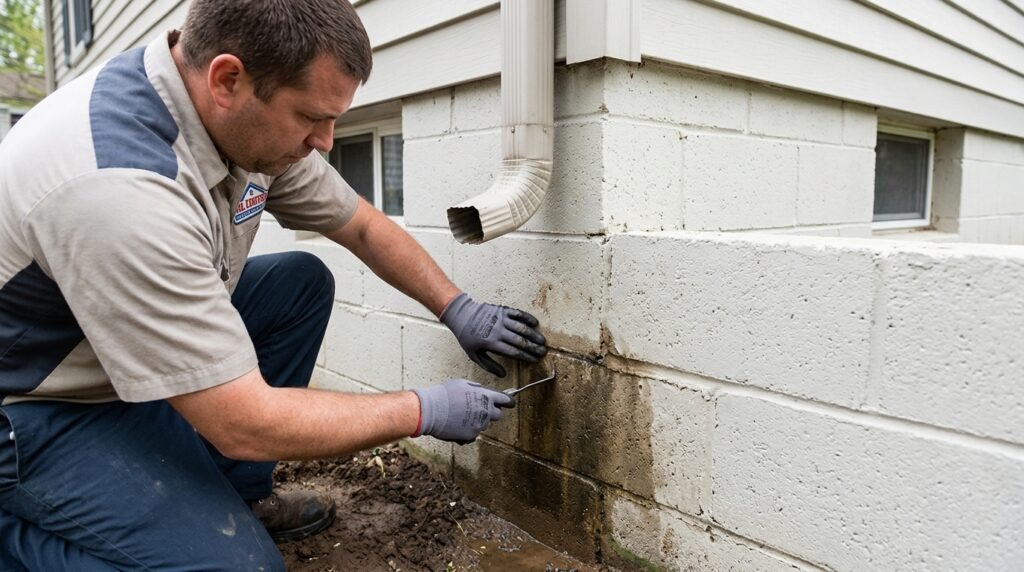
Our crews notice a vertical dark streak under a downspout elbow before they touch the wall. It tells them where the water lands. Often the whole story is right there.
Normal dampness versus a problem
Block and concrete are porous. A little dampness is normal. A wall that stays wet, keeps getting darker, or shows powder, flaking, or matching stains inside is sending a signal.
Inside versus outside
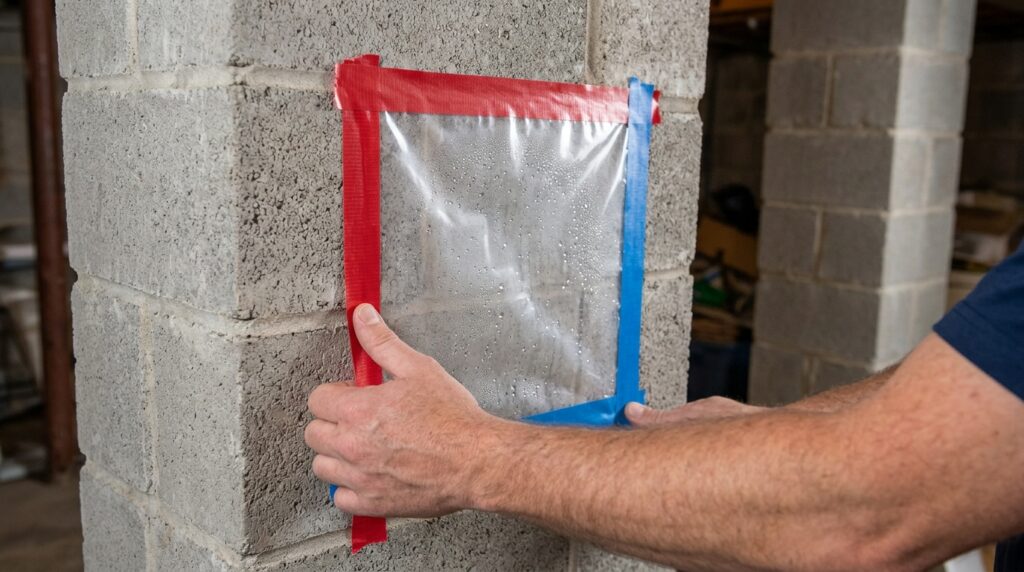
Is it seepage from outside, or condensation from inside? A common homeowner check is the plastic sheet test. Tape a small piece of plastic sheet to the interior wall and leave it for a day or two. If moisture shows up under the sheet, on the side facing the wall, it points to water coming through. If moisture shows up on the room side of the plastic, it points to condensation. It is a simple check, not a diagnosis. Confirm what you find with a professional.
What Causes a Damp Block Wall in Michigan
I will keep this to what we see most.
Roof water and gutters
Clogged or overflowing gutters send water right down the wall. Downspouts that dump at the corner do the same. The University of Minnesota Extension, a cold climate source, recommends downspout extensions that discharge at least 4 feet beyond the wall, and at least one downspout for every 50 linear feet of roof eave. That is cold climate guidance from Minnesota. Michigan winters are similar, but ask your local building department about local rules.
Soil, grading and splash-back
If the soil slopes toward the house, water follows it. Soil piled above the footing line and mulch against the block hold moisture on the wall. The same University of Minnesota page recommends sloping the soil away from the foundation at a minimum of 1 inch per foot for at least 6 feet.
Freeze-thaw and Michigan weather
Wet block that freezes can flake faces and open mortar joints. Spring thaw also saturates the ground.
Efflorescence and what it means
The Brick Industry Association explains that efflorescence needs three conditions: soluble salts, water, and a path to the surface. Remove any one and it stops. Efflorescence alone is not proof of a leak. It does tell you that water moved through the wall.
Other sources
Hose bibs that drip. Sprinklers that hit the foundation. Window wells full of leaves. Failed mortar and cracks. Check them all.
What To Do Right Now
These steps are safe, and they are in the right order.
Walk the house during or right after rain
Take photos. Watch where water lands from each downspout. Write down which spots stay wet.
Clear gutters and downspouts, and add extensions
Make sure water leaves the wall by at least 4 feet, as the University of Minnesota Extension advises.
I once had a homeowner who wanted to seal the wall right away. I asked him to hold off until the gutters were cleaned, the soil that had crept up past the footing line was lowered, and the downspout discharge was fixed. He was not thrilled. But that order is what works.
Check the soil
Lower soil that sits above the footing line only where it is safe. Re-slope away from the house. Keep mulch off the block. For major regrading or any digging near the foundation, use a professional and call 811 first. In Michigan, MISS DIG 811 is the free utility locate service, and the utility companies ask you to wait at least three business days after calling for them to place flags.
Dry brush efflorescence, do not wash it away
The Brick Industry Association recommends dry brushing first, testing any cleaner on a small area, correcting the cause first, and washing only in warm, dry weather. Washing adds moisture to the wall.
Watch the inside
A basic hygrometer will show humidity. Note whether dampness tracks the rain. If it does, the source is outside.
What Not To Do
- Do not seal the wall with waterproof paint first. It does not remove the moisture source.
- Do not rely on a dehumidifier alone. The University of Minnesota Extension says a dehumidifier can reduce humidity and odor but does not solve the problem. In a basement with moisture problems it can even draw moisture in faster and lead to efflorescence and spalling.
- Do not pressure wash hard at block or mortar. See our post on pressure washing and exterior paint.
- Do not trap plastic against the wall.
- Do not dig up the foundation yourself.
- Do not use acid on block without testing and protection.
Practical Example: Walking a Block Foundation With a Crew Leader
Here is how the walk goes on a typical house.
We start at the gutters. Are they full? Do they overflow at the corners? We check the downspouts. Is there an extension, or did the mower knock it off? Then the soil. Is it piled above the old paint line? Is there mulch against the block?
Then the mortar joints. We look for powder at the joints, stepped cracks, and joints that are deeply recessed or sandy.
Only after all of that do we look at the wall surface itself.
On a house I am thinking of, there was powder at the mortar joints, the soil sat above the old paint line, and a downspout dumped right beside the foundation. The order we recommended was water control first, mason repairs second, and breathable coating last. That order saves money, because the cheapest fixes often do the most work.
Repair vs Recoat vs Replace: Who Fixes What
Different problems belong to different trades. I would rather tell you who to call than have you pay the wrong person.
| Problem | Who fixes it | Fix |
|---|---|---|
| Gutter overflow, short downspouts | Homeowner or gutter contractor | Clean, extend, add downspouts |
| Poor grading, soil above footing | Landscaper or excavation contractor | Re-slope, lower soil |
| Persistent wet basement, hydrostatic pressure, footing drains | Waterproofing contractor | Exterior or interior drainage systems |
| Cracked, failing mortar | Mason | Repoint, repair |
| Bowing or stepped cracked wall | Structural engineer or foundation specialist | Evaluate before any coating |
| Sound, dry block with stained, peeling or powdery surface | Painter or coating contractor | Clean, repair, prime, coat |
For persistent seepage, Green Building Advisor, a building science site, notes that the best results come from excavating to the footing with a waterproof membrane, a drainage mat, and coarse backfill, and it advises talking to a wet basement specialist. That is a waterproofing contractor’s job.
Drainage and structural work cost far more than gutter and grading fixes. I will not give you dollar figures I cannot support.
Once the water is handled and the block needs cleaning and coating, we will look at it for free. You can book a 5 minute call to talk it over.
How a Ceramic Elastomeric Coating System Fits
Here is my honest view. Rhino Shield is a coating. It is not a waterproofing system.
It is flexible, breathable, and water resistant. It bridges hairline cracks and resists mold, mildew and algae. Block is one of the surfaces we coat.
When does it make sense? When the block is sound, the moisture source is fixed, and the face is stained or the old paint is peeling. For an above grade foundation wall that is dry at the source, a coating reduces how much rain the porous face absorbs and gives you a washable finish.
When does it not? It does not stop groundwater. It does not stop hydrostatic pressure. It does not stop seepage that comes through from the inside. Below grade waterproofing is another trade, and I will tell you to call that contractor first.
Our 11 step process includes inspection, cleaning, patching and repairs, caulking, full area priming, and a high mil finish coat. See how we prepare and repair surfaces for details.
The 25-year No Chip, Crack, or Peel warranty covers chipping, cracking, and peeling under its written terms. It does not cover moisture, leaks, or efflorescence.
Cost and Timing in Michigan Seasons
Fix the water in spring and fall, before winter freezes the block. Do coating and masonry work in the warm season.
Gutter and downspout work is cheap compared with a drainage system. Start there.
For the coating, Rhino Shield costs about 2 to 2.5 times a traditional paint job. A typical three bedroom home with about 2,000 square feet of wall runs about $13,000 to $18,000. Foundation block is usually a small part of that, and our free estimate itemizes it. See our pricing page, and our guide on how much Rhino Shield costs in Michigan.
Frequently Asked Questions
Is a damp block foundation wall normal?
Some dampness is normal because block is porous. A wall that stays wet or shows powder, flaking, or matching stains inside is a signal worth checking.
What is the white powder on my block foundation?
It is usually efflorescence. Water carried salts to the surface and left them behind. Fix the moisture, then dry brush the residue.
Will waterproof paint fix a damp block wall?
No. It does not remove the moisture source and it can trap water. Fix gutters, grading, and drainage first.
How far should the ground slope away from the house?
The University of Minnesota Extension recommends at least 1 inch per foot for at least 6 feet. That is cold climate guidance.
How far should downspouts discharge?
At least 4 feet from the wall, according to the same source.
Do I have to dig up the foundation?
Not always. Try gutters and grading first. Exterior excavation is for persistent seepage and is a waterproofing contractor’s job.
Can Rhino Shield be used on a block foundation wall?
Block is a surface we coat. We do it only on sound block after the moisture source is fixed.
Does the warranty cover moisture or efflorescence?
No. It covers chipping, cracking, and peeling under its written terms.
Talk to Us Once the Water Is Under Control
If your block wall is damp and you are not sure where to start, call us. If the wall is actively wet, we will point you to the right trade first. Once the water is handled, schedule a free estimate and we will tell you honestly if the block is ready for a coating.
Call us at 810-360-6583. We are a family owned, BBB accredited A+ business with MI License #2102200455, and you can see our 4.8 star rating on our Google Business Profile.
We serve Brighton, Livingston County, Southeast Michigan, Ann Arbor, Lansing, Grand Rapids, Traverse City and the Lake Michigan coastline. See the full list on our areas we serve page.