
By Marc Mercier, owner of Rhino Shield of Michigan, Brighton, MI. Family owned, 25+ years in home improvement.
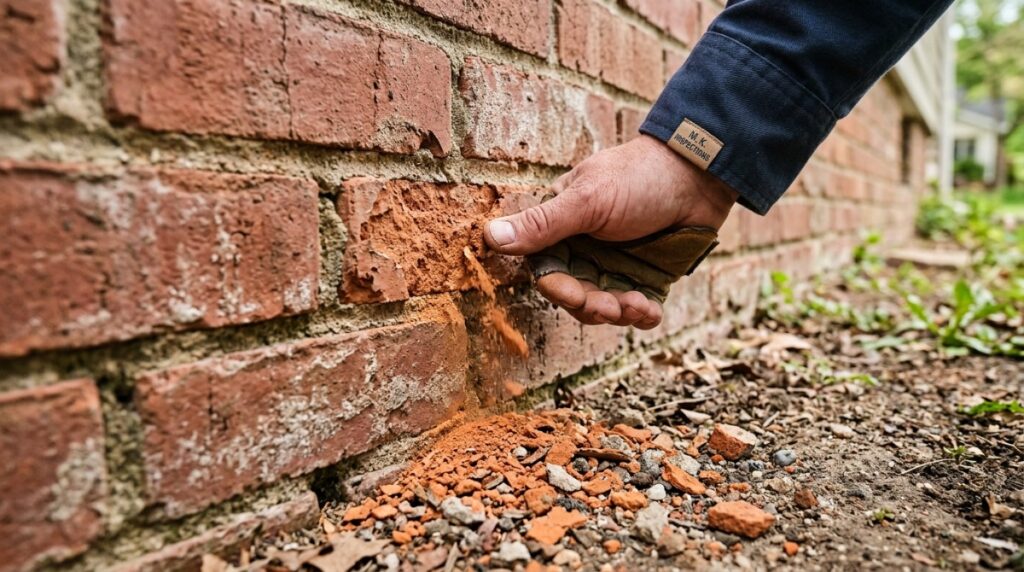
It is early spring, and I am standing at the base of a brick wall with one of our crew leads. The flower bed is dusted with small orange and red flakes. I run a thumbnail along one brick, and a thin layer of the face lifts right off.
The homeowner asks, “Is it the whole wall?”
I look up at the gutter first. Then I look down at the soil line. That is what I check before I answer anything.
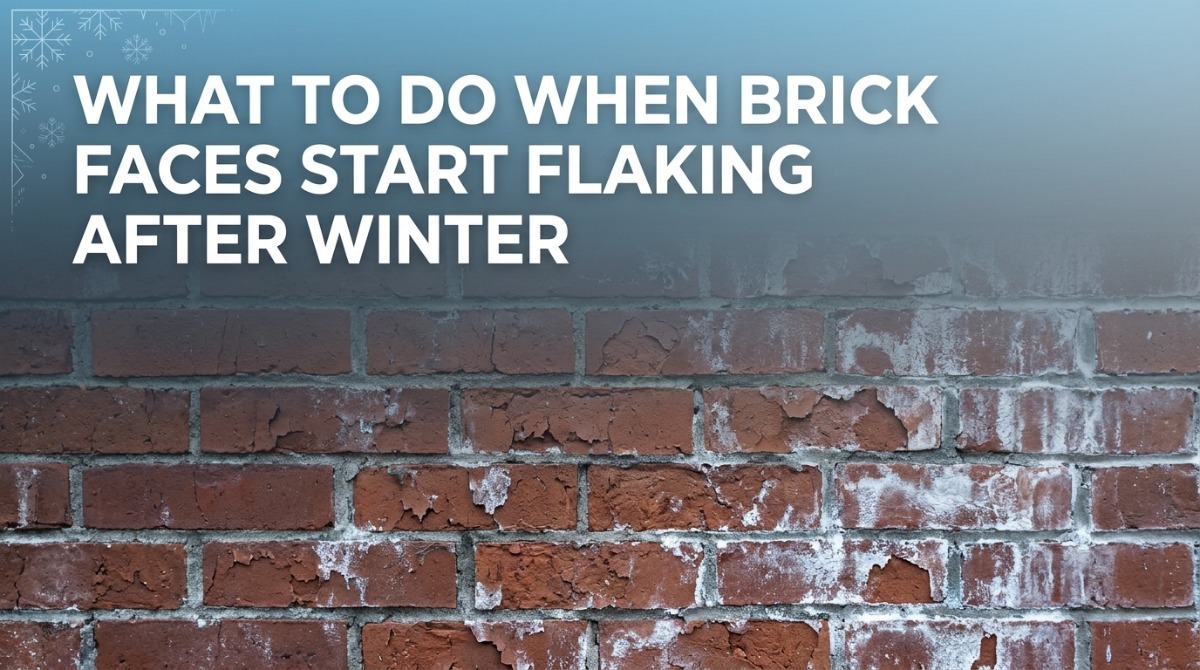
Brick flaking after winter, which is called spalling, almost always means water got into the brick and froze. The fix starts with the water. Then a mason repairs or replaces damaged brick and mortar. A coating comes last, if it comes at all.
The Short Answer
Brick faces flake after winter because water soaks into the brick, freezes, and expands, then repeats with each freeze and thaw. This is called spalling. Fix the water sources first, such as gutters and failed caps, then have a mason repair or replace damaged brick and mortar.
Do not seal or paint it yet. A coating cannot hold on a face that is still coming apart.
Quick Diagnosis: How Bad Is It?
Start by looking at what the wall is showing you. Most flaking falls into one of a few patterns, and each pattern points to a different next step.
| What you see | What it likely means | What to do |
|---|---|---|
| A few flakes on a few bricks | Early surface spalling | Watch it, fix the water, photograph it |
| Face loss across one section | Water is concentrated in that spot | Find the source, then call a mason |
| Soft, crumbling, or sandy mortar | Mortar has failed and is letting water in | Repointing, done by a mason |
| Hollow sound when you tap | Face or brick has separated from what is behind it | Call a mason soon |
| Stair-step cracks | Movement in the wall | Call a structural professional first |
| Bowing or leaning | Serious movement | Call a structural professional now |
| White powder next to the flaking | Salts moving with water | Fix the moisture, then clean |
| Paint peeling with the brick face attached | Trapped moisture under a coating | Stop, call a mason, do not repaint |
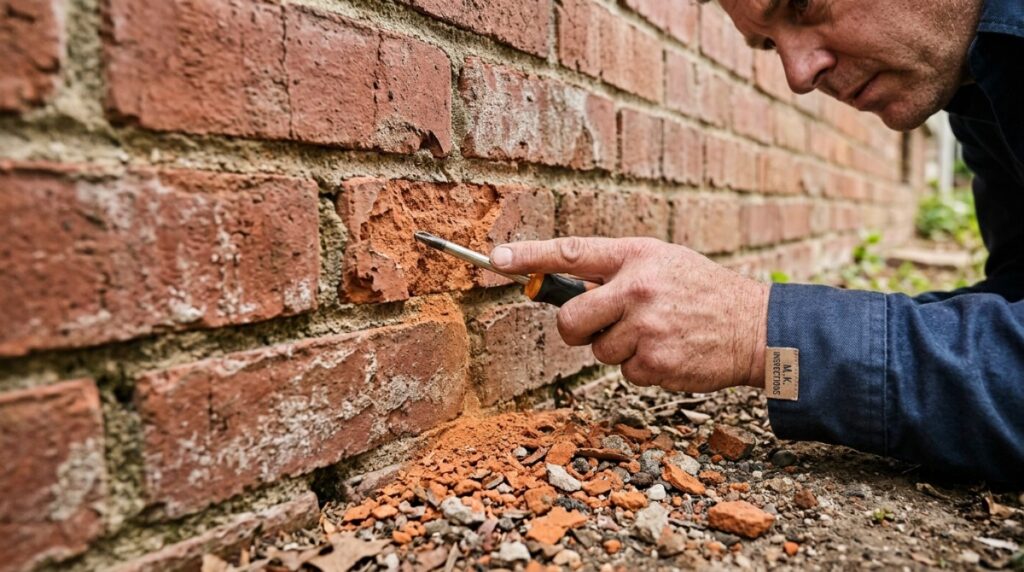
Here is the simple test we use. A crew member taps the wall with the handle of a screwdriver or a knuckle and listens. Sound brick rings. Brick with a loose face or a gap behind it sounds dull or hollow. Then we try a thumbnail on the edge of a flaking spot. If only a thin curl lifts, that is a surface problem. If a larger slab moves, the damage is deeper.
Soft brick tends to shed thin curls. Harder brick tends to let go in larger pieces. Either one is telling you the same thing about water.
Flaking, spalling, and efflorescence: how they differ
Brick flaking after winter and spalling are the same problem at different stages. The face of the brick breaks away in thin pieces or small chips. Efflorescence is different. It is white salt left on the surface when water moves through the wall and evaporates. It does not take pieces of the brick with it.
You can have both at once, and when you do, moisture is the common thread. If you are seeing white powder, that is its own topic with its own cleaning steps. For now, treat the water first.
Why Brick Faces Flake After a Michigan Winter
Brick looks solid, but it is porous. It drinks water. When that water freezes, it expands. The National Institutes of Health published a technical bulletin on the freeze-thaw cycle in concrete and brick assemblies, and it puts the volume of frozen water at 9 percent greater than liquid water. That pressure has to go somewhere.
The same bulletin says the damage comes from too much water. Surface spalling happens when water or snow keeps collecting on a surface and the brick stays wet. When it freezes, the outer layer fractures to the depth the water reached and falls off. The inner layers that are left behind are softer and more porous, so they are more vulnerable the next time around.
It is the saturation that matters. A dry brick does not spall. A brick that is soaked and then freezes does.
Every cycle opens the cracks a little more. Those cracks let in more water. The next cycle does more damage than the last.
I see this pattern on walls where the worst flaking sits on the side that stays wet. Behind a downspout. Under a missing cap. Along the north face where the sun never dries it out. The sunny side of the same house can look fine. The damage follows the water.
Michigan gives brick a hard time. We get repeated freeze and thaw swings through March and April, wet snow that sits against walls, and long, damp springs. Homes in Southeast Michigan, Ann Arbor, Lansing, and Grand Rapids often have older brick and chimneys that have been through many winters. Traverse City and the Lake Michigan coastline carry heavy snow that melts against masonry.
Water getting in: caps, flashing, gutters, grade, and snow
Most of the water comes from a short list of places. A missing or cracked chimney cap. Flashing that has lifted. Gutters that overflow onto the wall. Downspouts that dump right at the foundation. Soil built up against the lowest courses. Snow piled against the wall all winter.
Each of these is a fix that costs far less than rebuilding brick. That is why we start there.
Mortar that is harder than the brick
This one surprises people. If the mortar is harder and stiffer than the brick, it does not give. Water and stress then get pushed into the brick faces instead of the joints. Over time the faces are what fail.
A good mason matches the mortar to the brick, so the joint is the part that gives, not the brick. If a past repair used a hard cement mix, that may be part of why your brick is flaking now.
Salt
Road salt and de-icing products reach steps, low walls, and the base of brick near driveways. Salt can also live inside the wall already. When salt gets into the brick with water, it adds to the damage. Keep de-icers off masonry where you can.
Old, soft, or underfired brick
Some older Michigan homes were built with softer brick. It was fine for decades, but it takes in water more easily. If your brick is soft, it will spall sooner when the wall stays wet. That does not mean the wall is ruined. It means water control matters even more.
What to Do Right Now
You do not need to rush into a big repair. You do need to stop the water from doing more damage. Here is the order I recommend.
Step 1. Photograph and mark the worst areas
Take dated photos of the flaking. Take wide shots and close shots. A pencil mark or a piece of painter’s tape beside the worst bricks helps you see if the damage spreads over the next few months.
Step 2. Fix the water you can control
Clean the gutters. Add downspout extensions so water leaves the wall. Pull mulch, soil, and shrubs back from the base. Move snow piles away from the house. Check that sprinklers are not hitting the brick.
Step 3. Brush off loose flakes gently
Wear eye protection. Use a soft brush and clear the loose debris. Do not pick at sound brick, and do not chip at it. You are only removing what is already loose.
Step 4. Protect exposed areas
If a chimney cap has failed, have it repaired. A temporary cover can slow water until a mason can get there, but it is a stopgap and not a fix.
Step 5. Call a qualified mason for anything beyond small areas
When you see face loss across a section, soft mortar, hollow sounds, or any cracking, a mason is the right call. Ask the mason to match the mortar to your brick and the brick to your wall. Ask to see photos of similar work.
Is it safe to wait until summer? For a few flakes, usually yes, as long as you fix the water. For hollow areas, cracks, or leaning, do not wait.
If you want a second opinion on what you are looking at, we will walk the wall with you. You can book a 5 minute call, and if the first call should be to a mason, we will tell you.
What Not To Do
Some well meant fixes make flaking brick worse. I have seen all of these.
- Do not pressure wash. High pressure strips more of the face and drives water into the wall. Read more about pressure washing and exterior surfaces before you rent a machine.
- Do not apply a film forming sealer or non breathable paint to damp brick. It traps water. Designing Buildings, a UK building reference, warns that silicone water repellents applied the wrong way can keep brickwork from drying out and make frost damage more likely.
- Do not patch with hard cement mixes that do not match the brick. They look neat for a season and then they crack or push stress into the brick.
- Do not ignore a bowing or stair-step cracked wall. That is a structural question, and it belongs with a professional.
- Do not chip at the brick yourself. You can remove more than you meant to.
I think of one wall in particular. The brick had been sealed with a glossy product years earlier. The face was peeling in sheets, and the coating was coming off with it. When our crew lifted a loose piece, the back of it was damp and the brick behind was soft. The sealer had held water in instead of letting it out.
I told the owner the truth. This was not a job for a coating company. It needed a mason, a gutter fix, and time for the wall to dry. They did that first. Then we talked about the finish.
A Practical Example: From Flaking Wall to Finished Wall
Here is how a typical job runs when the order is right.
A homeowner calls in April because the lower courses of a brick wall are flaking. We walk the wall. We tap it. We find one downspout dumping at the corner and a gutter that overflows in heavy rain. A mason repoints the soft joints and replaces a handful of bricks that have lost their faces.
The gutter is rerouted. The downspout gets an extension. The soil is pulled back from the base. Then the wall is left alone through the warm months so it can dry.
Only after that does the coating conversation start. Not before.
If the wall has been painted before and the paint is also peeling, that is a related problem with its own fixes. For this wall, the lesson is about order. Water control first. Masonry repair second. Coating last, and only if the wall is dry and sound.
When we do coat, the work follows our coating process. That includes inspection, cleaning, patching, caulking, full area priming, and the finish coat. It starts only when the wall is ready.
Repair, Recoat, or Replace: How to Decide
This table is a starting point. A mason should confirm it on your wall.
| Condition | Best move | Notes |
|---|---|---|
| Minor surface loss on sound brick | Repair and monitor | Fix the water and watch for change |
| Moderate loss with sound mortar | Replace the affected bricks and repoint | Match brick and mortar |
| Widespread loss | Rebuild sections or reface | Get a mason’s advice on scope |
| Structural cracking or bowing | Structural professional first | Do not coat or repair until assessed |
HomeServe, a home services company, notes that mild spalling may only need surface patching, while extensive damage can mean replacing the affected brick and mortar, and that a professional mason should assess it. That fits what we see. It is one source’s view, not a code, so let a mason look at your actual wall.
Where a Ceramic Elastomeric Coating Fits (and Where It Doesn’t)
I will be plain about this. Rhino Shield will not rebuild a brick face that is coming apart. It should not go on until the water problem and the masonry repairs are done.
After that, it can help. Rhino Shield is a ceramic based acrylic elastomeric coating. It is flexible, breathable, and water resistant. On repaired brick it can protect the surface and bridge hairline cracks. Our crews patch and prime the wall before the finish coat, and you can read how we handle prep on our substrate and repairs page.
When is it not the answer? If the brick is actively spalling. If there are loose or hollow bricks. If there are structural cracks. If the wall is still wet. In those cases, a coating would sit on a surface that cannot hold it.
One more thing. If your brick is unpainted, coating it changes the look for good. Think about that before you decide.
The 25-year No Chip, Crack, or Peel warranty is a written warranty on the coating. It covers chipping, cracking, and peeling under its written terms. It does not cover spalling, moisture, or masonry failure.
Cost and Timing in Michigan
I will not give you a number for repairing brick flaking after winter, because it depends on the wall. A small patch costs far less than rebuilding a section. The cost drivers are access, such as whether scaffolding is needed, how well the new brick matches, and how many bricks are involved.
Early repair of small areas is almost always cheaper than waiting. That is the best reason to act this spring.
Timing matters. Masonry repair needs mild, above freezing weather, so most work happens from spring through early fall. Get a mason on the schedule early, because good ones book up. A coating follows once the wall is dry.
For coating cost, see our pricing page.
Frequently Asked Questions
What is spalling brick?
Spalling is when the face of a brick breaks away in thin layers or chips. It happens when water gets into the brick, freezes, and expands. It is common after hard Michigan winters.
Is flaking brick a serious problem?
It can be. A few flakes on a few bricks is usually minor if you fix the water. Hollow sounds, soft mortar, stair-step cracks, or bowing point to something deeper and need a professional.
Can spalled brick be repaired without replacing it?
Sometimes. Mild surface loss may only need monitoring or patching after the water is fixed. Bricks that have lost their faces are often replaced and the joints repointed.
Can I paint or coat flaking brick?
Not until repairs are done and the wall is dry. A coating cannot hold on a face that is still delaminating. Once the wall is sound, a breathable coating is an option.
Should I seal brick that is flaking?
Not on damp brick. Wrong sealers can trap moisture and make things worse. Fix the water source first and ask a mason which products, if any, make sense for your wall.
How much does it cost to repair spalling brick?
It depends on how many bricks are involved, how hard they are to reach, and how well replacements match. Small areas cost far less than rebuilding a section. A mason can quote your wall.
Does pressure washing cause spalling?
It can make it worse. High pressure can strip the face and push water into the wall. Use a soft brush for loose flakes instead.
When is the best time of year to repair brick in Michigan?
Mild, above freezing months. Most masonry repair happens from spring through early fall. Plan early so a mason can fit you in.
Not Sure What You Are Looking At?
If you see flaking brick on your house, you do not have to guess. Schedule a free estimate and we will look at the wall, check the water sources, and tell you honestly whether you need a mason first. If the answer is a mason, we will say so. Sometimes the right first call is not to us.
Call us at 810-360-6583. We are a family owned, BBB accredited A+ business with MI License #2102200455, and you can see our 4.8 star rating on our Google Business Profile.
We serve Brighton, Livingston County, Southeast Michigan, Ann Arbor, Lansing, Grand Rapids and many other communities. See the full list on our areas we serve page.