

By Marc Mercier, owner of Rhino Shield of Michigan, Brighton, MI. Family owned, 25+ years in home improvement.
It is early spring. I am standing at the foot of a brick chimney, running a dry hand across a white powder that comes off like flour. The homeowner asks, “Is my brick dying?”
I answer with a question: where does the water get in?
White deposits on brick are usually efflorescence, a salt left behind when water moves through the brick and evaporates. It is usually harmless to look at, but it tells you water is getting in. Dry brush it, find the water, fix that, and then decide about protection.
The Short Answer
White deposits on brick are usually efflorescence, a salt left behind when water moves through the brick and evaporates. It signals moisture, not usually damage. Brush it off dry, find where water is getting in, fix that source, and let the wall dry before any sealing or painting.
Quick Diagnosis: Is It Efflorescence?
Not every white mark on brick is salt. Use this table, then try the simple test below.
| What you see | How to test | What it likely is |
|---|---|---|
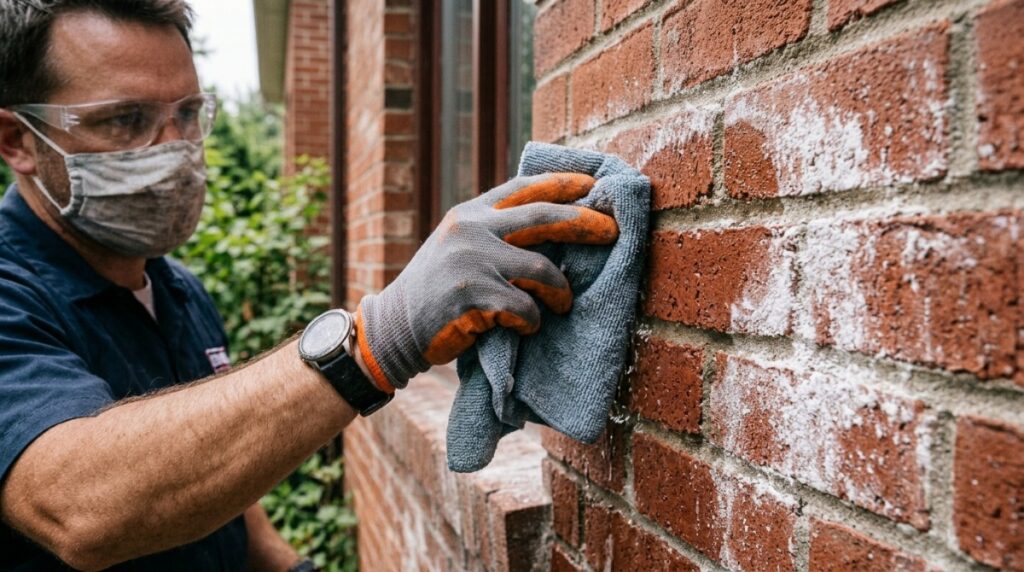
| Fine white powder that brushes off dry | Dry brush, then wipe with a damp cloth | Efflorescence |
| Hard white crust that does not dissolve | Try a damp cloth and a stiff brush | Heavier salt buildup or lime run |
| White fuzzy or spotted growth that smudges dark | Smell it, and see if it smears | Mold |
| White chalk from old paint | Rub and compare to the paint nearby | Paint chalk |
| White haze after acid cleaning | Check the cleaning history | White scum |
| Streaks from mortar or limestone | Look at where they start | Lime run |
The damp cloth test
A crew member brushes a small patch dry. Then they wipe it with a damp cloth. If the powder disappears and comes back after rain, it is almost certainly salt. If it smells musty or smears, it may be mold. Please do not taste anything to find out.
I like this test because it tells you if the white is active. A deposit that reappears after every rain is telling you where the water is getting in.
Efflorescence, lime run and white scum
These look alike but are not the same. Efflorescence comes from soluble salts carried by water. Lime run comes from mortar or cement. White scum can follow an acid cleaning. The Brick Industry Association, in Technical Note 23, advises having a stain identified before cleaning if you are unsure. That is good advice. The wrong cleaner can make it worse.
For background, Wikipedia’s entry on efflorescence describes how salts migrate to the surface of a porous material and form a white deposit.
Why White Deposits Appear on Brick
Efflorescence needs three things: soluble salts, water to dissolve them, and evaporation to bring them to the surface. Take away one and it stops. Water is the one you can control.
Salts already in the brick, mortar or soil
Brick, mortar and the soil next to it all contain some salts. They sit quietly until water moves through.
New masonry still drying out
New brick can bloom in its first season and often fades with weathering. One manufacturer guide from the UK says one to two years on exposed surfaces. That is general guidance from a different climate, so I treat it as a rule of thumb and not a promise.
Why It Shows Up After Winter in Michigan
Michigan is hard on brick. Freeze-thaw cycles, wet springs, snow piled against walls and road salt carried onto steps and low walls all push water and salts through masonry. Lake effect moisture near the Lake Michigan coast adds more. Older homes in Southeast Michigan, Ann Arbor, Lansing and Grand Rapids often have aging mortar and flashing.
We see this a lot. The white stops exactly at a missing cap or a failed joint. Or it follows the line of a downspout splash. The pattern points to the source.
Chimneys and caps
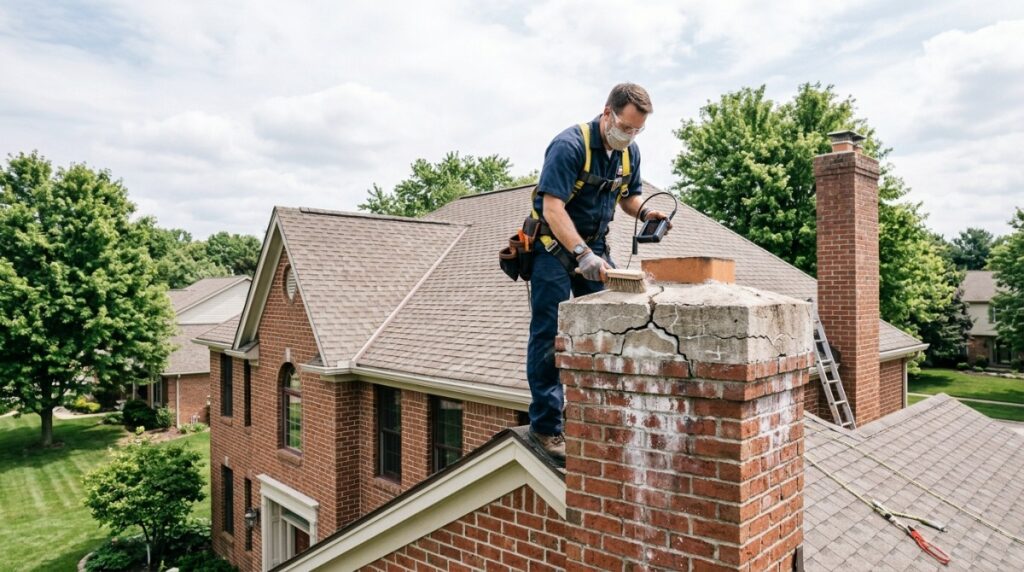
A chimney crown that has cracked, or a cap that has gone missing, lets water into the top of the wall. White streaks under the crown are a common sign.
Mortar joints and flashing
Open joints let water in. Flashing that has been installed backward, or has pulled away, sends water into the brick instead of out of it. Mosby Building Arts, a masonry source, names missing mortar and reversed flashing near chimneys as common causes.
Gutters, downspouts, grade and sprinklers
A downspout dumping at the base, soil piled against brick or a sprinkler spraying the wall will keep the bottom courses wet. The white tends to be heaviest on the lowest course and under windowsills.
What to Do Right Now
Step 1. Dry brush with a stiff, non-metal brush
Steel bristles can leave rust marks. The General Services Administration, which maintains federal buildings, recommends starting with a stiff, nonmetallic brush. You can read its procedure for removing salts and efflorescence from brick and stone masonry.
Step 2. Photograph and track it for a few weeks
Take a photo now and again after a rain. If it comes back in the same spot, you have found a clue.
Step 3. Walk the water path from the top
Start at the top and work down. Check the crown, flashing, caps, mortar joints, gutters and grade. Our page on substrate and repairs shows how we think about each surface.
Step 4. Rinse lightly if you need more
If dry brushing is not enough, the GSA procedure says to wash with clean water and scrub with a stiff brush. Avoid heavy wet work near freezing. The GSA says not to do exterior wet cleaning when temperatures are below 40 degrees F or when frost is possible. Please check the current wording on its page before relying on this.
Step 5. Bring in a mason or roofer when the source is in the wall
If the cause is a cracked crown, failed flashing or open mortar, that is trade work. A mason or roofer should fix it before anything else.
If you are not sure what you are seeing, send us a photo or call. We are glad to take a look, and you can book a quick 5 minute call.
What Not to Do
- Do not pressure wash. It drives water deeper and can bring more salts out. See pressure washing and exterior surfaces.
- Do not soak the wall. More water means more salts moving.
- Do not use acid casually. The Brick Industry Association warns that unbuffered muriatic acid can cause white scum and stains, especially on light, tan, brown, black or gray brick.
- Do not seal or paint over active efflorescence.
- Do not use steel brushes.
Here is the shape of a story I have heard more than once. A homeowner cleaned with strong acid, or a pressure washer, hoping to fix it in an afternoon. What our crew saw later was blotchy staining and pitted mortar. I told the owner what I will tell you: the white was a symptom. The cleaning made the wall worse because it never touched the cause.
A Practical Example: Painted Brick That Keeps Blistering
This is a job type we see often.
The paint on a brick wall is lifting in flakes. Behind the flakes, there is white powder. The homeowner wants a fresh coat and a clean look.
Our crew inspects first. We find damp brick near the bottom course and a gutter that dumps near the wall. That is the water path.
So the sequence goes like this. The gutter gets fixed. The wall is allowed to dry. Failed joints are repointed or patched. Then we clean the surface and talk about a coating. The coating is the last step, not the cure.
The lesson is patience and order. If you paint first, the white will come back through the paint. If you fix the water first, you give the coating a fair chance. Painted brick that peels has its own set of causes, and I will cover it in a separate post.
You can see how we run each step in our 11 step coating process.
What a good inspection looks like
When we inspect a brick wall, we go in a set order. We start at the crown or the roofline. Then we look at flashing, caps, mortar joints, gutters and grade, and only then at the surface. The surface is where the problem shows. It is rarely where the problem starts.
Good field details help. Powder that brushes off dry is different from a crust that stays put. White that is heaviest on the bottom course and under windowsills points to water from the ground and the sills. Damp mortar that looks dark in the morning tells us the wall is still wet. And bloom that appears after a thaw or a rain, then fades in a dry week, tells us the wall is moving moisture right now.
Paint blisters with salt behind them mean the coating is being pushed off from inside. None of this needs special tools. A hand, a brush, a good light and some patience will tell you a lot.
Clean, Repair, Coat or Rebuild: How to Decide
| Situation | Best move |
|---|---|
| Light recurring bloom on sound brick | Monitor and brush it off dry |
| Active bloom with failed mortar | Repoint first |
| Blistering paint with salts | Fix the source, let it dry, then recoat |
| Crumbling brick | Call a mason about the brick faces |
| Leaning, bulging or cracked walls | See a mason or engineer |
A brick wall that sheds its faces after winter is a different problem than surface salt. I will cover it in a separate post about brick faces flaking after winter.
Where a Ceramic Elastomeric Coating Fits, and Where It Does Not
I want to be honest about what a coating can do.
Rhino Shield is a ceramic based acrylic elastomeric coating. It is breathable, so trapped moisture can escape, and it is flexible, so it bridges hairline cracks. But it is a coating. It will not stop water from entering the wall. It should not go on until efflorescence is under control and the mortar is repaired.
Coating raw brick changes how it looks, permanently. Please think that decision through. If you love your brick as it is, there may be no reason to coat it.
For painted brick, our process still includes cleaning, patching, full area priming and a finish coat. When is it not the answer? New brick that is still drying, a chimney with failed flashing, or a wall with active leaks.
The 25 year “No Chip, Crack, or Peel” limited warranty covers chipping, cracking and peeling under written terms. It does not cover efflorescence or moisture problems. Read the terms on our 25 year warranty page.
Cost and Timing in Michigan
Brushing and monitoring cost nothing. Repointing, flashing and crown repairs vary with the size of the job and the access, so I will keep that general.
For a coating, a typical 3 bedroom home with about 2,000 square feet of wall area runs roughly $13,000 to $18,000. That is about 2 to 2.5 times a traditional paint job. See our pricing page.
Wet cleaning and masonry work belong in the milder months. Let the wall dry before any coating, and do not rush in early spring when it is still damp.
Frequently Asked Questions
Is efflorescence harmful to brick?
Usually it is not harmful to look at. It tells you water is moving through the wall, and long term moisture can hurt mortar and masonry.
Will efflorescence go away on its own?
New brick often fades with weathering. On older walls, it tends to return until the water source is fixed.
Can I use vinegar or muriatic acid on it?
Vinegar is also an acid, so test a hidden spot and rinse lightly. Muriatic acid is best left to a mason for anything beyond a small test. The Brick Industry Association warns about unbuffered acid, especially on light brick.
Why does it keep coming back?
Because the salts, the water and the evaporation are still there. Fix the water path and it slows or stops.
Can I paint or seal over efflorescence?
Not while it is active. Fix the source first. If you seal, use a breathable product.
How do I tell efflorescence from mold?
Brush a small patch dry, then wipe it with a damp cloth. Powder that disappears and returns after rain is likely salt. Mold smells musty and may smear.
Does white powder on brick mean I have a leak?
Not always, but it means water is moving through the wall. A walk from the roofline down will usually find the path.
Does pressure washing help?
No. It can drive water deeper and bring more salts out.
Want a Second Set of Eyes on Your Brick?
If white deposits on your brick keep coming back, you do not have to guess. Schedule a free estimate or a 5 minute discovery call. Some walls need a mason first, and I will say so.
Call us at 810-360-6583. We are a family owned, BBB accredited A+ business in Brighton with MI License #2102200455, and you can see our 4.8 star rating on our Google Business Profile.
We serve Brighton, Livingston County, Southeast Michigan, Ann Arbor, Lansing and Grand Rapids. See the full list on our areas we serve page.