
By Marc Mercier, owner of Rhino Shield of Michigan. Family owned, 25+ years in home improvement.
A homeowner meets us at the front door. “I clean the north wall every spring,” she says. “By fall it is green again.”
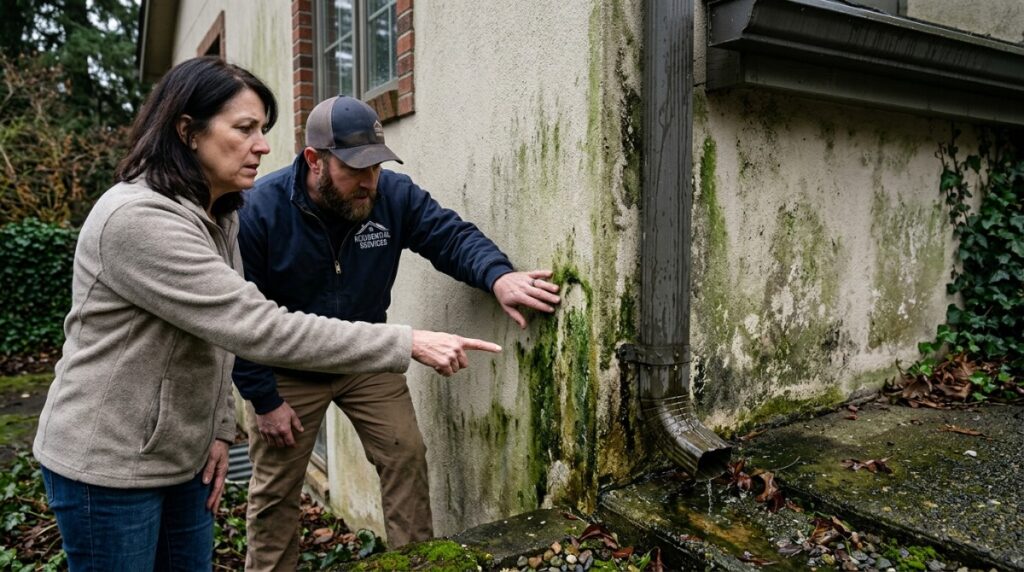
I walk the house with her. At the corner there is a downspout dumping water right against the wall. A hedge touches the siding a few feet over. The green sits exactly where the water lands and the air does not move.
When mold keeps coming back on your siding, it is because moisture, shade and food are still there. Find and reduce the moisture source, wash safely, and then consider a mold, mildew and algae resistant coating if the siding is sound. We see this across Michigan, from Brighton to the Lake Michigan coastline.
The Short Answer
Cleaning removes growth but not the cause. Mold returns where siding stays wet and shaded. Fix gutters, sprinklers, vents and plants touching the wall first, wash safely, and consider a resistant coating on sound siding. Check for leaks if siding is soft or interior walls smell damp.
Quick Diagnosis: Mold, Mildew or Algae, and Why Here?
The name matters less than the cause. Eyes often cannot tell mold, mildew and algae apart. Where the growth sits tells you more.
| What you see | Where | Likely cause | Next step |
|---|---|---|---|
| Green film on the shaded wall | North or east side, under trees | Algae and shade | Wash, trim, add airflow |
| Black or dark spots near the ground | Low courses | Soil splash and moisture | Wash, fix grading, lower the mulch |
| Dark streaks below a gutter corner or roof edge | Under the gutter | Runoff or a leak | Fix the gutter or flashing |
| Growth behind shrubs | Behind plants | No airflow | Trim back |
| Growth near a vent or dryer outlet | At the vent | Moisture exhaust | Redirect the vent |
| Soft siding, swelling or a musty smell inside | Anywhere | Moisture inside the wall | Needs a professional inspection |
Growth follows water
Our crews notice that growth follows water. A line of green runs below a gutter seam. A patch sits right behind a shrub. The pattern shows the source. When the growth is only on one side of the house, the cause is local to that wall, not to the whole house.
If you want a second set of eyes, we are happy to walk your house after a rain and tell you where the water is going. You can book a quick 5 minute call.
Why Mold Keeps Coming Back on Michigan Homes
Moisture that never dries
Growth needs water. Michigan gives it plenty: humid summers, wet springs and falls, dew, lake effect moisture and sprinklers. Michigan State University Extension notes in an archived publication that controlling moisture is the most important step, and that any treatment must begin with stopping the water. If the moisture problem is not fixed, the mold will return even after cleaning. That publication is about mold in homes generally, so I use it only for the moisture principle. You can read it as MSU Extension bulletin E2814.
Shade and tree cover
North and east walls get less sun, so they stay damp longer. Heavily treed lots in Southeast Michigan and around Traverse City make it worse. Shade slows drying, and slow drying is what growth likes.
Food
Dirt, pollen, tree debris and pollution give growth something to feed on. This is general knowledge from years of cleaning exteriors, not a lab claim.
Paint and siding surface
I want to be careful here. Mildewcides in a paint can help, but they do not guarantee long term resistance on a wall. Coatings resist growth. They do not make a wall immune. A wall that stays wet can grow something whatever is on it.
Water getting into the wall
Sometimes the growth is a clue to something bigger. Leaks, failed flashing, ice dams and damaged siding can all put water where it should not be. If you see soft siding, swelling or staining on inside walls, that is a different problem from surface growth.
Why one house is clean and the neighbor is not
Differences in shade, gutters, sprinklers and the condition of the coating or paint all matter. Two houses on the same street can behave very differently.
Homeowners often tell us their neighbor never washes and the house stays clean. When we look, the neighbor has a south facing lot, gutters that drain well and a slope that sends water away. It is not luck. It is drainage, sun and a surface that sheds water. You can copy those conditions, at least in part, with the fixes in the walk-around below.
Find the Moisture Source: A Michigan Walk-Around
Our crews walk a house with a hand on the siding after a rain. They look at the gutter, then at the sprinkler arc, then at the ground. You can do the same.
Check these:
- Gutters and seams. Look for overflow and drips.
- Downspout extensions. Does the water land at the wall or away from it?
- Roof edge and drip edge. Look for staining below the roofline.
- Sprinkler arcs. Is spray hitting the siding?
- Shrubs and vines touching the siding.
- Mulch or soil touching the siding.
- Dryer and bath vents.
- Deck ledger flashing.
- Hose bibs.
- Window and door flashing.
- Ice dam history.
- Grading. Does the ground slope toward the house?
Look again the morning after a rain. A wall that is still damp to the touch at 8 a.m. is telling you something.
If you would like us to walk your house after a rain and show you where the water is going, we are glad to do that, and there is no pressure.
What To Do Right Now
- Walk the house after rain. Note where water lands and lingers.
- Fix the easy things. Clean gutters, extend downspouts, redirect sprinklers, trim plants back and lower the mulch.
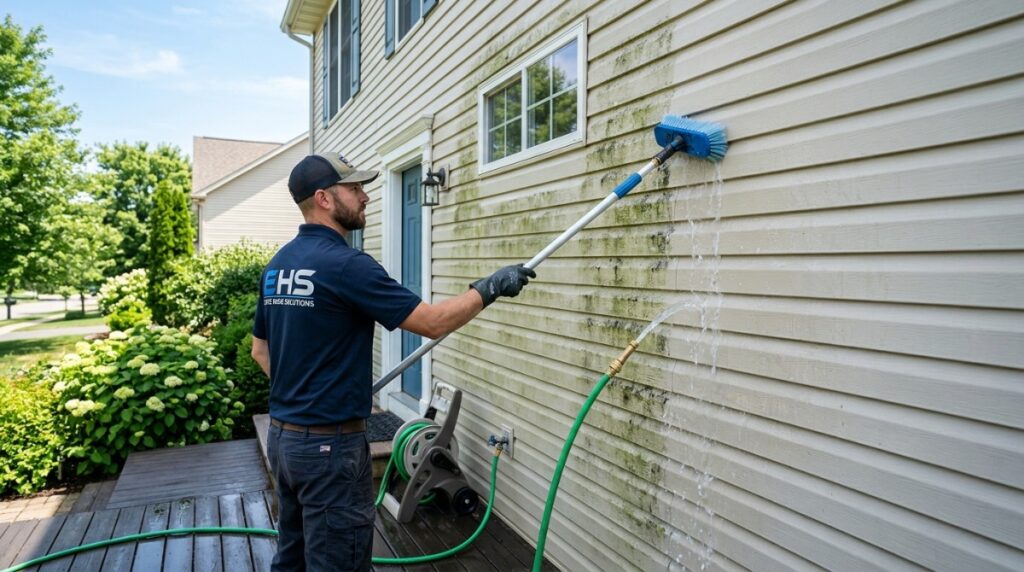
- Wash safely. Wear gloves and eye protection. Protect plants. Use a soft brush and a siding safe cleaner. If you use bleach, dilute it, and never mix it with ammonia based cleaners or vinegar. Rinse top to bottom at low pressure, and do not drive water behind the laps. Vinyl siding makers generally recommend soft brush cleaning and warn against high pressure and harsh solvents. The Alside vinyl siding warranty is an example, and you can read it in the Alside warranty PDF.
- Let the siding dry. Check again after a week.
- Photograph before and after. This helps you track recurrence.
- If siding is soft or swollen, or an inside wall smells damp, get a professional inspection before washing again.
- Consider a coating only after the moisture source is addressed.
What Not To Do
- Do not keep bleaching without changing the conditions.
- Do not mix bleach with ammonia based cleaners or vinegar.
- Do not pressure wash hard or upward. Water behind siding makes things worse. See can pressure washing damage exterior paint.
- Do not paint over mold. Clean it off first.
- Do not ignore soft or swollen siding.
- Do not seal moisture in with a coating on a wet wall.
- Do not let cleaner run onto plants or lawn without rinsing.
A Practical Example: From Green North Wall to a Wall That Stays Cleaner
Here is the sequence on a house where the green had become a yearly chore.
First, the homeowner fixed the moisture. The downspout got an extension, the hedge got trimmed back, and a sprinkler was redirected. Those fixes cost far less than any coating and they came first.
Then our crew started. We did an inspection and made a production plan. We washed the wall thoroughly. We repaired soft wood and open seams, caulked, masked and primed the full area. The finish coat went on, followed by a final inspection with the crew leader. You can see every step in our 11 step coating process.
The homeowner felt relief when the green stopped being a yearly chore. I want to be honest, though. Shade and moisture remain. Growth can still return in some conditions. What changes is that it comes back more slowly and rinses off more easily. The cleaning schedule gets lighter. I do not claim permanent immunity.
The lesson is the order. Find the water, then wash, then protect.
Clean, Coat or Fix the House First: How to Decide
| Situation | Best move |
|---|---|
| Light growth, siding sound, causes easy to fix | Clean only |
| Sound siding, repeated growth despite fixes, owner wants a longer interval between washes | Clean and coat |
| Leaks, rot, ice dam damage, failed flashing, soft siding | Fix the house first |
| Rot or damage that cannot be repaired | Replace sections |
Sellers and HOA boards often ask about curb appeal. In many cases a good wash and a gutter fix are all the house needs. Our page on substrate and repairs explains how we handle damaged wood and other surfaces before any coating.
Where a Ceramic Elastomeric Coating Fits, and Where It Does Not
Rhino Shield is a ceramic based acrylic elastomeric coating. It resists mold, mildew and algae. It is breathable, so trapped moisture can escape, and it is water resistant. It is also flexible and reflects UV. You can see outside lab results on our testing and data page.
Our crew washes first, repairs, then primes the full area before the finish coat goes on.
Here is where I am honest. A coating does not fix a moisture source. It will not guarantee that a wall never grows anything. And it is not the answer for a leaking or rotted wall until the repairs are done.
The 25 year “No Chip, Crack, or Peel” limited warranty covers chipping, cracking and peeling, and our website lists flaking too, under its written terms. It does not cover mold. Read the terms on our 25 year warranty page.
A time we said fix the house first
One homeowner asked us to coat a wall that kept turning dark below the roof edge. When we looked, the drip edge was missing in one spot and the fascia behind it was soft. Water was running down the wall from above, and the growth was only the first sign.
I told him a roofer and a carpenter should come first. A coating would have looked good for a season while the leak kept going. We came back after the repairs, and the wall was a much better candidate for a coating. Honest sequencing is how I want to run this business.
Cost and Timing in Michigan
The cheap fixes come first. Gutter cleaning, downspout extensions, trimming and sprinkler adjustments cost far less than a coating, and they often make the biggest difference.
A coating system typically costs about 2 to 2.5 times a traditional paint job. For a typical 3 bedroom home with about 2,000 square feet of wall area, that is roughly $13,000 to $18,000, or $6.50 to $9.00 per square foot. Latex runs about $5,000 to $9,000 and usually needs repeating every 5 to 7 years. Our website currently shows up to 25% off and 0% financing, so confirm the terms in your written estimate.
See our pricing page and how much Rhino Shield costs in Michigan.
Washing and coating work best in dry, mild weather from late spring to early fall. Allow drying time after washing.
Frequently Asked Questions
Why does mold keep coming back after I clean it?
Moisture, shade and food are still there. Cleaning removes growth but not the conditions that feed it.
Is it mold, mildew or algae?
Often it is a mix. The cause matters more than the name.
Does bleach kill it for good?
It removes growth, but it does not change the conditions. If you use it, dilute it, protect plants and never mix it with ammonia based cleaners or vinegar.
Is mold on siding dangerous?
Surface growth is common. Wear protection while cleaning. Check for moisture inside the house, and contact the proper professional for indoor mold. I am a contractor, not a medical expert.
Will a coating stop it?
A coating can resist growth, but it does not guarantee a wall will never grow anything, and the moisture must be fixed first.
Can I pressure wash vinyl siding?
Gentle only. Follow the manufacturer’s guidance and never spray upward under the laps.
Does your warranty cover mold?
No. It covers chipping, cracking, peeling and flaking under the written terms.
How often should I wash siding?
It depends on shade and moisture. Yearly is common, but there is no firm rule.
Tired of Washing the Same Wall?
If mold keeps coming back on your siding, we can start with the cause. Schedule a free estimate or a 5 minute discovery call. We will walk the house with you, starting with the water, not a sales pitch.
Call us at 810-360-6583. We are a family owned, BBB accredited A+ business in Brighton with MI License #2102200455, and you can see our 4.8 star rating on our Google Business Profile.
We serve Brighton, Livingston County, Southeast Michigan, Ann Arbor, Lansing and Grand Rapids. See the full list on our areas we serve page.