
By Marc Mercier, owner of Rhino Shield of Michigan. Family owned, 25+ years in home improvement.
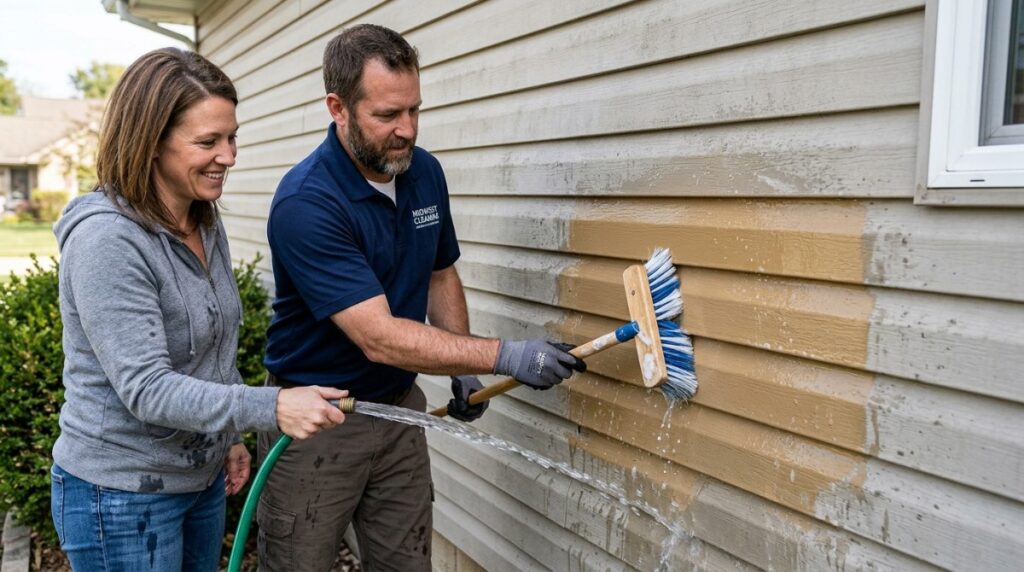
It is a sunny afternoon, and the south wall of a vinyl sided house looks washed out. The north wall looks fine. The homeowner is sure the whole house is bad. Our crew shows them the difference with a hose and a soft brush.
When vinyl siding looks faded and dull, first find out whether it is dirt, chalk or true fade. Wash a test patch. If the color comes back, clean the house. If it does not, the options are a vinyl-safe coating in a safe color, or replacement.
I have seen this on homes from Brighton and Howell to Grand Rapids and Traverse City.
The Short Answer
Test a small patch with a soft brush and mild detergent. Dirt and mildew wash off. Chalk and true fade do not. For true fade, a coating in a color near or lighter than the original can work on sound vinyl. Brittle, cracked or warped siding should be replaced.
Quick Diagnosis: Dirt, Chalk or True Fade?
Three different things get called “faded.” This test sorts them out, and any homeowner can do it safely.
| Test | What you see | What it means | Next step |
|---|---|---|---|
| Wash a small patch | Color returns, dull film gone | Dirt, pollen or mildew | Clean the house |
| Wipe a dry cloth | Pale powder on the cloth | Chalking, surface weathering | Wash well, then consider a coating |
| Compare with the color behind a fixture or under an eave | A clear stripe of richer color | True fade from sun | Coating or replacement |
| Press a panel | It cracks, feels brittle or has warped | Siding at end of life | Replace affected panels |
Our crew does the wash test first on every vinyl house. The dull wall suddenly shows its color along the cleaned patch. That teaches the homeowner something: dull is often dirt and chalk, not lost color.
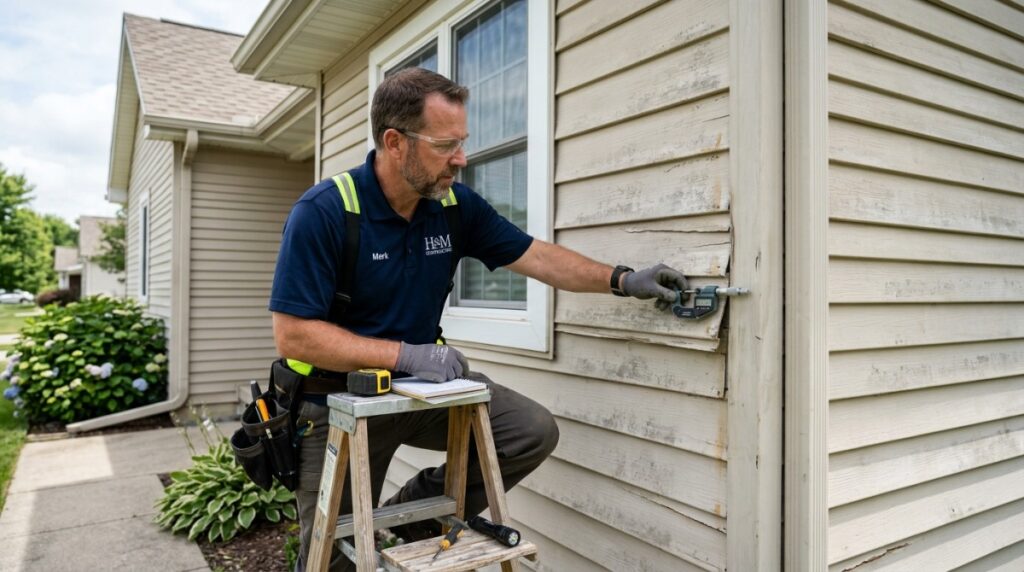
We do the second check too. We compare a panel from behind a downspout or under a wall light with an exposed panel. The stripe of original color shows how much the sun has taken over the years.
If you would like a second set of eyes on your siding, we will check the gauge and condition and tell you plainly what we would do. You can book a quick 5 minute call.
Why Vinyl Siding Fades in Michigan
Sun exposure on south and west walls
UV light breaks down pigment and the surface of the siding. South and west walls take the most. Dark colors fade and also absorb more heat.
Michigan temperature swings
Vinyl expands and contracts with summer heat and winter cold. That movement stresses any coating applied later. It is one reason we look at the condition of the siding before we talk about color.
Dirt, pollen and algae
Shady and damp sides pick up grime that reads as dull. Traverse City and the Lake Michigan coastline see a lot of damp weather.
Age and gauge
Older or thinner siding is less forgiving. The feel of a thick panel in the hand is different from a thin one. That difference matters when we decide whether to coat.
What the sun and weather do to color
Vinyl is colored all the way through, but the surface takes the beating. Over the years the top layer weathers, and the color looks flatter. Reds, deep blues and greens tend to show it first. Whites and light tans hide it better.
Our crews notice it most on south and west walls in the summer. They also notice it on homes with no shade. A house with big trees on one side will often have one wall that looks ten years older than the other.
Moisture and shade add their own layer. Dirt sticks to a chalky surface more than to a smooth one, so a wall that is chalking also gets dirty faster. That is why a wash can bring back some of the color and not all of it.
What Your Siding Warranty Probably Says
This is general information, not legal advice. Read your own warranty before you paint anything.
Siding manufacturers usually describe chalking as normal weathering. They often define fading by a measured color change. Many void coverage if the siding is painted or coated without authorization.
The Alside vinyl siding warranty is a good example of this language. It treats oxidation and chalking as normal weathering. It excludes painted or coated siding unless authorized. It also advises against prolonged or high pressure rinsing and against abrasive, solvent or ammonia based cleaners. You can read it on Alside’s warranty PDF. Your siding may be from a different maker, so look up your own.
What To Do Right Now
- Do the diagnosis tests.
- Find your siding brand and warranty paperwork.
- Wash gently. Use a soft brush, mild detergent and a garden hose. Work from the bottom up and rinse down.
- Avoid high pressure and never spray upward under the laps. See can pressure washing damage exterior paint.
- Let it dry fully. A couple of days is a general guide before any coating work.
- Check for cracks, loose panels and warping.
- Get an inspection if you are leaning toward a coating.
What Not To Do
- Do not use baby oil, WD-40 or similar. They give a short shine and attract dirt.
- Do not repaint in a much darker color. Dark paint absorbs heat. Sherwin-Williams says repainting vinyl in a darker shade is a common cause of warping. See their article on vinyl siding warp.
- Do not use ordinary paint not made for vinyl. Oil-based coatings are not recommended because they lack flexibility.
- Do not use abrasive pads, solvents or ammonia-based cleaners.
- Do not pressure wash at close range or upward.
- Do not paint in direct sun or cold weather.
- Do not paint over loose chalk without washing it off.
- Do not skip reading the warranty.
A Practical Example: A Washed-Out South Wall
A homeowner called because the south wall looked tired. They also wanted a much darker color, and that is where the conversation got interesting.
Our crew started with a test patch and checked the gauge and condition of the siding. Then we talked about color. I explained what happens to vinyl in the heat. Dark colors hold more of it, and the panels can warp.
The homeowner was disappointed at first. Then glad we told them. We picked a color close to the original instead.
Then we followed our real process: wash, repair, caulk, mask, full area prime where needed, finish coat and a final inspection. You can see the full 11 step process.
The lesson is the color rule. Stay near the original or lighter, and respect the gauge.
Some details from the visit are worth sharing. We pressed a thumb on a few panels to feel how flexible they were. A thick panel pushes back. A thin or brittle one flexes and sometimes cracks. We also looked at the lower panels, which take the most abuse from mowers and trimmers, and at panels near the dryer vent and the hose bib.
We checked the sheen on the cleaned patch against the dull wall beside it. The difference is easy to see, and it tells the homeowner what the wall will look like after prep. We also talked about the HOA. Some associations have color rules, and a color that is too far from the original can cause trouble even if the siding could take it.
By the end of the visit, the homeowner had a plan in writing. It said what we would clean, what we would repair and what we would coat. It also said what we would not do.
If color is the question, look at which exterior colors fade the least in Michigan and our color selection process.
Clean, Coat or Replace: How to Decide
| Option | When it fits |
|---|---|
| Clean | Color returns on the test patch |
| Coat | Siding is sound and thick enough, with real fade or chalk, and the color is safe |
| Replace | Siding is brittle, cracked, warped or thin, or the owner wants a significantly darker color |
HOA boards and sellers often care about curb appeal. In that case, cleaning first is a low cost way to see what you really have.
Where a Ceramic Elastomeric Coating Fits, and Where It Does Not
Rhino Shield coats vinyl depending on gauge and thickness. That qualifier is the honest center of this post.
Our crew inspects the siding, discusses colors with heat in mind, then washes, repairs, primes the full area and applies the ceramic finish. The coating is flexible and breathable. It resists mold, mildew and algae and reflects UV. Learn more on the what is Rhino Shield page.
I will tell you where we say no. Very thin or brittle vinyl. Warped panels. A color far darker than the original. In those cases we advise against it. I do not quote a light reflectance number, because it depends on the siding and the color. We talk it through on site.
The written 25 year “No Chip, Crack, or Peel” limited warranty is transferable and not prorated. It covers chipping, cracking and peeling, and our website lists flaking, under its written terms. It does not cover fading or chalking of the underlying siding. Your siding maker’s warranty is separate and may be affected. See our 25 year warranty page.
When we say no
Our crew once pressed a thumb on a panel that cracked at the edge. It was brittle, and several others around it felt the same. The siding was thin and old. We told the homeowner that coating it would not be a good use of their money. Replacement was the better call.
The homeowner was surprised. They had expected us to want the job. But a coating cannot make brittle vinyl strong again. It can only sit on top of what is there. Gauge and condition decide, not our schedule.
We also tell people when cleaning is enough. More than once we have washed a test patch, watched the color come back and said, “You do not need us.” That is a good day.
Cost and Timing in Michigan
A coating system typically costs about 2 to 2.5 times a traditional paint job. For a typical 3 bedroom home with about 2,000 square feet of wall area, that is roughly $13,000 to $18,000, or $6.50 to $9.00 per square foot. Latex runs about $5,000 to $9,000 and needs repeating every 5 to 7 years.
Vinyl is quoted after inspection. Our website currently shows up to 25% off and 0% financing. Confirm the terms in your written estimate.
See our pricing page and how much Rhino Shield costs in Michigan.
The season is spring through early fall. Pick dry, mild days and avoid hot direct sun on south walls. Cold nights stop the work. We also serve Ann Arbor and Lansing on the same schedule.
Frequently Asked Questions
Can faded vinyl siding be restored?
Dirt can be washed off. True fade cannot be washed back. For that, the options are a coating or replacement.
Can you paint vinyl siding?
Yes, with the right product and color, on sound siding. Mind the warranty.
Will painting vinyl siding void the warranty?
It often can. Read your warranty and ask for authorization first.
What colors are safe for vinyl?
Stay near the original color or lighter. Dark colors absorb heat and can warp the panels.
Does baby oil restore vinyl siding?
Only for a short time. It also attracts dirt.
Is pressure washing safe?
Only gently. Never spray upward under the laps.
How do I know if my siding is too old to coat?
Brittle, cracked or warped panels mean it is time to replace.
Do you coat vinyl siding?
Yes, depending on gauge and thickness, after an inspection.
Want a Straight Opinion on Your Siding?
If your vinyl siding looks faded and dull, you do not have to guess. Schedule a free estimate or a 5 minute discovery call. Our crew will check the gauge and condition and tell you the truth, even if the answer is “clean it” or “replace it.”
Call us at 810-360-6583. We are a family owned, BBB accredited A+ business in Brighton with MI License #2102200455, and you can see our 4.8 star rating on our Google Business Profile.