
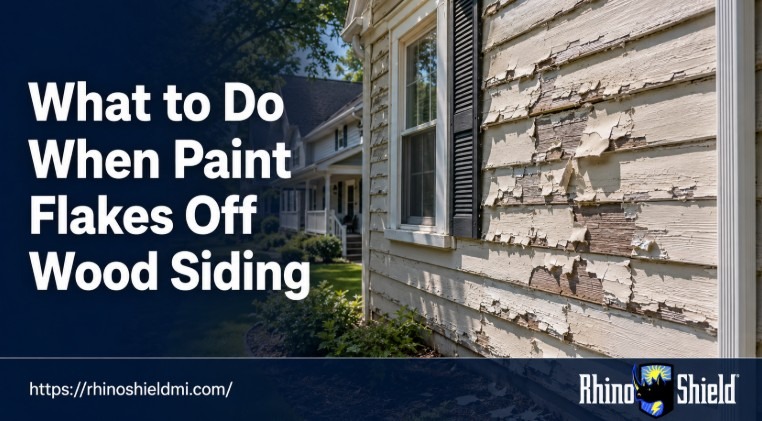
Late spring. Flakes of paint are scattered on the ground under a south wall, like confetti after a party. One of our crew leaders picks up a single chip and holds it to the light. Three different colors are stacked in it, and the oldest layer is curled at the edge.
That chip is a paint history of the house. And the bottom layers have been failing for years.
When paint flakes off wood siding, it is usually because the wood moves with moisture and temperature while old, brittle paint cannot. Find out whether moisture or layer buildup is the cause, check the wood for rot, and then scrape, prime and recoat properly. Painting over it will not work.
The Short Answer
Paint flakes off wood siding when the boards swell and shrink and the old, brittle paint cannot keep up. Moisture behind the paint, many layers and poor prep speed it up. Probe for soft wood, scrape to sound paint, let the wood dry, prime bare spots, then recoat.
Quick Diagnosis: Is It Just Old Paint or Something Worse?
Not all flaking means the same thing. This table helps you sort it out before you buy any supplies.
| What you see | Likely cause | Next step |
| Flakes mostly from a sun facing wall, several layers in each chip | Brittle buildup and UV wear | Scrape to the next sound layer, prime bare wood, recoat |
| Flakes along bottom edges and joints, wood dark or damp | Moisture | Find the water source first |
| Fine cracks in a pattern like reptile skin before flaking | Aged paint film cracking (called alligatoring) | Scrape and sand, check how far it goes |
| Flakes near sprinklers, soil or shrubs | Splash and constant dampness | Fix the spray and the grade, then repair |
| Soft, spongy or crumbling boards | Rot | Replace the boards before painting |
| Only the newest top coat is flaking | Poor prep or layers that did not bond | Remove the loose coat, wash, prime and recoat |
Three quick checks
Count the layers. Pick up a flake and look at its edge. One or two thin layers is a different story from five or six. Many layers mean the paint has lost its ability to flex with the board.
Probe the wood. Press a screwdriver gently into the lower boards, the corners, the butt joints and the window sills. Sound wood pushes back. Rotten wood gives.
Look for water. Check for gaps in the caulk, overflowing gutters and sprinklers spraying the wall.
If a probe finds soft spots, plan on carpentry before paint. Our page on substrate and repairs shows how we handle that.
Why Paint Flakes Off Wood Siding in Michigan
Wood moves and old paint does not
Wood is not static. It swells when it takes on moisture and shrinks as it dries. Michigan makes that cycle bigger, with humid summers and winters that swing between thaw and hard freeze.
A fresh, flexible coat can handle some movement. Old paint cannot. Over the years it gets harder and more brittle, and eventually it cracks and lifts away.
The National Park Service explains in its federal guide, Preservation Brief 10, that a thick buildup of old paint layers can crack and peel when another coat is added. Thick paint tends to fail at its weakest point, the oldest layers next to the wood.
That is why I tell homeowners to count layers. More layers mean more risk every time you repaint.
Moisture getting behind the paint
Water finds its way into wood siding in many places. Open caulk lines, gaps at trim, roof and gutter water, ground splash and indoor humidity are the usual ones.
On older Michigan homes, shaded north walls can stay damp for weeks. Homes close to the Lake Michigan coastline take on more moisture again.
When moisture gets behind the paint, the wood swells and the bond loosens. The same federal guide notes that peeling down to bare wood is most often caused by excess moisture collecting behind the paint film.
Prep and application mistakes
A lot of flaking traces back to what happened before the paint went on.
- Painting over dirt, mildew or chalky residue
- Leaving bare wood unprimed
- Painting wood that is still wet. As a rule of thumb, wood above about 20 percent moisture content should not be painted, and a moisture meter will tell you.
- Applying coats too thick
- Skipping the end grain and the edges
None of these show on day one. They show after the first hard winter.
Sun, age and low quality product
South and west walls take the most sun, and UV breaks paint down faster there. Thin, cheap paint wears out sooner. This is a smaller factor than the others, but it explains why one wall flakes before the rest.
What To Do Right Now
- Photograph the wall and mark the worst areas. This gives you a record to compare against later.
- Probe the lower boards, corners and sills with a screwdriver. Note any soft spots.
- Check what is wetting the wall. Look at gutters, downspouts, sprinklers, bushes and caulk.
- If your house was built before 1978, stop and read this first. Old paint may contain lead. The EPA Renovation, Repair and Painting program requires lead safe work practices for paid work in these homes.
- If the wood is sound, scrape the loose paint with hand tools. Scrape back to a sound edge and sand the edges smooth.
- If you wash the wall, let the wood dry completely before priming. A few dry days is a good rule. Do not rush it.
- Prime bare wood promptly. The federal guide says bare wood should be primed within about 48 hours. Caulk the joints, then recoat with a quality exterior paint in suitable weather.
- If boards give under the screwdriver, replace them first. New paint will not hold on soft wood.
What Not To Do
- Do not paint over flaking paint. It will flake again, often within a season.
- Do not use a heat gun or open flame near old paint and siding gaps. The federal guide warns about fire risk inside wall cavities.
- Do not power wash at high pressure. Soft wood can be damaged. See our article on whether pressure washing can damage exterior paint.
- Do not dry sand old paint without lead precautions. The dust is the real hazard.
- Do not caulk over wet wood. The bead will not bond.
- Do not coat over soft or rotted boards. Replace them.
- Do not spot prime and skip the rest. Patches show through.
A Practical Example: Scraping a Weather Side Wall
Here is how our crew handles a typical wall, from first look to finish.
We start with a wash to remove dirt and loose residue, then we let the wall dry. Then we scrape. On a sound edge the scraper catches and stops. On a failed bond it slides under and lifts a whole sheet.
As the paint comes off, we find what was hiding underneath. Knot holes. Hairline cracks following the grain. Nail heads starting to rust. Sometimes cupped or split boards.
Next we probe the lower courses and corners. If something gives, the conversation changes from paint to carpentry, and the boards get replaced before anything else happens.
Then we patch. Reviewers on our Google page often mention how thorough our crews are with knot holes and cracks, and that is by design. A coating over an unpatched knot hole looks fine for a season and then fails.
After patching, we caulk the joints and prime the whole area, not only the bare spots. Then comes the finish coat. By the end, the homeowner can hold up one board from before and one from after, and the difference is easy to see.
If you want a second opinion on your own wall, send us photos of the flaking and tell us when the house was last painted. We will tell you what we see. You can also book a quick 5 minute call, or look at finished homes on our Our Work page.
Repair, Recoat, Strip or Replace
| Situation | Best path |
| Local flaking on sound wood | Scrape, sand, prime and recoat |
| Widespread flaking with thick buildup | Remove paint to the next sound layer, or strip fully if many layers are failing, then prime and coat |
| Soft or rotted boards | Replace the boards |
| Many failing layers and a repeat problem | Consider a flexible coating system after full prep |
The federal guide recommends removing paint only as far as needed, using the gentlest method that works. That matches what I see. Stripping a whole house to bare wood is rarely necessary and can damage the siding.
Our page on substrate and repairs explains how we prepare wood before any coating goes on.
What about stain instead of paint?
Some homeowners ask if stain is better for siding that keeps flaking. Stains soak into the wood instead of forming a film, so they do not peel the same way. But they often need redoing more often, in the range of several years depending on the product and exposure. It depends on what look you want and how much upkeep you are willing to do.
Where a Ceramic Elastomeric Coating System Fits, and Where It Does Not
I want to share a house we turned down for a coating, at least for the time being. The owner wanted his wood siding coated. When we probed the boards, too many gave under the screwdriver, especially on the bottom courses.
I told him the siding needed repair first and a coating second. He was surprised, but I would rather say that than coat a wall that will not hold.
Rhino Shield is a ceramic based acrylic elastomeric coating system. It is flexible, so it moves with the wood and bridges hairline cracks. It is breathable, so trapped moisture can leave, and it is water resistant. It is also a coating, not a repair for rot or a moisture source.
Our crews wash, patch, scrape loose paint, caulk with acrylic elastomeric caulk, prime the full area and apply the ceramic finish at high mil thickness. The details are in our coating process, and you can read more about the product on the what is Rhino Shield page.
It carries a written 25 year “No Chip, Crack, or Peel” limited warranty, which is transferable and not prorated. The terms are in writing, so read them on our 25 year warranty page.
Cost and Timing in Michigan
Carpentry repair is separate from coating, so a house with soft boards costs more before any paint goes on.
For a coating system, a typical 3 bedroom home with about 2,000 square feet of wall area runs roughly $13,000 to $18,000. That is about two to two and a half times a traditional paint job, which may cost $5,000 to $9,000 and usually needs repeating every 5 to 7 years. See our pricing page and our guide on how much Rhino Shield costs in Michigan for more.
Timing is simple. Michigan work happens in warm, dry stretches. Some newer exterior products can be applied in cooler weather, but traditional latex needs warmer conditions, so always follow the product label.
Frequently Asked Questions
Can I just paint over flaking paint on wood siding?
No. The new paint will flake along with the old. Remove the loose paint first.
Do I have to strip all of the old paint?
Not always. Remove paint to the next sound layer and keep what is sound. Strip fully only when many layers are failing.
Does flaking mean the wood is rotting?
Not always. Probe the lower boards, corners and sills with a screwdriver to find out. Soft wood needs replacing.
How long should paint last on wood siding?
It depends on prep, product and exposure. Ordinary latex often needs repeating every 5 to 7 years, and good prep helps.
Should I switch to stain?
Stain does not peel like paint, but it usually needs redoing every few years. Choose based on the look you want and the upkeep you can manage.
Can I pressure wash flaking paint off wood?
Only gently. High pressure can force water into the wood and damage it.
Is flaking paint on an old house a lead risk?
It can be on homes built before 1978. The EPA rule covers paid work in those homes, so use lead safe practices or hire a certified contractor.
Does the Rhino Shield warranty cover flaking?
Our website lists flaking along with chipping, cracking and peeling under the written terms. It is a limited warranty, so read the written copy you receive.
Get a Wood Inspection with Your Free Estimate
If paint flakes off wood siding on your house, you do not have to guess how far the problem goes. Schedule a free estimate and we will probe the wood and look at the wall in person. No pressure. If the answer is new boards before paint, we will say so.
Call us at 810-360-6583. We are a family owned, BBB accredited A+ business with MI License #2102200455, and you can see our 4.8 star rating on our Google Business Profile.
We serve Brighton, Howell, Southeast Michigan, Ann Arbor, Lansing, Grand Rapids, Traverse City and many other communities. See the full list on our areas we serve page.