
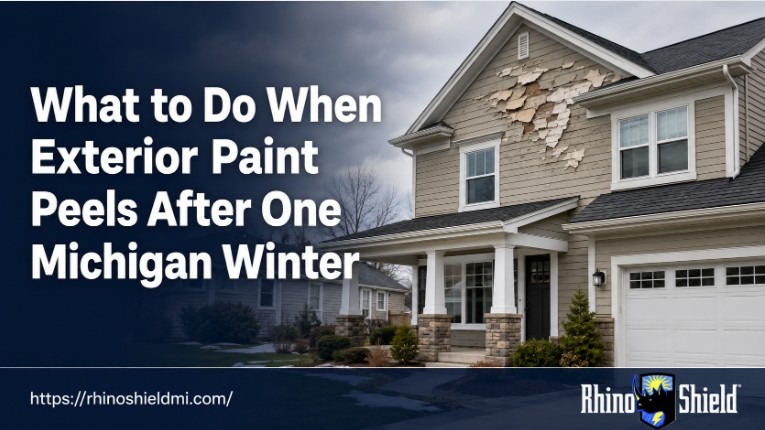
Every spring I get the same phone call. A homeowner walks the north side of the house, picks at one curl of paint with a thumbnail, and a whole strip comes away in one piece. Last year’s paint job is already letting go.
When paint peels after one Michigan winter, the cause is almost always water behind the paint or a surface that was not prepared well enough. The first move is to find out which one you have, before anyone repaints anything.
I have stood in front of a lot of these walls with our Brighton crews. Here is what we look for, what you can safely do yourself, and what usually decides whether the next paint job lasts.
The Short Answer
Paint that peels after one Michigan winter usually has water behind it or a weak bond underneath it. Look at the back of a peeled chip, check gutters, caulk and roof edges for water, and do not repaint until the wood is dry and the cause is fixed.
Ordinary paint only goes so far in this climate, and exterior paint only lasts 3 to 5 years in many cases. But failing in the first year points to something specific, not just age.
Quick Diagnosis: What Is Your Peeling Paint Telling You?
The pattern of the peeling tells you a lot. Walk the whole house before you decide anything. Different walls often fail for different reasons.
| What you see | Most likely cause | What to do first |
| New paint lifts off the old paint cleanly | Poor prep or layers that did not bond | Check the back of the chip. Plan a full scrape, wash and prime |
| Paint and old layers lift down to bare wood | Moisture or long term loss of adhesion | Find the water source before any scraping |
| Peeling in a band under the roofline or below a roof valley | Ice dam or roof and gutter water | Have the roof edge and gutters checked first |
| Peeling at joints, corners and window trim | Failed caulk or open joints | Remove old caulk and reseal once the wood is dry |
| Peeling only on the sunny side | UV and heat on old, brittle layers | Test the paint layers for adhesion before touching up |
| Small bubbles before the peeling starts | Moisture pushing out through the film | Check for wet wood and interior humidity |
| Peeling on the bottom course near the ground | Splash back or soil moisture | Check clearance between siding and soil, and the drainage |
The back of the chip test
This is the first thing I teach homeowners. Pull off a loose piece of paint and flip it over.
If the back is clean and chalky with bare wood under it, the bond failed at the wood. If you see old paint on the back or under it, the new coat never bonded to the old one. If the chip feels damp or the wood below looks dark, water is involved.
It takes two minutes and it tells you where to look next.
Why Paint Peels After One Michigan Winter
Winter does not usually create the weakness. It exposes it.
Here is how it works. Water slips in behind a paint film through an open joint or a poorly bonded edge. When temperatures drop, that water freezes and expands. The bond lets go a little. A thaw comes, and water moves further in. Then it freezes again.
Michigan repeats that cycle many times in a single season, with a warm spell in January followed by a hard cold snap a week later. By spring the paint has been pushed loose in dozens of spots, and the sun finally shows you what happened. That is why so many calls come in April and May.
If you are dealing with paint that peels after one Michigan winter, these are the three places I look.
Moisture is the usual culprit
Water finds its way in more places than people expect. Open joints and failed caulk at trim are the obvious ones. Roof edges, overflowing gutters and downspouts that dump against the wall are next. Indoors, a humid house pushes moisture outward through the wall in winter, and it stops at the back of the paint.
The National Park Service’s Preservation Brief 10, a federal guide to paint problems on exterior woodwork, says peeling down to bare wood is most often caused by excess interior or exterior moisture collecting behind the paint. It also says there is no point repainting before the moisture source is dealt with, because new paint will simply fail.
I agree with that completely. We have seen it on job after job.
Prep and application problems
The second cause is what happened before the paint went on. A few things I see over and over:
- Dirt, chalk or mildew film left on the wall, so the paint stuck to the dirt and not the siding
- A glossy old coating that was not scuffed or primed
- Latex put over old oil paint without the right primer
- Bare wood spot primed instead of fully primed
- Paint applied too thick, or in cold, damp conditions
- Painting late in the fall, when dew settles on the wall each evening
None of these look like a problem on the day the crew leaves. They look fine for a few months. Then winter tests every weak bond at once.
Weather at the time of painting matters too. Check the product label for its minimum temperature and drying time. If someone painted in late October just to beat the snow, that alone can explain a lot.
Michigan specific stress points
Some of this is local. In Livingston County and across Southeast Michigan, a few things hit homes harder than they would in a milder state.
Ice dams are the big one. Snow melts on a warm roof, runs to the cold edge, refreezes, and backs water up under the shingles and behind the trim. Shaded north sides stay damp for weeks. Humid summers feed mildew on the same surfaces. Homes near the Lake Michigan coastline get wind driven moisture from the lake on top of all that.
Here is a scene I remember. A homeowner called about paint peeling in a neat stripe right under the eaves, almost like someone had drawn a line. They were sure the painter had cheated them.
Our crew leader pulled the trim back and found wet wood behind it. The roof edge was leaking meltwater every time it thawed. The paint was not the problem. It was the first thing to show it.
We told the owner to have the roof and gutters fixed before any coating went on. A coating cannot fix a water source. It can only cover it for a while.
What to Do Right Now: Safe, Honest Steps
You do not need to rush. A calm week of checking will save you from repeating the mistake.
- Take dated photos. Wide shots of each wall and close shots of the worst spots. You may need them later.
- Do the back of the chip check and a tape test. Press strong tape on an area near the peeling, pull it off, and see what comes with it. Test a patch of a foot or so around a peeled spot. If paint keeps coming, the bond is weak well beyond what you can see.
- Walk the roofline and gutters. Look at the caulk, staining, ice dam marks, and any wet or soft wood. Press gently with a screwdriver. Soft wood means rot, and rot needs repair before paint.
- Stop before scraping if your home was built before 1978. Paint from that era may contain lead. The EPA Renovation, Repair and Painting rule requires lead safe work practices when paid contractors disturb painted surfaces in homes built before 1978. Landlords and property managers should pay close attention to this one.
- Contact the previous painter in writing. Send your photos and the date the job was finished. Stay factual. Ask what prep was done and what the warranty covers.
- Wait for dry weather. Do not touch the surface while the wood is damp.
Keep it simple and keep your records. If the first painter will not respond, you will at least have a clean timeline.
What Not To Do
A few well meant shortcuts make this worse.
- Do not paint over peeling paint. The new coat will peel with the old one.
- Do not blast it with a pressure washer. High pressure can force water behind the paint and into the wood. Read more about whether pressure washing can damage exterior paint. The same federal guide cautions against waterblasting above 600 psi on exterior wood.
- Do not caulk over wet or failed joints. Remove the old caulk first, or the new bead will not hold.
- Do not spot prime and call it done. Patches show through and the surrounding paint is still weak.
- Do not paint late in the fall just to beat the snow. Cold nights and dew work against you.
- Do not dry scrape or dry sand an older home. Lead dust is a real risk, and it is easy to spread.
A Practical Example: Walking a House After One Winter
Here is how one of these inspections goes. I will keep it general, because the pattern repeats from house to house.
A homeowner calls in spring. The house was painted the previous summer, and by March the paint is lifting on three sides. Our crew leader starts at the roofline and works down.
First the roof edge and gutters, to see if water is coming from above. Then the caulk at the windows, corners and butt joints. Then the wood itself, probing for soft spots. Then the paint, with a scraper and a thumbnail.
A scraper tells you a lot by sound and feel. On a sound edge it catches and stops. On a failed bond it slides under and lifts a whole sheet. When a crew hears that second sound across a whole wall, everyone knows prep was skipped.
On a typical house like this we find the same things. The wall was never washed, so dirt sits on the back of the chip. Primer was applied only on bare spots. Caulk was skipped at several joints. Old layers underneath were already loose, and the new paint rode on top of them.
We show the homeowner the evidence right there on the wall. Then we put a repair plan in writing: what needs repair, what needs prep, and what gets coated. No guessing and no pressure.
If you want a second set of eyes before you argue with your painter, send us photos of the peeling and tell us when the house was last painted. We will tell you honestly what we see. You can also book a quick 5 minute call and talk it through.
Repair, Recoat or Replace: How to Decide
Not every peeling house needs the same fix. This is how I think about it.
| Situation | Best path |
| Small, isolated area, dry and sound wood, cause already fixed | Spot repair |
| Widespread peeling, wood is sound | Full prep and recoat |
| Soft, rotted or split boards and trim | Replace the damaged wood first, then coat |
| Water coming from gutters, roofline or indoor humidity | Fix the house first, then recoat |
Spot repair is fine when the problem is small and you know why it happened. It is a bad idea when peeling is widespread, because the paint around the patch is usually weak too.
Surface condition matters as much as the coating. Our page on substrate and repairs explains how we handle wood, stucco and fiber cement before anything goes on.
HOA boards and sellers often ask whether a quick touch up is enough before listing. If the peeling is more than a small patch, buyers and inspectors will notice it. A proper repair is usually the cleaner answer.
Where a Ceramic Elastomeric Coating System Fits, and Where It Does Not
I want to be straight about this part.
A few years ago I looked at a house where the owner wanted a full coating. The gutters were pulling away from the fascia and dumping water down one wall. The siding behind that wall was soft. I told him to fix the gutters and the siding first, and to call me after that.
He was not thrilled. But if we had coated it then, the problem would have come back, and so would he, upset. I would rather lose a job than do that to someone.
Rhino Shield is a ceramic based acrylic elastomeric coating system. It is flexible, it bridges hairline cracks, and it is breathable while staying water resistant. It is a coating. It does not fix gutters, ice dams, roof leaks or indoor humidity.
What it does well is deal with the failure points we have been talking about. Our 11 step coating process covers cleaning, patching, scraping, caulking, masking, a full primer coat and a high build finish coat. Dirt, loose paint, open joints and unprimed wood get handled before the coating goes on. If you want the full background, read what Rhino Shield is.
It comes with a written 25 year “No Chip, Crack, or Peel” warranty. You get the written copy after the job is complete and final payment is made. The warranty is transferable to the next homeowner, and the terms are in writing, so please read them. You can see the details on our 25 year warranty page.
What Fixing This Costs and When to Do It in Michigan
A small repair costs a small amount. A full prep and repaint costs more. The honest answer is that it depends on how much of the house has failed and why.
For a coating system, most Michigan homes run about $6.50 to $9.00 per square foot of wall area. A typical 3 bedroom home with around 2,000 square feet of wall comes to roughly $13,000 to $18,000. That is about two to two and a half times a traditional paint job, which can run $5,000 to $9,000 for the same house but usually needs repeating every 5 to 7 years.
If you have already repainted once and watched it peel, the math changes. Paying for the same failed job twice costs more than doing it right once. Our guide on how much Rhino Shield costs in Michigan breaks the numbers down, and the pricing page shows what is included. We also offer financing and promotions that change from time to time, which we confirm in the written estimate.
Timing matters here. Michigan crews work in warm, dry stretches. If you get your inspection in spring or early summer, you have the best shot at booking before the busy fall weeks fill up.
Frequently Asked Questions
Is it normal for paint to peel after one winter?
No. A sound paint job should get through a normal Michigan winter. When it does not, the cause is usually moisture, poor prep, or an application problem.
Is it my painter’s fault?
Often it is a prep or application issue, though sometimes the house itself is sending water behind the paint. Document everything with dated photos and ask the painter in writing. Do not assume before you know the cause.
Can I just scrape and repaint?
Only if you have found the cause, the wood is dry and sound, and lead is handled safely in an older home. Otherwise it will likely peel again. Scraping alone treats the symptom.
Do ice dams cause peeling?
They can. Ice dams push melted snow back under shingles and behind trim, and that water ends up behind the paint. If peeling follows the roofline, check the roof edge first.
Will primer stop it from peeling again?
Primer helps the paint bond, but it cannot cure a moisture problem. If water keeps getting in, even a good primer will eventually lose its grip.
What temperature is safe for repainting in Michigan?
Follow the minimum temperature on the product label. Dew and cold nights can still hurt the finish even when the daytime number looks fine.
How long should exterior paint last in Michigan?
Ordinary paint often needs repeating every 5 to 7 years. Good prep and conditions help, but plan on repainting cycles with standard paint.
Does the Rhino Shield warranty cover peeling?
The written warranty covers chipping, cracking and peeling under its stated terms. It is a limited warranty, so read the written copy you receive.
Get a Straight Opinion Before You Repaint
If your paint peels after one Michigan winter, you do not have to guess what went wrong. Send us a few photos, or schedule a free estimate and we will look at the house in person. No pressure. If the answer is a gutter repair or a new board, we will tell you that.
You can call us at 810-360-6583. We are a family owned, BBB accredited A+ business with MI License #2102200455, and you can see our 4.8 star rating on our Google Business Profile.
We serve Brighton, Howell, Southeast Michigan, Ann Arbor, Lansing, Grand Rapids and many other communities. See the full list on our areas we serve page.